
Getting the Ball In the Hole
The most undervalued trait in sports

Getting the ball in the hole might be the most undervalued trait in the world, especially in data-driven, prediction-oriented circles. Those who get the job done, even if they do not necessarily look the part, should not be overlooked in favor of those who carry the aesthetic without the results.
You don’t have to go searching too hard for examples in the sports realm, where infatuation with athleticism and measurable physical characteristics often takes precedence over actual results. That’s not to say athleticism or technique don’t matter — physical and mechanical shortcomings can be limiting— but perhaps we’ve over-indexed on 40-yard-dash times and ball speed numbers at the expense of recognizing the golfer who finishes the hole in the fewest number of strokes.
I’ve fallen into this trap in the past: I thought Cam Davis, the smooth-swinging Australian with effortless power, was destined to become a very solid professional when he first arrived on Tour. No disrespect to Davis, who I’d love to see find his way, but I was wrong!
This bias shows up frequently and across many domains, but it appears most clearly every spring when the NFL Combine and Draft roll around, the latter of which commenced Thursday night. I’m not going to suggest that I know more about football talent evaluation than NFL front offices — I unequivocally do not — but I can’t help but wonder how often front offices make a mistake in bypassing productive, less-flashy players for more athletic, better-measuring prospects.
I’ve had the misfortune, at least in recent years, of being a lifelong fan of the Indianapolis Colts, an organization that seems like the prime case study in valuing measurables over getting the ball in the hole. Colts General Manager Chris Ballard consistently emphasizes physical traits. “Athleticism, speed, the ability to play on all three downs,” Ballard answered on Monday when asked which traits are important to him in evaluating defensive ends and linebackers. It might be a little unfair to isolate that quote as evidence of Ballard’s overall drafting philosophy — the question, after all, was specifically about traits — but he could have answered, “Well, traits are great but we want guys who can tackle, know how to play the position, and get the job done.”
There is a prevalent football metric that captures athleticism, the Relative Athletic Score (RAS), which distills combine results into a composite score on a scale from 1-10. Under Ballard’s tenure, the Colts have notoriously targeted high-RAS players more than any other team in the league. And perhaps not coincidentally, they’ve also drafted poorly.
Again, this isn’t an argument against athleticism. It matters. But if less-athletic players consistently produce equal or better on-field results, maybe that reveals something about what actually drives performance. Maybe some players get the ball in the hole in ways that are discounted more than they should be. And maybe some freakishly athletic prospects are valued more highly than is warranted.
Nobody epitomizes this concept more appropriately than Colts quarterback Anthony Richardson. Drafted fourth overall in 2023, Richardson posted some of the most extraordinary athletic testing numbers ever recorded at the position. He has never, however, demonstrated the ability to read a defense and methodically move the ball down the field. In other words, he has never shown the ability to efficiently get the ball in the hole. Today, Richardson is currently on the trade block after mastering the quarterback position about as well as I have during his short time in Indianapolis.
NFL drafting involves a thousand moving variables, plus an immense amount of luck. I’ll readily concede that cherry-picking one failed experiment shouldn’t serve as an indictment of athleticism. But what if it isn’t a coincidence that one of the teams most intent on prioritizing physical traits boasts one of the most shameful track records in the NFL Draft? What if we’re over-indexing on athleticism, and the real edge lies in properly valuing the ability to get the ball in the hole?
I believe that to be true.
{{inline-article}}
An idea from Daryl Morey, President of Basketball Operations for the Philadelphia 76ers and a pioneer of the sports analytics space, has stuck with me from the moment I heard it. On a 2024 episode of Invest Like the Best, he explained a ubiquitous human bias.
“I use Michael Lewis’ principle, which is that if there is a player who looks completely different succeeding in their area, they’re probably even an extra cut above everyone else in that industry because they’ve had to battle that bias each step and overcome,” Morey explained. “It’s like women breaking into many industries, or minorities breaking into industries, or anyone who looks different breaking into anything. You have to be extra good relative to everyone else, or the immune system of that industry is going to reject you.”
Morey wasn’t referring specifically to golf, but there is no better sport to evaluate through this lens. Jim Furyk is the quintessential example. I can only imagine how much skepticism he faced at every stage of his development, given his unorthodox swing. And yet, he rose to become the second-ranked player in the world and had one of the most underrated careers of this century. He defied the doubters and thrived in the only area that matters: getting the ball in the hole.
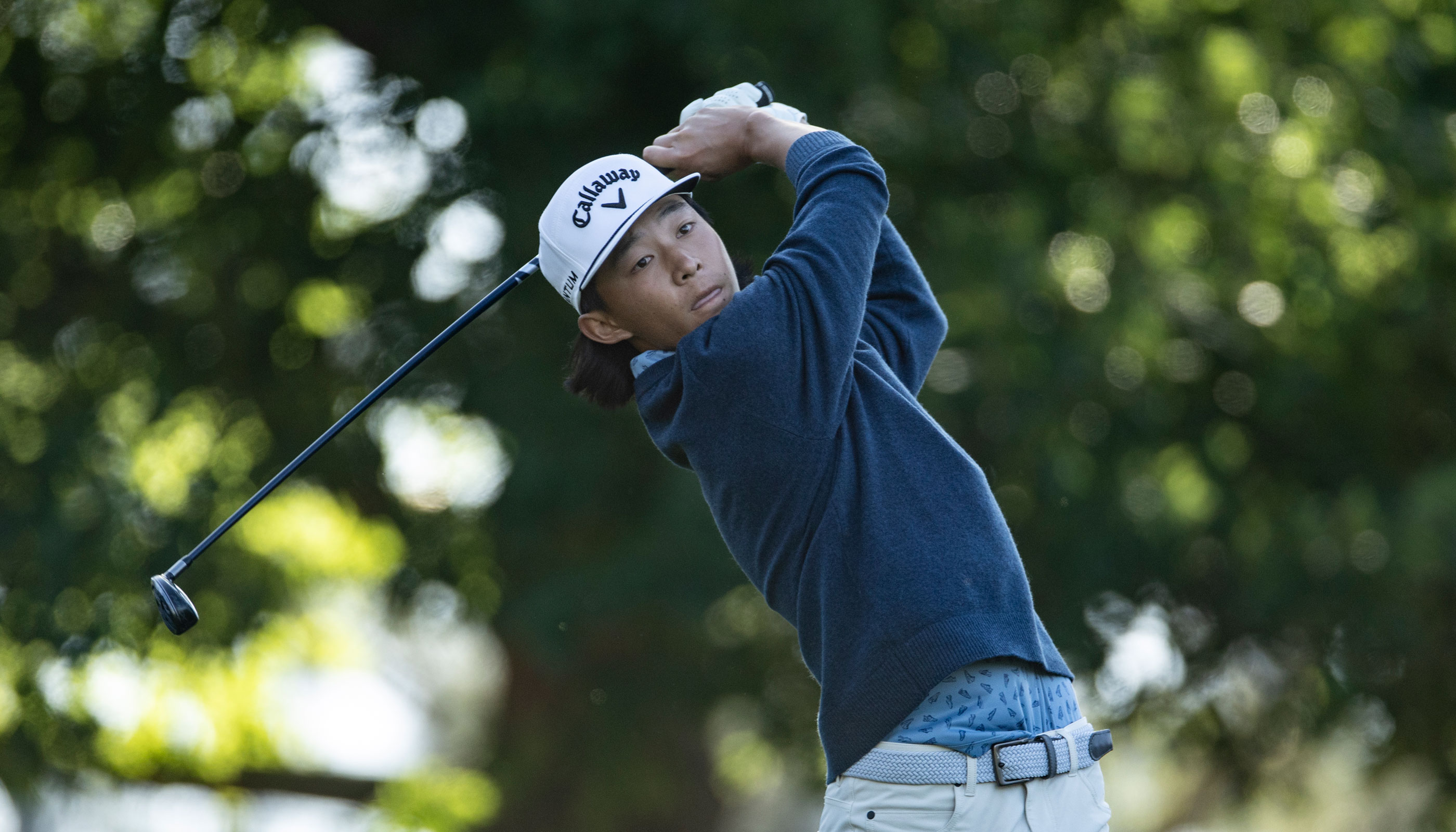
I couldn’t help but think about this while following Ethan Fang around on Friday at the Masters. Fang doesn’t have overwhelming speed or the purest-looking ball flight, a subject of ridicule among his college golf peers. His swing doesn’t scream “elite prospect.” Chris Ballard wouldn’t draft him, so to speak. And yet, the Oklahoma State junior is the eighth-ranked amateur in the world, the reigning Amateur Championship winner, and the runner-up finisher at the Western Am last summer. His peers might not want to trade for his swing or ball flight, but nearly all of them would be wise to trade for his scorecards. He gets the ball in the damn hole.
Watching the skinny, 6-foot-tall Cowboy exclusively hit fades — and not the type of power fades you see from someone like Brooks Koepka — around Augusta National, I thought about how I wouldn’t have taken Fang’s future very seriously a few years ago. I know better now than to overlook the golfer who has spent a lifetime being overlooked.
I have no idea if Fang will succeed as a pro. A lot has to go right for any player to make it on Tour. But I do know that players like him are easy to underestimate and foolish to ignore.
Scottie Scheffler shuffles his feet at impact and doesn’t have the most aesthetically pleasing action on Tour, yet he’s been the most dominant player in the world since Tiger Woods. If golf had a combine like the NFL, Jacob Bridgeman and Robert MacIntyre wouldn’t post the highest RAS scores on the leaderboard. They’ve been two of the best players in the world over the last six months, though.
Perhaps there is a lesson in all of this, one that is congruent with Daryl Morey’s perspective. That the unconventional golfer, the player who fails the eye test while kicking your ass, is not one to dismiss. In fact, they probably possess a dangerous weapon: the mental fortitude, resilience, and conviction that becomes ingrained after years of posting low numbers while others scoff.
The immune system of the industry is going to deny those who do not look the part. Unless, of course, they refuse to be denied.






Weekend Round-Up: Rory McIlroy Responds to Kevin Kisner, Eugenio Chacarra Wins (Again)

A Great Weekend for the Future of American Golf
Winners and Losers from LIV Golf 1.0

It's Too Soon for Jon Rahm's LIV Golf Retrospective
Lauren Coughlin's Brush With Perfection
Weekend Update: Tom Kim Earns Military Exemption, Michael Block Stumbles
Get full access to exclusive benefits from Fried Egg Golf
- Member-only content
- Community discussions forums
- Member-only experiences and early access to events