Buffalo Dunes Golf Course
The best golf course in the U.S. that anyone can play for less than $50, and it’s not particularly close


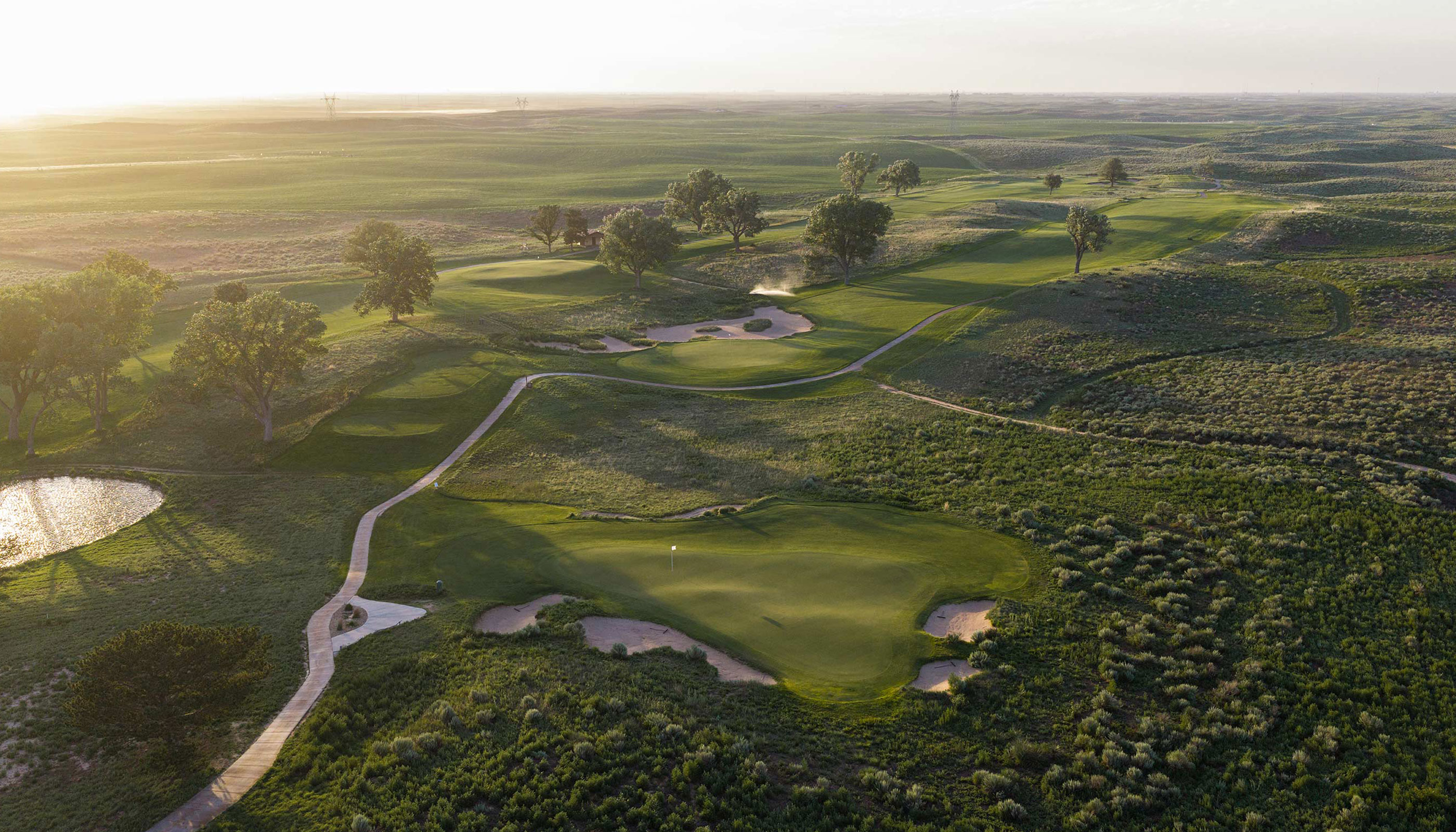
Designed for the municipality of Garden City by Frank Hummel in 1976, Buffalo Dunes has long been considered the top public golf course in southwestern Kansas. It sits on excellent terrain: a swath of broadly sloping duneland wedged between angular chop hills to the north and flat farmland to the south. Over the years, however, the property took on a parkland character, becoming lush and over-treed.
Seeing an opportunity to cut down on water usage, superintendent Clay Payne sold the city government on a low-cost, multi-year renovation in 2019. With the help of architects Zach Varty and Todd Clark, Payne and his crew tackled three holes per year between 2021 and 2025. They filled in artificial ponds, removed nonindigenous trees, and rebuilt the bunkers and greens on all 18 holes, all for less than $700,000. The transformation was remarkable: Buffalo Dunes can now be spoken of in the same breath as Dave Axland and Dan Proctor’s Wild Horse Golf Club. The shaping — primarily performed by Varty, a member of Coore & Crenshaw’s stable — is first-rate, and the revised ninth and 13th holes feel like instant classics. Today, Buffalo Dunes is the best golf course in the U.S. that anyone can play for less than $50, and it’s not particularly close.
Take Note…
Getting there. No two ways about it: Garden City is remote. It’s a decent-sized town, with a population of 31,000, but the nearest big city, Wichita, is 200 miles away. In general, western Kansas is very rural. It’s not terribly difficult to fly in, however. There are daily flights from Dallas-Fort Worth to Garden City, as well as from Denver to Dodge City, the region’s other urban hub. Also, golfers who enjoy driving should keep in mind that the Nebraska Sandhills are about four-and-a-half hours north and Prairie Dunes Country Club is three hours east.
What’s in a name? One of Garden City’s founders, Charles “Buffalo” Jesse Jones, was renowned for his skills as a buffalo hunter. Later in life, however, he had a crisis of conscience and became a bison breeder and conservationist. Ever since, Garden City has been associated with buffaloes.
Spectator infrastructure. The small, weathered grandstands by the ninth fairway and the 18th green are portable, but they typically stay on the course through the season. Buffalo Dunes hosts a number of annual tournaments, including the Epson Tour’s Dream First Bank Charity Classic in late August.
The spot. For lunch in Garden City, I recommend Traditions Soda & Sandwich Shoppe, a 1950s-style diner serving burgers, sandwiches, and old-fashioned hand-mixed malts. Cheap, friendly, and good.
{{buffalo-dunes-about-gallery}}
Favorite Hole
No. 9, par 4, 344 yards
After an overhaul by Zach Varty and Todd Clark, Buffalo Dunes’ ninth hole, formerly a pedestrian, tree-lined affair, has become a unique and compelling short par 4. The architects knocked down most of the non-native pines (while leaving a few specimen cottonwoods) and shifted the fairway left, to the brink of a ridge. Players now have options from the tee: Challenge the left side — guarded by the drop-off and a pair of large, rugged bunkers — for the best angle into green, or play more conservatively to the right, accepting a trickier approach. The fairway rides over a natural hog’s back, so tee shots to the right will kick farther right, whereas well-struck drives along the left side will bound forward.
What gives heft to the strategic design of this hole is the severity of the green. Pushed up, angled left to right, and protected by two bunkers front right and a runoff back left, the putting surface is hard to access from the right side of the fairway. From the left, however, it opens up nicely.
The revised ninth hole is the new Buffalo Dunes in a nutshell: gettable but treacherous, well-adapted to the land, and strategically sound.
Favorite Hole
No. 9, par 4, 344 yards
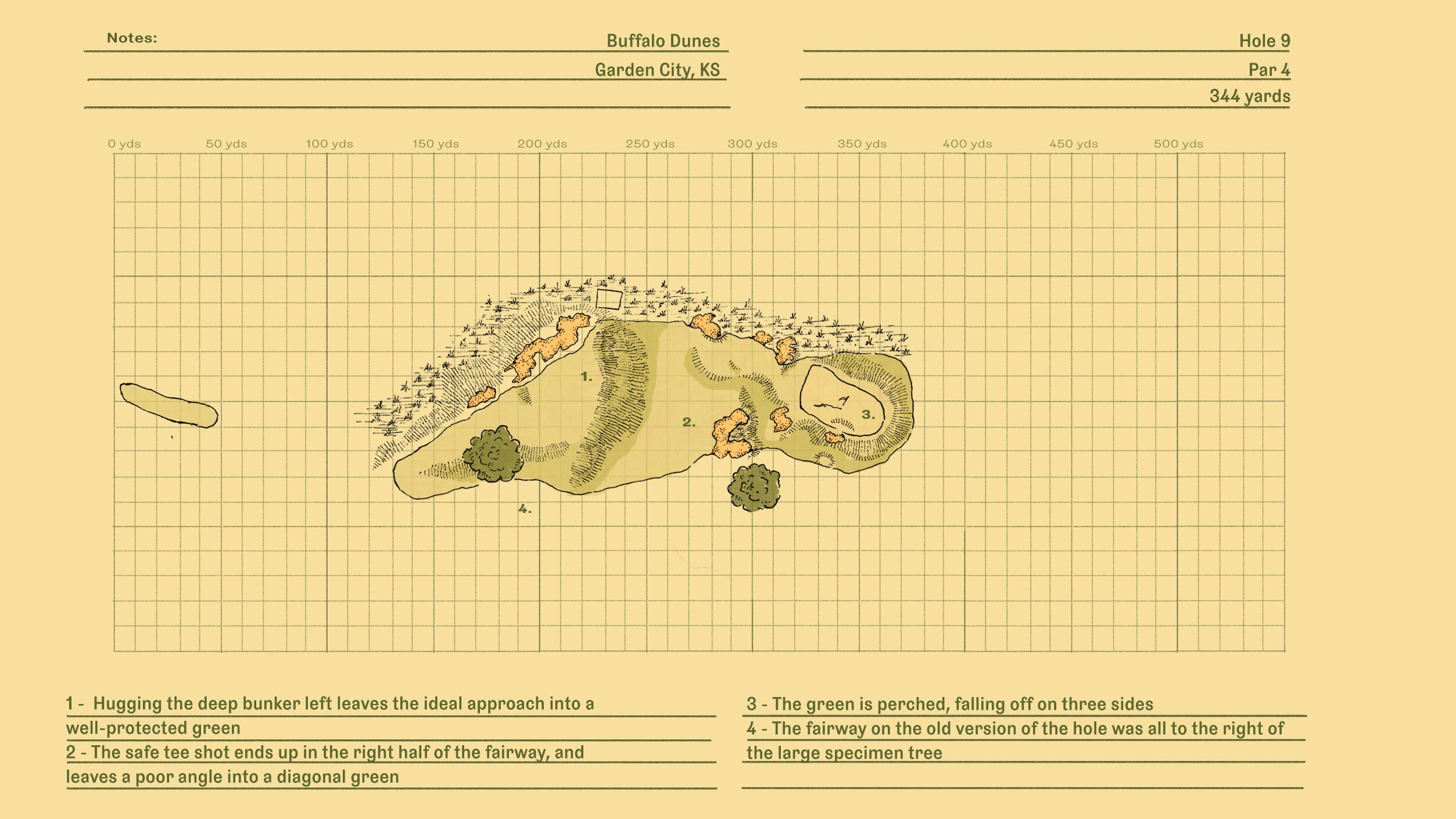
After an overhaul by Zach Varty and Todd Clark, Buffalo Dunes’ ninth hole, formerly a pedestrian, tree-lined affair, has become a unique and compelling short par 4. The architects knocked down most of the non-native pines (while leaving a few specimen cottonwoods) and shifted the fairway left, to the brink of a ridge. Players now have options from the tee: Challenge the left side — guarded by the drop-off and a pair of large, rugged bunkers — for the best angle into green, or play more conservatively to the right, accepting a trickier approach. The fairway rides over a natural hog’s back, so tee shots to the right will kick farther right, whereas well-struck drives along the left side will bound forward.
What gives heft to the strategic design of this hole is the severity of the green. Pushed up, angled left to right, and protected by two bunkers front right and a runoff back left, the putting surface is hard to access from the right side of the fairway. From the left, however, it opens up nicely.
The revised ninth hole is the new Buffalo Dunes in a nutshell: gettable but treacherous, well-adapted to the land, and strategically sound.
{{buffalo-dunes-favorite-hole-9-gallery}}
Overall Thoughts
Buffalo Dunes has always been a strong municipal golf course. It occupies a fine piece of land — sandy, rolling, and well scaled for the game. Its original routing, established by Frank Hummel in 1976, was very good, linking together natural green sites, generating hole-to-hole variety, and leading the golfer on a pleasant, engaging exploration of the property. Plus, the course has long been well regarded in western Kansas for its turf conditions.
Over the past six years, however, Buffalo Dunes has reached a different level. Architects Zach Varty and Todd Clark, along with superintendent Clay Payne and his small crew, have improved every aspect of every hole. The most important changes include:
The removal of ponds and nonindigenous pine trees
Buffalo Dunes once featured three ponds. Today, just one remains near the fifth tee, largely out of play.
The course was also home to hundreds of smallish pine trees and a few dozen massive cottonwoods, almost all of which were planted in the 1980s and 90s. Payne’s team has removed most of the pines while retaining the more attractive, better adapted cottonwoods.
These moves have fundamentally altered the character of the site. Rather than a conventional parkland layout, Buffalo Dunes now looks and feels like a Midwestern sandhills course in the mold of Prairie Dunes, with long views across tawny, gunch-covered slopes and continual exposure to the wind.
Comprehensive re-bunkering
Because of budget limitations, Varty and Clark had to work primarily within the existing footprint of the course. Still, they managed to give Buffalo Dunes a great deal more strategic and aesthetic interest by re-bunkering every hole.
Previously, most of the course’s bunkers were positioned to catch errant shots — front right or front left of the greens, or to the sides of the fairway landing zones. Varty and Clark’s new bunkers pose strategic dilemmas: Play close to them and earn a reward, steer clear of them and pay the price on your next shot.
For instance, on the par-5 14th hole, there used to be just one bunker short and left of the green. Varty and Clark retained this bunker as well as the right-to-left angle of the green, then added a bunker back right. The green now strongly favors an approach from the right. To complete the strategic scenario, the architects built a pair of bunkers eating into the right side of the fairway between 120 and 140 yards out. So, to gain the advantageous angle, the player must take a risk.
{{buffalo-dunes-14-google-earth}}
The course's new bunkers are also beautifully shaped, with a simple, rustic aesthetic that matches the sandhills environment. Varty’s shaping skill, developed under Bill Coore’s tutelage, is on full display here. Unlike many bunkers recently built in the naturalistic style, Buffalo Dunes’ are not overworked or showy. They look like they’ve been there for years.
The reorientation of several holes
In a few cases, Varty and Clark went for bigger changes. They moved the fourth green 50 yards back and to the left, giving it a more striking location on the edge of a natural rise. They also reimagined the previously long and dull eighth hole as a short, enticing par 3.
{{new-and-old-buffalo-dunes-8}}
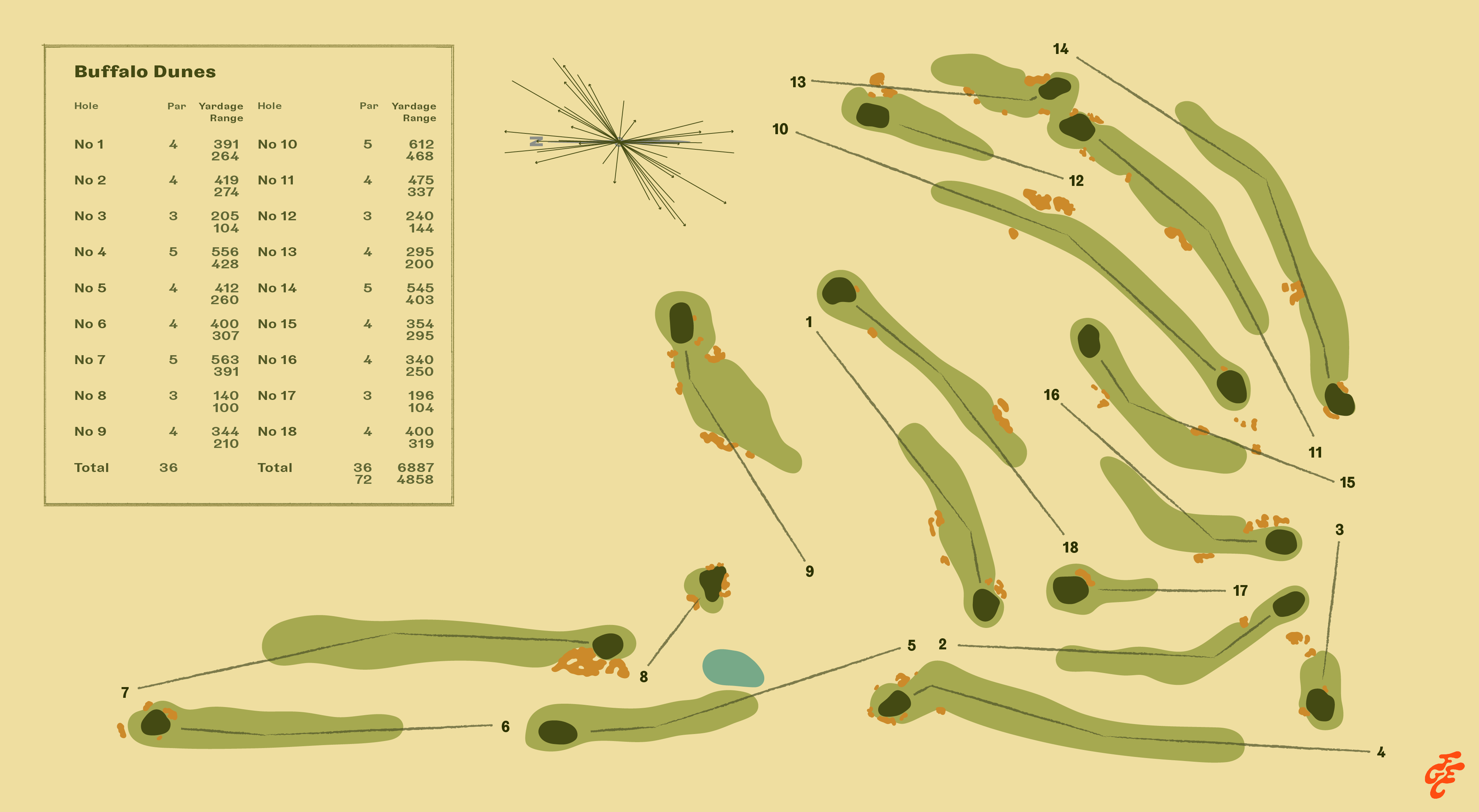
Most ambitiously, Varty and Clark reconfigured holes 11 through 13, moving the 11th green 100 yards downrange, shortening the downhill 12th hole from a mid-length par 4 to a long par 3, and lengthening the uphill 13th hole from a long par 3 to a short par 4. This is now the course’s standout sequence, with several exciting and memorable shots.
{{buffalo-dunes-11-13-old-and-new}}
Cumulatively, these more dramatic changes have introduced more variety to Buffalo Dunes. One flaw of Hummel’s original design was its reliance on mid-length par 4s and longish, uphill par 3s. Today’s course contains a short par 3 (No. 8), a long, downhill par 3 that encourages players to use the ground (No. 12), a very long par 4 (No. 11), and a very short par 4 (No. 13).
The redesign and reconstruction of every green
For any municipal course looking to implement low-cost renovation, the good news is that building a great set of greens is no more expensive than building a poor set of greens.
Varty’s work at Buffalo Dunes is proof of this principle. His greens, like Coore’s, are elegant and impeccably tied in with their surroundings. They don’t advertise their own inventiveness or difficulty, yet they are inventive (I’ve never seen a green quite like the 15th, with its front-right row of tightly mown hummocks) and can be difficult: see the sharp tilt of the 13th green, or the steep falloffs around the 11th.
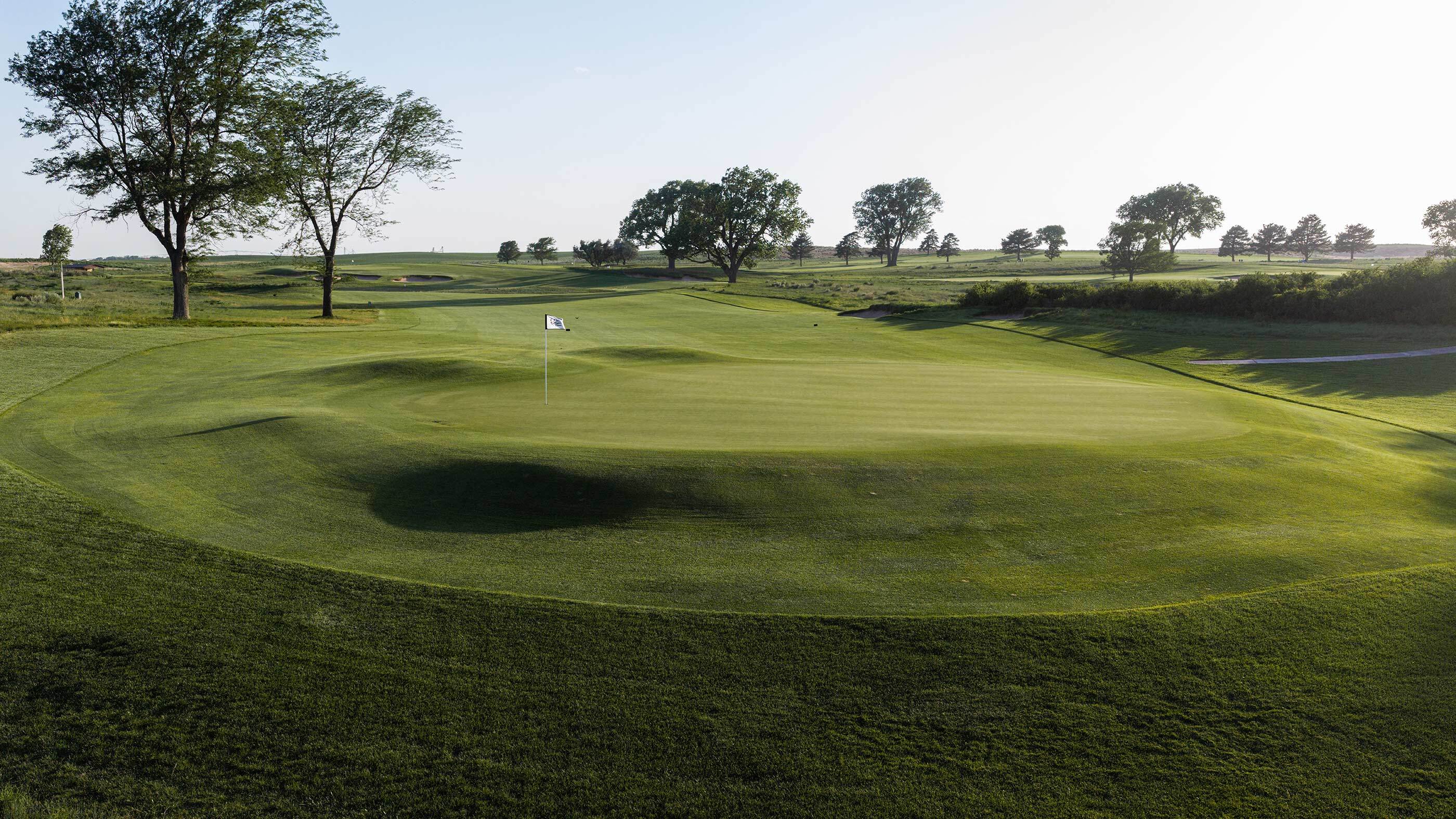
Varty’s use of exterior contour is particularly inspired. Most of Buffalo Dunes’ greens are bordered by fairway-height turf and clever arrangements of mounds and swales. The 11th and 18th greens, for instance, are each fronted by a subtle bump that interacts with a running approach, sometimes helping (by slowing the ball down, then feeding it on) and sometimes hurting (by holding the ball up completely, or deflecting it to the side). These features, combined with Payne's commitment to firmness and short grass, give superb variety and interest to approach play and the short game.
Payne, Varty, and Clark still have some items left on their to-do list. They are building a few new tees to create angles better suited to the redesigned bunkers and greens. They hope to remove the handful of remaining non-native pines. And they will eventually refurbish the course's cart paths, installing some new sections and eliminating some old ones.
But I already feel confident in saying that the 2021-2026 renovation of Buffalo Dunes is one of the most impressive municipal-golf projects of the 21st century. I’m astonished that it cost several hundred thousand dollars rather than several million.
2 Eggs
Buffalo Dunes earns its Eggs for strengths across our categories of land, design, and presentation. The course doesn’t quite reach the heights of Wild Horse or St. Andrews Beach, the reigning champions of the sub-$100 USD tier. But right now Buffalo Dunes is one of the best values in American golf, and it’s only going to get better. Go play it before everyone else discovers it.
Course Tour
{{buffalo-dunes-course-tour-01}}

Get full access to exclusive benefits from Fried Egg Golf
- Member-only content
- Community discussions forums
- Member-only experiences and early access to events