Chechessee Creek Club
A devotion to simplicity allows Chechessee Creek Club to melt into its environment. You won’t find a Lowcountry course with a stronger sense of place.

Okatie, South Carolina, USA
Coore & Crenshaw (original design, 2000)
Private

Chechessee Creek Club occupies a quiet corner of the South Carolina Lowcountry, about 25 miles from Savannah, Georgia, and 15 miles from Pete Dye’s famous Harbour Town Golf Links on Hilton Head Island. The golf course, designed by Bill Coore and Ben Crenshaw in 2000, winds through old-growth oaks and pines next to the salt marshes of Chechessee Creek. Low-profile to the point of looking docile, the course is actually quite challenging, with bouncy turf, unpredictable native areas, and narrow, pushed-up greens. Members are known to have sharp iron games.
The club operates on a model that has become popular in the 2020s: a private retreat, remote-feeling but close enough to an urban center, with a small real estate offering and a strong national membership. The founders — Jim Chaffin and Jim Light, who also helped develop Hilton Head’s Sea Pines Resort — made the smart decision not to overwhelm the course with housing. As a result, Chechessee Creek stands out in the Lowcountry for its rustic atmosphere and pure-golf focus.
Take Note…
Minimalism? Like most Lowcountry sites, Chechessee Creek Club is naturally soggy. In order to make the land golfable, Coore & Crenshaw had to move a great deal of dirt. As Ran Morrissett notes on Golf Club Atlas, they trucked in fill to raise the fairways by two to four feet, then capped each fairway with six inches of sand to create firm conditions. It is a testament to Coore & Crenshaw’s skill that the course does not look the least bit manufactured.
Artisans. Two of Coore & Crenshaw’s most prolific and respected associates, Jim Craig and Jeff Bradley, shaped most of the golf features at Chechessee Creek. Craig handled the greens and finish work, while Bradley, known in the industry as “The Bunker Guru,” concentrated on his specialty.
A dozen more. In 2026, the club added a 12-hole short course designed by Dave Zinkand, a former Coore & Crenshaw associate. The layout features a five-hole loop of par 3s followed by a seven-hole loop consisting of par 3s and short par 4s. Members can play either or both.
A fitting clubhouse. Chechessee Creek’s clubhouse, designed by South Carolina firm Thomas and Denzinger, matches the understated character of the golf courses. It consists of a series of interconnected, cottage-style structures, tucked under the canopies of live oaks and longleaf pines. As on most of Coore & Crenshaw’s and Zinkand’s golf holes, the user discovers the clubhouse piece by piece instead of receiving a full view right away.
{{chechessee-creek-club-about-gallery}}
Favorite Hole
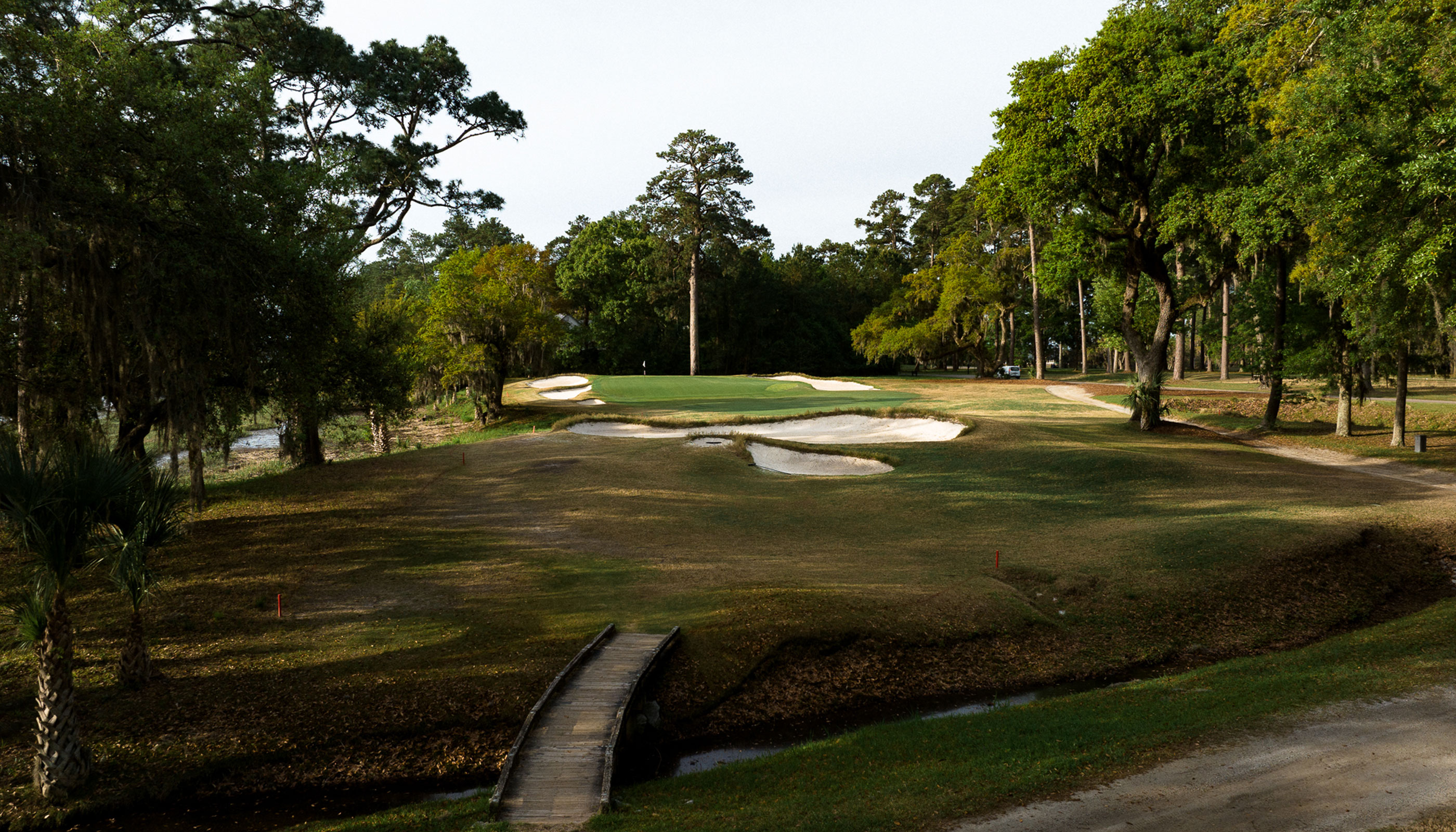
No. 4, par 4, 408 yards
This mid-length two-shotter appears to be modeled on the eighth hole at Shinnecock Hills, one of the best flat-land par 4s in golf. The similarities are unmistakable:
- The fairway jogs from right to left before bending back to the right, describing a large “C.”
- A carry bunker on the left (or, in Shinnecock’s version, a cluster of bunkers that started its life in 1931 as a tumbling waste area) matches the initial right-to-left diagonal of the fairway.
- A chain of bunkers runs down the right side of the fairway, protecting the inside of the primary dogleg as well as the direct line to the green.
- The green is built up, guarded by two bunkers on the right, and angled from left to right.
- Strategically, the hole is a fake-out: those familiar with Coore & Crenshaw’s (or William Flynn’s) design philosophy may assume that challenging the bunkers on the right will yield an advantage. The better angle for the approach, however, is from the left side of the fairway, where players will have access to the full length of the green and won’t need to worry as much about the front-right bunkers or the back-left runoff.
The fourth at Chechessee Creek is a good example of Coore & Crenshaw’s subtle, tasteful use of template designs. The source of inspiration is neither obvious nor overfamiliar, and the concept fits the Lowland terrain beautifully.
{{chechessee-creek-club-favorite-hole-4-gallery}}
Favorite Hole
No. 4, par 4, 408 yards
This mid-length two-shotter appears to be modeled on the eighth hole at Shinnecock Hills, one of the best flat-land par 4s in golf. The similarities are unmistakable:
- The fairway jogs from right to left before bending back to the right, describing a large “C.”
- A carry bunker on the left (or, in Shinnecock’s version, a cluster of bunkers that started its life in 1931 as a tumbling waste area) matches the initial right-to-left diagonal of the fairway.
- A chain of bunkers runs down the right side of the fairway, protecting the inside of the primary dogleg as well as the direct line to the green.
- The green is built up, guarded by two bunkers on the right, and angled from left to right.
- Strategically, the hole is a fake-out: those familiar with Coore & Crenshaw’s (or William Flynn’s) design philosophy may assume that challenging the bunkers on the right will yield an advantage. The better angle for the approach, however, is from the left side of the fairway, where players will have access to the full length of the green and won’t need to worry as much about the front-right bunkers or the back-left runoff.
The fourth at Chechessee Creek is a good example of Coore & Crenshaw’s subtle, tasteful use of template designs. The source of inspiration is neither obvious nor overfamiliar, and the concept fits the Lowland terrain beautifully.
Overall Thoughts
There’s a consensus that we’re still living in the “minimalist” era of golf architecture, which began with Coore & Crenshaw’s Sand Hills in 1995 and exploded in popularity with the first two courses at Bandon Dunes in 1999 and 2001. Since then, some say, innovation in golf course design has stalled, and too many architects have been reheating Bill Coore’s and Tom Doak’s naturalist, neoclassical nachos.
The same critics would probably admit that this view is oversimplified — that Tom Fazio’s influence, seen in the work of Mike Stranz and Jackson Kahn, has remained strong as well; that David McLay Kidd’s and Gil Hanse’s careers don’t fit neatly into the minimalist box; that the Coore/Doak school has not been as influential in Europe and Asia as it has in the U.S. and Australia.
But I would go further: the Sand Hills era is over. It ended sometime in the early 2010s, when 1) the Recession ravaged the middle tiers of the golf course industry, pushing new development upscale; and 2) social media imagery became a key promotional tool for clubs and resorts. New courses grew bigger, bolder, more expensive to build, and more optimized for Instagram. “Mimimalism,” which started as a call for restraint in earthmoving, came to be misunderstood as a style — wide fairways, frayed bunker edges, and large, undulating greens.
This is why Coore & Crenshaw’s design at Chechessee Creek Club feels like it belongs to a different time. A few of its defining features have become distinctly unfashionable:
Simple Greens
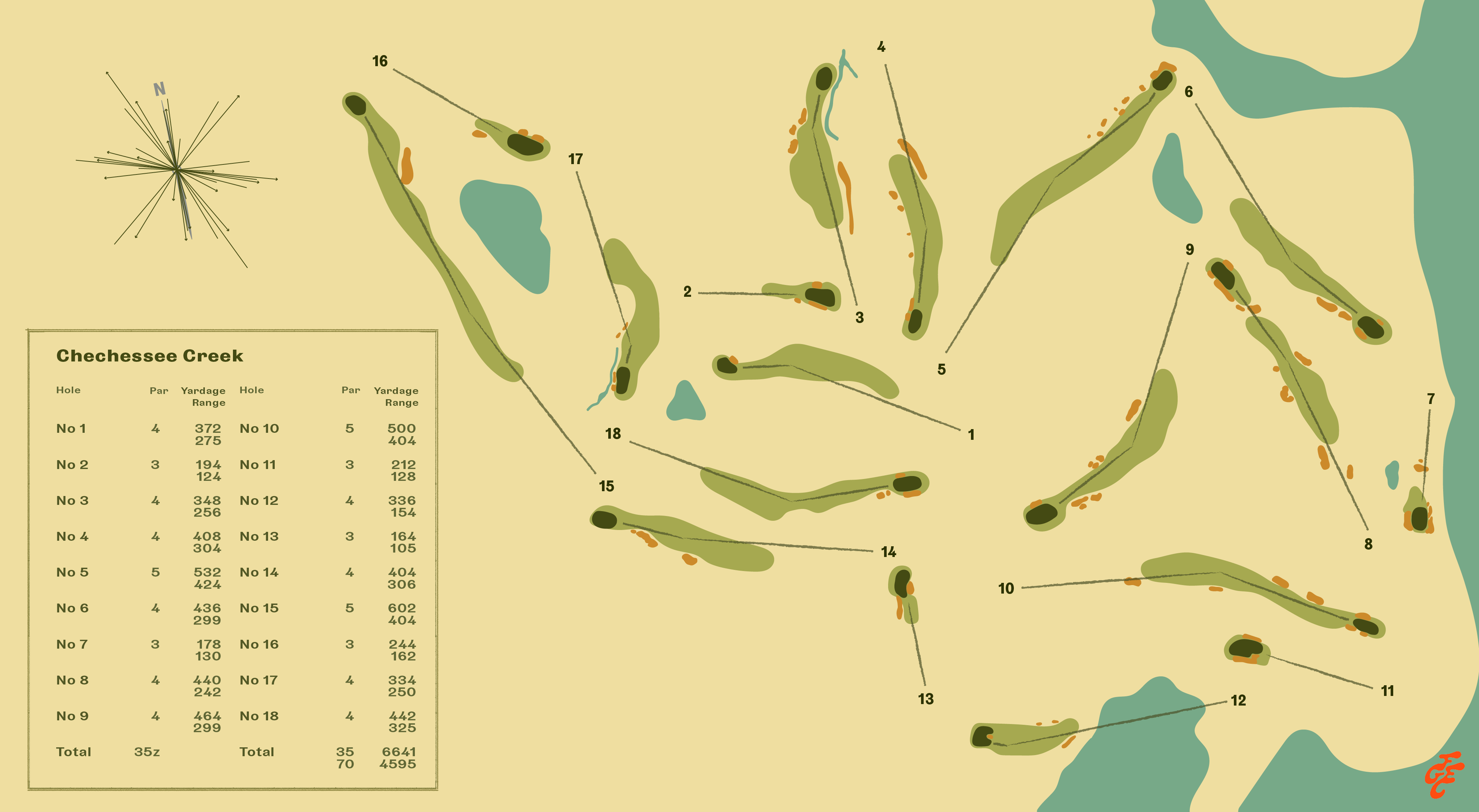
Almost all of the greens at Chechessee Creek are variations on a single theme: narrow, pushed up, sloped from back to front, and guarded on both sides by bunkers and runoffs. They range in size — from the tiny, raised platform of the first to the 45-yard-long runway of the 16th — but they are rarely any bigger than necessary to receive the expected approach shot.
By today’s standards, these greens are notably understated, straightforward, and precision-oriented.
Lots of Trees
As at nearby Harbour Town, the trees at Chechessee are not just scenery; they are integral to the strategic design of many holes.
Specimen oak trees often serve as primary hazards. On the excellent opening hole, for instance, players who want to pursue the ideal approach angle from the left side must navigate around a large live oak. Those who bail out to the right, on the other hand, may find themselves blocked out by another oak short right of the green. Similarly, on the long, snaking par-5 15th hole, a second shot that cautiously evades the bunker and overhanging limbs on the right will lead to a pitch over a squat, dense oak on the left.
This use of trees is perfectly in keeping with Coore & Crenshaw’s site-based philosophy. They believe in using what the land gives them, and at Chechessee the land gave them oaks and pines. Nowadays, however, golf architects seem hesitant to leave a significant number of trees in the line of play, even on forested properties.
Understatement
Coore & Crenshaw could have built much flashier features at Chechessee Creek. After all, every fairway, green, and bunker had to be lifted from the Lowcountry water table and shaped from scratch. No one would have blamed Coore & Crenshaw for getting more aggressive in an effort to create interesting golf on an uninteresting site. But they chose to keep the course low-profile, favoring subtle undulations and gradual tie-ins between manufactured elements and the natural grade.
It's hard to imagine any current designer, even Bill Coore himself, using such a light touch on flat terrain. Small-scale contour doesn't photograph well.
When Chechessee Creek Club opened, it was a rejoinder to the excesses of 1990s real estate golf, just as Harbour Town was a counterpoint to Robert Trent Jones’s spacious modernism. Recently, trends have again moved toward the big and bold, and Chechessee’s understatement feels as fresh as it did a quarter century ago
1 Egg
Chechessee Creek Club’s architectural restraint is both a strength and a weakness. Many holes hide genuine intricacy beneath a placid surface; others verge on dull. The green designs are well-suited to the property but become slightly repetitive by the end of the round. (The course’s spiritual forebear, Harbour Town, offers a greater variety of green complexes on similarly plain topography.) But Coore & Crenshaw’s devotion to simplicity, while occasionally too rigorous, allows the course to melt into its environment. I haven’t seen a Lowcountry course with a stronger sense of place.
{{chechessee-creek-club-course-tour-01}}

Get full access to exclusive benefits from Fried Egg Golf
- Member-only content
- Community discussions forums
- Member-only experiences and early access to events