
GrayBull Club
GrayBull’s pathbreaking design is fun to play and provides a different product than what is already available in the Nebraska Sandhills

Maxwell, Nebraska, USA
David McLay Kidd (original design, 2024)
Private

The new kid on the block, GrayBull Club, is the latest addition to the Dormie Network’s catalog of private golf courses and the newest golf course built within the Nebraska Sandhills. Roughly 30 minutes north of I-80, the course occupies a set of medium- to large-sized dunes which provide an ideal canvas for golf. Approximately 2,000 acres of land were available to choose from to build the 18-hole layout with the plan of it being the only one on the property. This gave Kidd the rare opportunity to hand-select precisely where he wanted to craft his golf course.
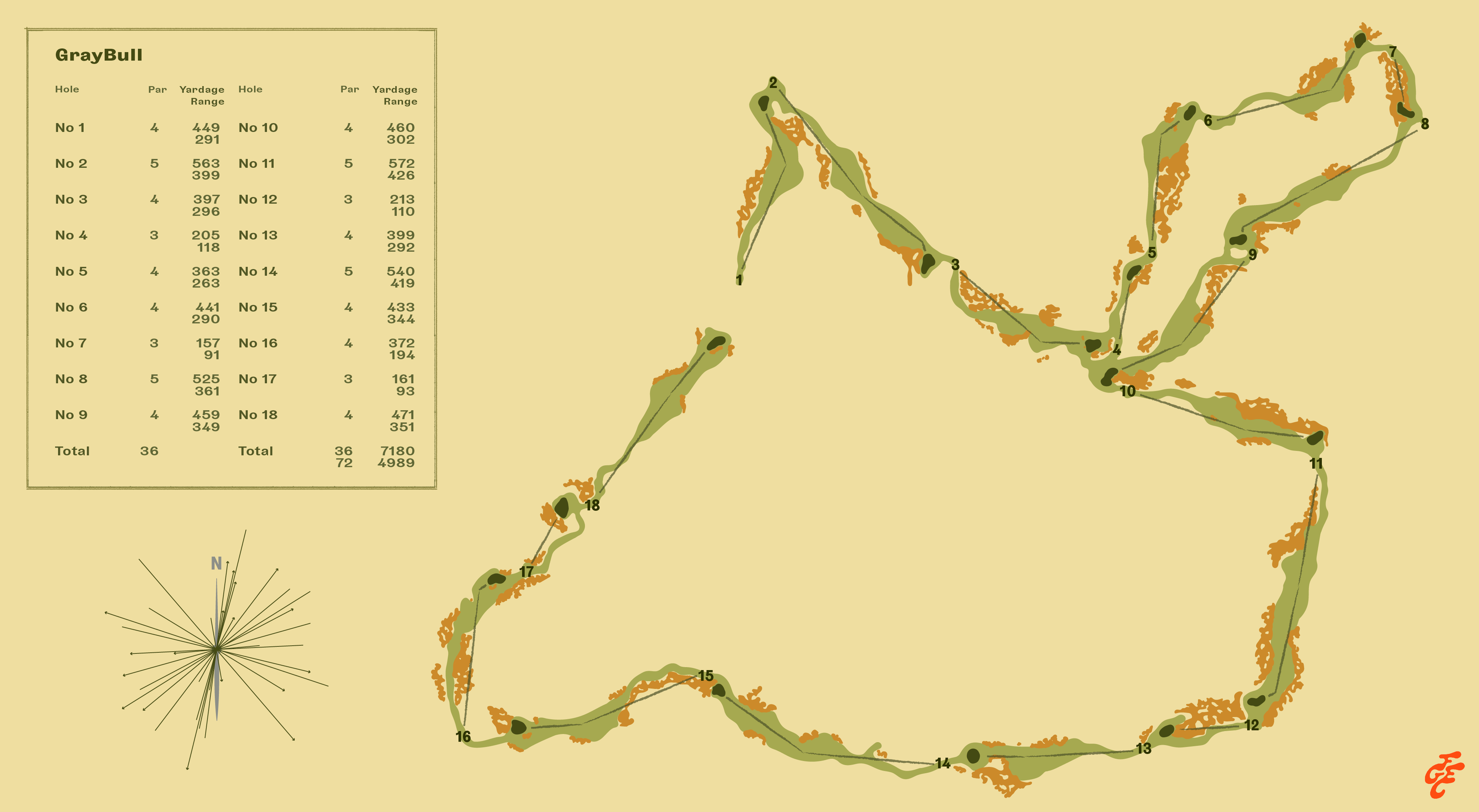
The course’s routing starts on top of a prominent ridge where the clubhouse and cottages reside and takes players down, out, around, and back up to the ridge in a wide-encompassing clockwise loop. With the design, there was a dedicated effort to make the playing surface a complete ribbon of uninterrupted, low-mowed turfgrass for all 18 holes. This continuously flowing style creates a very different look and feel from the other sandhills courses, as does the unique approach to the bunker style. GrayBull features the largest amount of exposed sand of any course in the Nebraska Sandhills, presenting a plethora of visual stimulation. While nearly every other course in the region has bunkers that are built to resemble naturally occurring blowouts, GrayBull has expansive waste areas with grass islands that take after the bunkers of Mammoth Dunes and Gamble Sands (two other Kidd designs). The pathbreaking design is very fun to play and diversifies the golf options in the region.
Take Note...
Quadfecta. The completion of GrayBull marks an interesting point in time where the four most notable and prolific architects of the 2000s each have an original design within the Nebraska Sandhills: Coore & Crenshaw’s Sand Hills, Tom Doak’s Red Course at Dismal River, Gil Hanse’s CapRock Ranch, and Kidd’s GrayBull.
Through the fire and flames. Just five months prior to opening day, a large prairie fire broke out near the golf course and was exacerbated by 40-mph winds. Garrett Morrison covered the event in detail, but thanks to the maintenance staff's efforts and good fortune, the course made it out unscathed, along with no personal injuries despite the entire surrounding landscape being scorched to nothing.
{{graybull-club-about-gallery}}
Favorite Hole
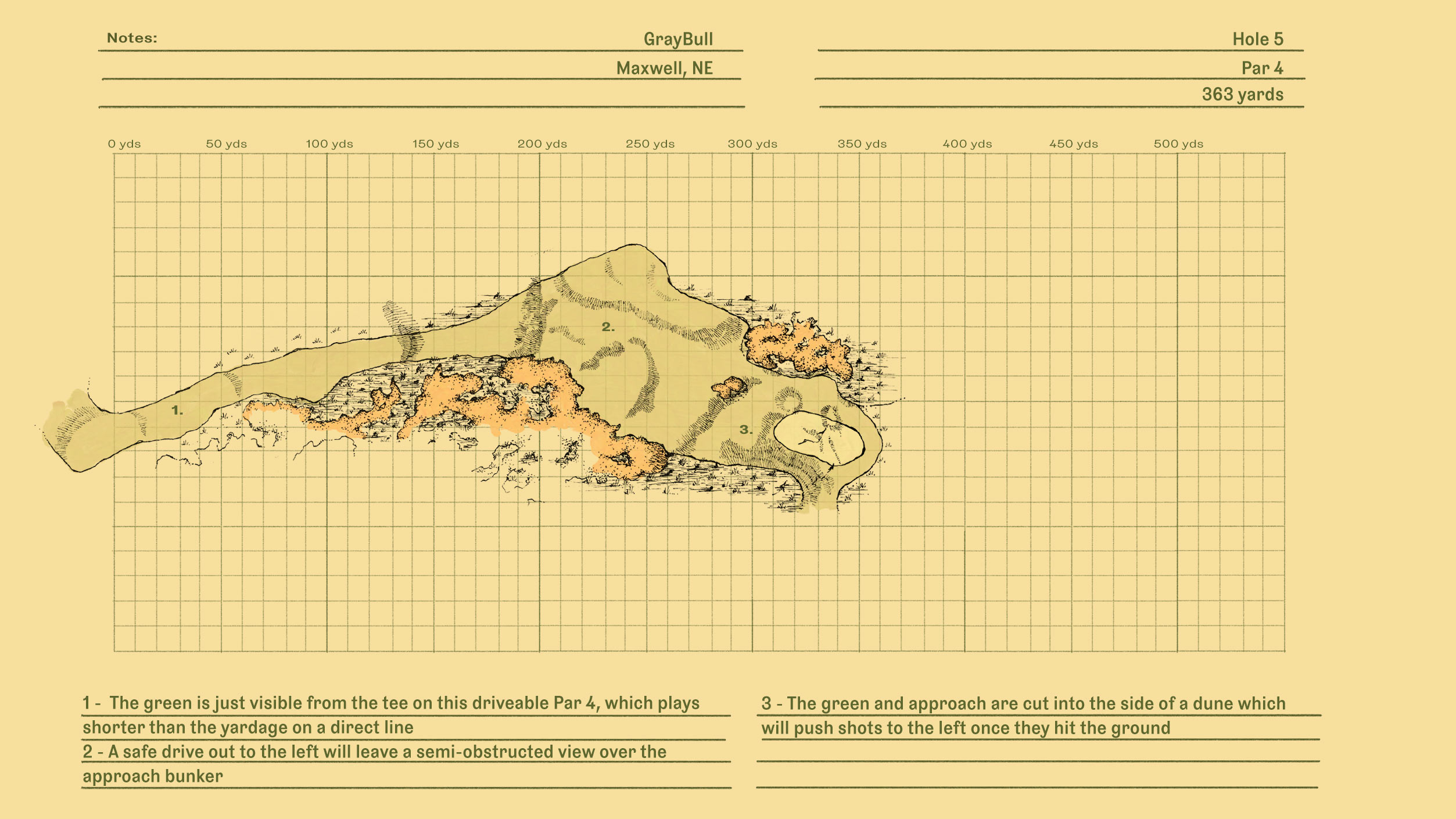
No. 5, par 4, 363 yards
Likely the most strategic hole on the course, the fifth presents two distinct options off the tee: 1) Take the aggressive line right at the pin by carrying an expansive waste bunker, or 2) Play it safe out to the left where the fairway grass is plentiful.
A large ridgeline runs parallel down the right-hand side of the hole and melts into the putting surface. This means approach shots are better received by the green from the expansive left side since the ridgeline acts as a catcher's mitt, but you’ll be semi blind and have to go over the centerline bunker. Taking on the green and threading the needle with the driver can set up eagles and easy birdies, as well as touchy 60-yard bunker shots.
I particularly admire the visual off the tee where the flagstick appears to be poking up out of the seemingly endless bunker. It looks like you’d have to carry the drive all the way to the green, but there’s ample shortgrass and downslopes that will propel you closer to the green.
Favorite Hole
No. 5, par 4, 363 yards
Likely the most strategic hole on the course, the fifth presents two distinct options off the tee: 1) Take the aggressive line right at the pin by carrying an expansive waste bunker, or 2) Play it safe out to the left where the fairway grass is plentiful.
A large ridgeline runs parallel down the right-hand side of the hole and melts into the putting surface. This means approach shots are better received by the green from the expansive left side since the ridgeline acts as a catcher's mitt, but you’ll be semi blind and have to go over the centerline bunker. Taking on the green and threading the needle with the driver can set up eagles and easy birdies, as well as touchy 60-yard bunker shots.
I particularly admire the visual off the tee where the flagstick appears to be poking up out of the seemingly endless bunker. It looks like you’d have to carry the drive all the way to the green, but there’s ample shortgrass and downslopes that will propel you closer to the green.
{{graybull-club-favorite-hole-5-gallery}}
Overall Thoughts
With such a scarcity of golf courses in the Nebraska Sandhills, it’s quite noteworthy when a new contender enters the playing field. Because the region is so inimitable in the U.S., you almost have to compare each design to its peers. GrayBull is just one of two courses built within the sandhills in the last 12 years, but the purpose of the design was to separate itself from the other courses in the region and cater to Dormie Network members. This produced an abnormal visual appearance relative to the other sandhills courses, a new concept of melding an infrastructural component into the design with a focus on luxury. In order to dissect Kidd’s course, let's look at each aspect of the design and dive into the strengths and weaknesses.
Routing
The backbone of the design.
While Kidd’s course is in fact a very delightful walk, the majority of Dormie members ride in carts when they play across the network’s seven U.S. properties. Thus, GrayBull was built with the notion of being a cart-heavy golf course. To circumvent the obtrusive cart path eye sores, the course was designed with continuous shortgrass from the first tee to the 18th green. This meant there would be no cart paths at all, and golfers could simply drive their carts wherever they desired. An innovative idea to avoid cart paths altogether, but I found this choice to be unnecessary and a silly, self-inflicted limitation. It forces the routing to only tackle the gentle and easily traversable land rather than seek out the most interesting areas of the nearly 2,000-acre site. While I don’t think the routing is particularly bad, I believe it could be more compelling given the dynamic site.
Essentially, the course follows a path of least resistance. While the counterclockwise loop produces holes that interact with the ever-present wind in every direction, it also produces a monotonous undercurrent. Many (almost all) holes play down below the dramatic towering sand dunes and over very mellow slopes; ”mellow” relative to the chaotic landforms abundantly found in the Nebraska Sandhills. A particularly sour result of this routing is the straight-line stretch of Nos. 11-14, where the bunker-lined holes blend together. I would have loved to see the routing explore more of the site’s unique areas or take more daring paths over interesting landforms. The reason No. 12 at Sand Hills Golf Club is so captivating is because of the massive hogback feature in the center of the fairway that sorts quality drives from lousy ones. Furthermore, the sensation of making a 15-hole trek to reach the breathtaking view found on the 16th tee at Sand Hills gives life and meaning to the routing’s journey. Will every course have the opportunity to create a routing as compelling as Sand Hills? No, but GrayBull certainly had the arrows in its quiver to produce something more enthralling than what is there.

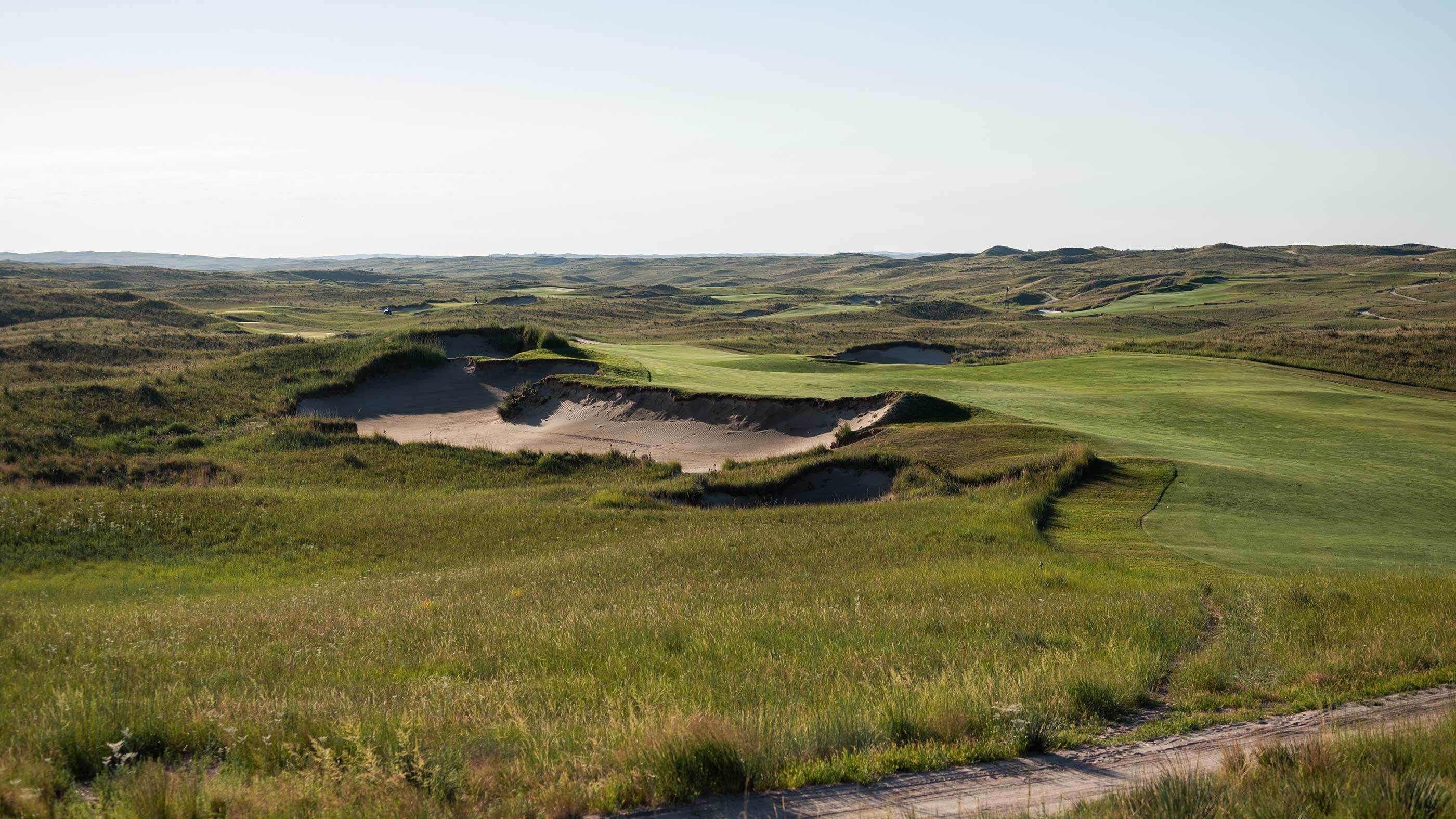
Additionally, the continuous flow of grass restricts and, in many cases, predetermines the surroundings of the greens. You need ample space for cart traffic around each green so it efficiently connects to the next tee box. This resulted in a lot of greens being surrounded by wide expanses of shortgrass, which homogenizes the approach appearance and penalty, or lack thereof, for misses. Choosing to prioritize cart accessibility without a doubt boxed the course in from a routing and design perspective.
Greens
The face of the design.
While DMK’s greens at Bandon Dunes or Mammoth Dunes don’t particularly excite me, the surfaces he and his team created at GrayBull are likely some of their best. They are very bold in many instances and sit nicely within the landscape. A few standouts include the multi-tiered third, which complements the short iron/wedge approach quite nicely, the 11th, where the surrounding contours provide intrigue, and the 15th, with its boisterous central mounding. Many of the green sites, especially the three above, are oriented in a way that certain positions in the spacious fairways provide a great advantage. Conversely, at least 12 greens sit down in hollows where most of the surrounding slopes feed into the putting surface, making a lot of greensites feel repetitive, especially so with the abundant shortgrass surrounds I touched on earlier. All things considered, the greens are certainly a strong suit of the design.
{{graybull-greens-3-11-15-gallery}}
Bunkering
The muscles of the design.
As someone who has helped maintain a golf course in the Nebraska Sandhills, I find the bunkering at GrayBull exorbitant and simply baffling from a maintenance perspective. It’s one of, if not the only, course in the region that has purposefully deviated from the naturally occurring “blowout” style of bunkering. To paint the picture, when you drive past cattle ranches in the sandhills you’ll see many naturally occurring sand exposures, and most of them will have old tires or objects inside of them to help prevent further erosion. That’s because any exposed sand in this ruthless, windy climate will continue to erode and blow out unless you actively mitigate the problem. While the bunkering at GrayBull may be attractive to some, it's a greenkeeper's nightmare. With roughly 1.1 million square feet (or 25 acres) of exposed sand, I foresee many issues with erosion and maintenance as the course ages. This excess of bunkering has also watered down the par 3s, as essentially all of them feature a forced carry over swaths of sand. Only the fourth provides an alternative ground option. I understand the club was trying to differentiate itself from the small crowd of courses in the sandhills, but I don’t believe this approach was appropriate given the harsh environment.
{{graybull-club-bunkers-par-3-gallery}}
One thing the bunkering does quite well is ask questions off the tee and create doubt on several holes. The diagonal nature of a few carry bunkers forces players to make a decision or creates visual deception, resulting in uncertainty. I can’t help but wonder if the same decision-making questions could have been posed with angles and carries over penalizing native grass that is significantly less intensive to maintain. Many sandhills courses have already played test dummy and solidified the understanding that using the naturally occurring bunker style as sparingly as possible is best for longevity and cohesion with the landscape, so I can’t help but question what has occurred at GrayBull.
Perhaps my intimate knowledge of the region, its courses, and maintenance has downplayed the quality of this design due to the red flags that are screaming at me, urging me to expand on them. I thoroughly enjoyed experiencing this course as it provides quite a fun playing field for golf and several noteworthy holes. At the same time, I truly believe the course missed the opportunity to create a world-class design like we see at Sand Hills, CapRock Ranch, and Wild Horse.
1 Egg
While the issues with the design overshadow the positives, at its core, GrayBull still provides a one-of-a-kind golf experience compared to the vast majority of courses in the world. It likely falls toward the bottom of the bucket in the Nebraska Sandhills, but this is like batting eighth in an MLB lineup. You’re not leading off or hitting cleanup, but you’re still in the big leagues.
Course Tour
{{graybull-club-course-tour-01}}

Explore Related Content

Bandon Dunes

Mammoth Dunes

Gamble Sands (Sands Course)
Get full access to exclusive benefits from Fried Egg Golf
- Member-only content
- Community discussions forums
- Member-only experiences and early access to events