
Medinah Country Club Course No. 3
A recent redesign of Course 3 at Medinah has brought back the drama of a Chicago-area championship course set on one of the city's best pieces of land

Transforming Medinah No. 3

A Q&A with Ashley Mead

All About Medinah No. 3 & a 2026 Presidents Cup Preview

Having hosted U.S. Opens, PGA Championships, a Ryder Cup, and Western Opens, Course No. 3 at Medinah Country Club has been the site of some of the most dramatic moments in championship golf. When OCM (Ogilvy, Cocking, and Mead) completed their extensive renovation and redesign of Course No. 3 at Medinah Country Club in 2024, it signalled a very different, but not necessarily new, era for the golf course.
Since it opened in 1928, the course has undergone significant changes. With the hopes of maintaining its bruiser status, holes were shifted, rebuilt, and shifted again, decade after decade. The first changes occurred almost immediately, when eight holes were completely rebuilt by Tom Bendalow after Harry Cooper’s 63 in 1930. George Fazio reportedly did work before the 1975 U.S. Open, same with Roger Packard in time for the 1990 U.S. Open, as well as Rees Jones, whose website lists ”complete redesigns” in 2003 and 2010 (including building the infamous driveable 15th for the 2012 Ryder Cup). The result of all this work was a fairly monotonous test of narrow fairways and small greens, and one that still struggled to test the modern professional golfer. In the 2019 BMW Championship, Justin Thomas cruised to a 25-under total, which included a Saturday 61.
The land that Course No. 3 occupies is fantastic. Huge, sweeping landforms seem to set up perfectly for landing zones and green pads, and Bendolow’s original routing made good use of them. The original course was also scaled effectively to show off the dramatic property with spacious greens and large, wavy bunkers. Sometime between the course’s construction and the post-war era, though, those shapes were, predictably, rounded and shrunken, a stylistic trend that continued into the 2010s. By the time the Ryder Cup rolled around in 2012, the greens had taken on a familiar, alien-head shape with narrow entrances bunkered front left and front right. Fairway bunkers that used to protect the inside of doglegs had been shifted to the outside, often lifted above grade with nothing tying them into the surrounding land. The same could be said for the tee boxes, many of which were propped up into mountainous pads. The course was fighting against, instead of utilizing, the tremendous property it occupied.
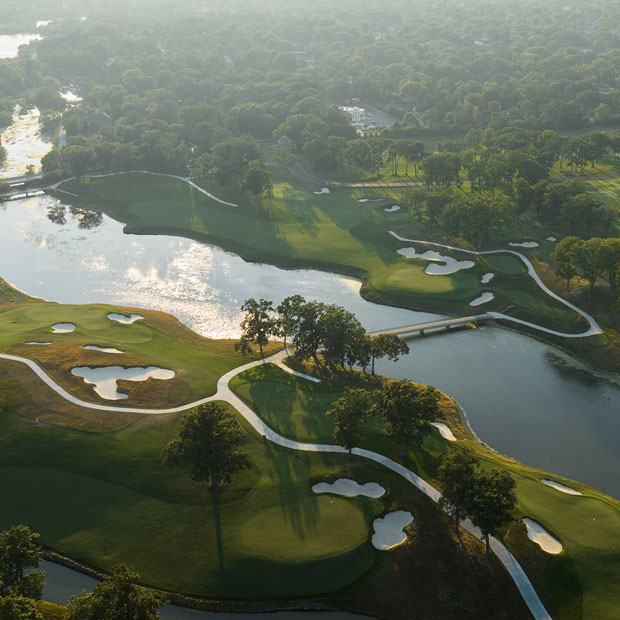
In the middle of the property sits Lake Kadijah, a picturesque feature that divides the site and has been ground zero for many of the past and current changes. Originally, only the par-3 second and 17th holes were played across the lake. A new 17th was eventually built, looking nearly identical to the now 13th hole just a few hundred yards down the lake. Instead of using Kadijah to create varied shots and angles, golfers continually played straight back and forth across it.
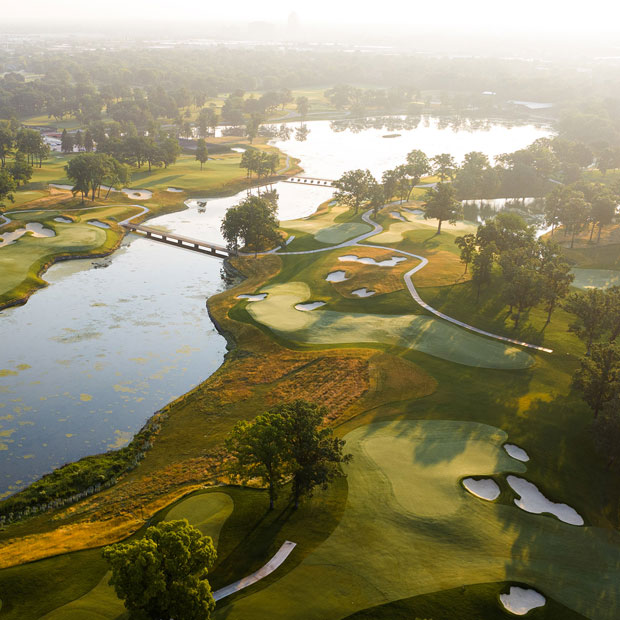
Enter the OCM design team in 2021. Without any real American projects to lean on, OCM proposed a bold concept, with a nearly complete redesign of the final six holes. Those six occupied the land around Lake Kadijah, and the results were dramatic. The area now features a multitude of shots, with the par-3 13th playing parallel to the lake, the short par-4 16th playing diagonally across it, the 17th now an angled par 3 playing across the water, and the 18th restored to its original corridor. During the redesign, the team focused on bringing features back down to the ground, allowing them to tie in more to the natural grade and, most importantly, restoring the scale of the golf course by increasing bunker and green sizes. Only time will tell whether Course No. 3 retains its reputation as the brute it once was.
Take Note…
Year-Round Club. When Medinah first opened, it included not just golf but a collection of other outdoor winter activities, including a ski jump and toboggan slide.
Sergio’s Tree. The tree made famous by Sergio Garcia’s infamous approach on the then 16th hole on Sunday of the 1999 PGA Championship was removed as part of renovation work in 2009. But the plaque remains.
A Long List of Architects. The architectural history of Course No. 3 at Medinah is a long one. Outside of the major projects, it’s believed that William Langford did some work, as did George Fazio, possibly Robert Trent Jones Sr. (it’s listed on his own website), and A.W. Tillinghast, who was employed by the PGA of America in the late 1930s to consult clubs about reducing maintenance costs.
{{content-block-course-profile-medinah-course-3-001}}
Favorite Hole
No. 6, Par 4, 476 yards
This is the second act in OCM’s boundary fence “play” and the most provocative. The strategy is simple: Push your ball as close to the OB fence down the left to give yourself the easiest angle into the rolling green. If this sounds too scary for you, simply utilize the 60-yard-wide fairway provided, but your approach shot is then playing straight towards the fence line rather than along it. Additionally, there’s a mere five-foot buffer between the green’s edge and the OB fence. Then again, there’s ample short grass right of the green for you to play it safe, but that leaves a tricky up and down.
What makes this hole so compelling is that it asks you a very difficult question and errs more on the side of extreme than mundane. It’s a choose-your-own-adventure golf hole where you select your level of risk. Many players will dislike this hole and call it unfair, but I applaud OCM for thinking outside the box and executing a compelling concept on some of the least compelling land.
Favorite Hole
No. 6, Par 4, 476 yards

This is the second act in OCM’s boundary fence “play” and the most provocative. The strategy is simple: Push your ball as close to the OB fence down the left to give yourself the easiest angle into the rolling green. If this sounds too scary for you, simply utilize the 60-yard-wide fairway provided, but your approach shot is then playing straight towards the fence line rather than along it. Additionally, there’s a mere five-foot buffer between the green’s edge and the OB fence. Then again, there’s ample short grass right of the green for you to play it safe, but that leaves a tricky up and down.
What makes this hole so compelling is that it asks you a very difficult question and errs more on the side of extreme than mundane. It’s a choose-your-own-adventure golf hole where you select your level of risk. Many players will dislike this hole and call it unfair, but I applaud OCM for thinking outside the box and executing a compelling concept on some of the least compelling land.
{{medinah-course-3-favorite-hole-6-gallery}}
Overall Thoughts
As a public golfer growing up in the suburbs of Chicago, playing any private course felt like an absolute treat. I can vividly remember my first time playing Naperville CC in 2012 and being over the moon to get a crack at the ho-hum private design. My young mind thought private = better. Coincidentally, I would get my first chance to lay eyes on the almighty Medinah No. 3 that same summer during a Ryder Cup practice round. It was an eye-opening experience getting to see Tiger Woods and other pros play on this big-scale golf course that was synonymous with championship golf to the highest degree. That September visit sparked a strong desire to qualify for an IJGA Invitational event that allowed junior golfers to compete on the famed Course No. 3. The following summer, I was able to lock up a spot in the event and play the course I had begun idolizing as a 15-year-old. It was finally my chance to play what I assumed was the “best” course in Chicagoland. Ironically, I hardly remember much from that round despite how much I had built up playing there in my head. I certainly wasn’t able to articulate why it felt less special than I anticipated. Now, as someone who studies golf course architecture almost religiously, it’s very clear why my 15-year-old self was uninspired by this “white whale” of Medinah No. 3. The course simply wasn’t great and most definitely wasn’t maximizing its potential. After OCM’s extensive overhaul, I can assure you that the golf course finally lives up to its name and championship history that I envisioned 14 years ago.
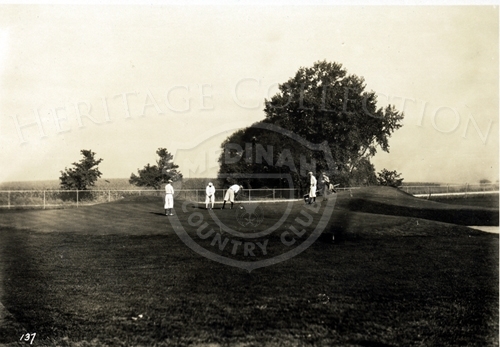
What I admire most about OCM’s approach to the redesign was the inspiration for the look and feel they wanted the new course to possess. Over the years, the large oak trees got bigger and the playing features got smaller. This shrinking of fairways and addition of bunkers were primarily to combat the professional game, which would frequently visit Medinah. This phenomenon was slowly throwing the scale and balance of the course out of whack. When you look at old photos of the course now, it’s jarring how narrow the corridors were on such an expansive site with wonderful rolling terrain.
{{medinah-3-old-course-photos-gallery}}
So what was the plan of attack? One of Mike Cocking and Ashley Mead’s first in-person visits included a stop at the nearby Morton Arboretum, which is roughly the same age as the golf course. The design firm was heavily inspired by open meadows, native tall grasses, and large specimen oak trees dotted across this protected sanctuary. They instantly saw the potential to return Medinah's landscape from an overcrowded sea of monochrome green grass to a more native Illinois landscape. One that has texture, long sightlines, and focal points that would amplify the site's terrain so it would feel more like the peaceful prairie environment it once was. I find this initiative to be the most impactful to the overall design as it redefined the feeling and sense of place of the golf course. Pair this new visual identity with a flurry of brilliant design ideas like the boundary fence and a re-routing that maximizes the central lake and the result is a terrific golf course that stands out in a crowded golf region.
Boundary Fence
The reintroduction of the boundary fence to holes 5-7 was a provocative choice by the designers, but a very intelligent solution rooted in history. Prior to the abundance of houses and commercial businesses surrounding the golf course, it was simply farm land and prairie. Several of the original holes were pushed right up against the boundary fence, creating a polarizing penalty. As development progressed, the holes were pulled away from the fence line for safety. An old photo of the fourth hole shows a split-rail fence right up against the green and provoked OCM to bring it back on this stretch that occupies some of the flattest land on the property. In order to maintain safety for the neighbors and the busy highway to the south, a new fence was built 20-30 yards away from the true boundary, a vegetative buffer from the outside that reintroduced the OB line that once bordered several holes. This choice created a strong identity for this mundane corner of the property and infused each hole with risk-reward strategy. A win-win on all fronts (except for those with a left miss).
Re-Routing
Most architects wouldn’t dare to suggest a dramatic change to the routing of a course as historic as Medinah, but that’s exactly what OCM did. They identified the glaring weaknesses in the design and proposed a significant change that would infuse more variety and drama into the course and final stretch. Their changes eliminated the redundancy of par 3s straight over water, resequenced the holes for better flow, and brought in a quality short par 4 that the course was previously lacking. Ultimately, their bold decision would pay off as they executed their concepts exceptionally well, leaving four very compelling holes at the end of the round and little to look down upon across all 18. We need more architects taking calculated risks that push the boundaries like OCM has done at Medinah.
{{medinah-3-google-earth-photos}}
1 Egg
OCM’s work at Medinah has truly transformed the course for the better. It almost seems unfathomable what used to exist on this splendid golfing ground. Not only did the design firm reintroduce a proportionate scale of golfing features to the land, but they also identified the weakest aspects of the course and transformed them into strengths. The course now boasts thoughtful greens, artful bunkering, and a playability that’s welcoming to members yet challenging for professionals. OCM took a tired, mangled design covered in dust and made it one of Chicagoland's most engaging courses.
Course Tour

{{medinah-3-course-tour-01}}
Explore Related Content
A Q&A with Ashley Mead
Get full access to exclusive benefits from Fried Egg Golf
- Member-only content
- Community discussions forums
- Member-only experiences and early access to events