North Haven Golf Club
Fine, sloping land, a seaside location, and strong design lineage make North Haven a lovely round of golf for the adventurous types

North Haven, Maine, USA
Wayne Stiles and John Van Kleek (redesign, 1925-1932)
Public

Like many seaside nines in Maine, North Haven Golf Club originated as a casual course for vacationers. The island of North Haven, accessible only by boat (and, today, the occasional private plane), had been a popular getaway for well-to-do easterners since the late 1800s. In 1916, summer residents purchased the Oren Waterman farm to establish a golf club. The original layout is lost to history; who designed it, or if there even was an architect, remains unclear. The club later hired Wayne Stiles and John Van Kleek to create a new nine-hole course, though details are murky: their plan is dated 1925, but the club claims the redesign was carried out by Stiles alone in 1932. Regardless, the course is skillfully built, with a routing that works across the hilly property and out to the coast on the par-3 sixth hole. With its wide, unirrigated fairways and old-fashioned push-up greens, North Haven offers something like time travel. Once you arrive at the course after the morning ferry ride, you’re back in the 1930s.
Take Note...
Logistics. To play North Haven without staying overnight on the island, catch the morning ferry from Rockland at 9:30 a.m. and the afternoon ferry back at 3:45 p.m. You can take a car if you make a reservation and pay a surcharge, but I would recommend just parking at the Rockland terminal, bringing your golf clubs with you, and walking to the golf course. The ferry ride takes just over an hour and the walk around 15 minutes, so you’ll have a window between about 11 a.m. and 3 p.m. to play golf.
{{north-haven-ferry-and-town-gallery}}
The spots. The town of North Haven is charming and homey, though fairly limited in its food and beverage offerings. If you have time left over after golf, consider getting pizza and beer at North Haven Brewing Company at Calderwood Hall or coffee and baked goods at Waterman’s Community Center.
Original clubhouse. Initially, North Haven’s “clubhouse” (really just a shack, and I mean that as a compliment) stood in the middle of the course, between today’s third tee and fourth green. When a new clubhouse was built at the southern end of the property — a more practical location, especially for parking — the holes were renumbered.
Islanders. North Haven is part of a small cadre of island golf courses in Maine. Others include Great Chebeague Golf Club on Great Chebeague Island (not far from Portland), Tarratine Golf Club on Isleboro (about 10 miles north of North Haven, as the crow flies), and Frye Island Golf Club on Frye Island (in the middle of Sebago Lake). There are also three excellent courses on Mount Desert Island — Kebo Valley Club, Northeast Harbor Golf Club, and Causeway Club — but you don’t have to take a boat to get to them.
{{north-haven-about-gallery}}
Favorite Hole
No. 5, par 5, 554 yards
The par-5 fifth hole at North Haven is an adventure, traversing 554 yards of tilting, rolling terrain at the northern boundary of the property. The back tee is tucked deep in the woods, where only the start of the fairway is visible. Tee shots hugging the high right side of the fairway gain an advantage. At the landing zone, the hole turns right, against a right-to-left slope. The fairway then travels up and over a small hill; second shots must be well hit to reach the top and gain a view of the green.
The approach shot is a thrill. The land races to the left, feeding into a small green at the bottom. When conditions are firm — as they usually are in the summer — a ball played low and well out to the right will scamper along the ground toward the target, rewarding golfers who embrace the ground game.
Favorite Hole
No. 5, par 5, 554 yards
The par-5 fifth hole at North Haven is an adventure, traversing 554 yards of tilting, rolling terrain at the northern boundary of the property. The back tee is tucked deep in the woods, where only the start of the fairway is visible. Tee shots hugging the high right side of the fairway gain an advantage. At the landing zone, the hole turns right, against a right-to-left slope. The fairway then travels up and over a small hill; second shots must be well hit to reach the top and gain a view of the green.
The approach shot is a thrill. The land races to the left, feeding into a small green at the bottom. When conditions are firm — as they usually are in the summer — a ball played low and well out to the right will scamper along the ground toward the target, rewarding golfers who embrace the ground game.
{{north-haven-favorite-hole-5-gallery}}
Overall Thoughts
Last month in our discussion forum, Fried Egg Golf Club member Dale Miller posed an excellent question: “What would be some small or big things to look for on a golf course to know the architecture has good bones?”
Saying a golf course has “good bones” is, admittedly, something of a backhanded compliment. The implication is that the original architect did fine work but that the course has deteriorated to the point that only the bones remain. Bunker shapes, mowing lines, and green contours have melted away, or become hidden under careless tree plantings. In order to appreciate the virtues of the underlying architecture, you have to pay attention — and perhaps exercise a little imagination.
I find that process enjoyable. That’s why I don’t use “good bones” as an insult, and why I’m always looking for courses that could be great with a bit of TLC. When I find one, I feel like I’m getting away with something.
North Haven Golf Club is just such a course.
So, to address Dale’s question, here are a few senses in which North Haven has good bones:
1. Topography and routing
These are the most important criteria: is the topography varied and interesting, and does the routing use that topography in varied, interesting ways?
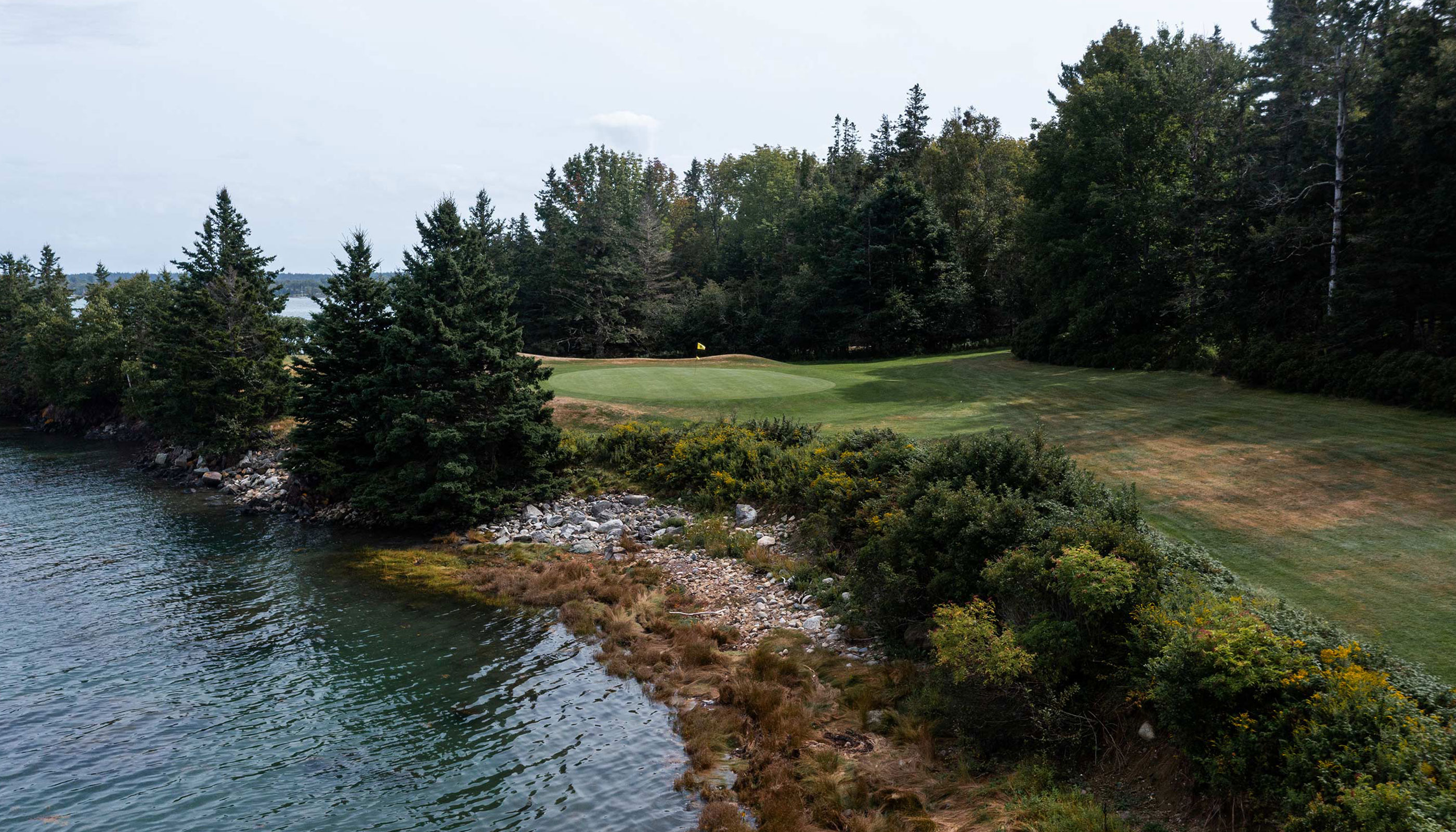
At North Haven, the topography is compelling but relatively simple. The course occupies a single, broadly sloping hill overlooking the thoroughfare between the islands of North Haven and Vinalhaven. One hole, the 137-yard sixth, sits hard against the ocean.
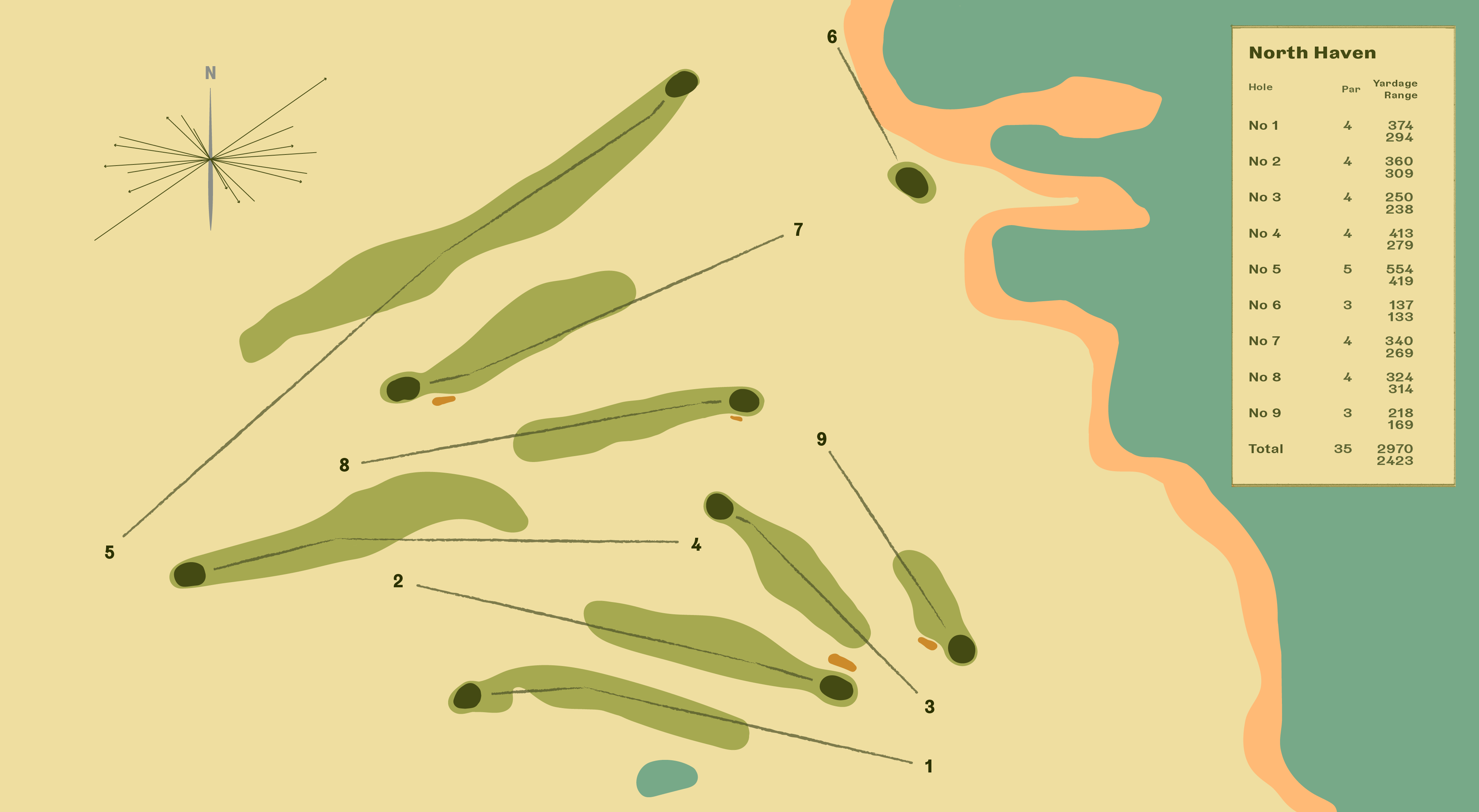
What makes this property come alive, however, is Wayne Stiles and John Van Kleek’s routing. Each hole has a different topographical profile. No. 1 travels ridge to ridge, turning softly to the left; No. 2 plays downhill, bending with a left-to-right slope; No. 3 climbs sharply uphill; No. 4 plays up and over a rise; No. 5 turns against, then with, a right-to-left slope; No. 6 jumps across a small inlet to a triangular cape jutting into Waterman Cove; No. 7 climbs gradually uphill while tilting from left to right; No. 8 slopes from right to left while ascending to the highest point on the property; and No. 9, a long par 3, returns players to the base of the hill.
The lack of repetition in this routing is a clear sign of quality architecture.
2. Different kinds of green sites
Similarly, I look for variety and balance in green-site selection. Less expertly designed courses might overuse ridge-top locations for greens, or simply overlook suitable natural spots. At North Haven, Stiles and Van Kleek found a range of green sites, from hilltop (1, 3) to subtle rises (6, 9) to sidehill (5, 7) to relatively flat ground (2, 4, 8). Again, this is an indicator of thoughtful design.
3. Distinctive green contouring
If you have interesting greens, you have an interesting golf course.
Now, I will say that North Haven’s greens are not particularly varied or inventive. Most are relatively flat and built up on the edges with prominent, berm-like shoulders. This style of construction becomes slightly overfamiliar by the end of the round.
At the same time, there is a winning simplicity to Stiles and Van Kleek’s green architecture at North Haven — one that suits the course’s rustic identity. If the putting surfaces were expanded back to their original dimensions, I bet they would feel just varied enough.
Indeed, it’s hard not to daydream about how much better North Haven could be with a low-cost, light-touch restoration. Stiles and Van Kleek’s plan shows dozens of since-lost bunkers, many of which are still in the ground, waiting to be refilled with sand. It also reveals a range of green sizes and shapes, easy enough to recover through a shift in mowing practices.
These changes could be made at little cost to the club. Unlike many courses of its era, North Haven does not have a significant tree-management problem. The playing corridors are plenty wide, and the fairway turf is a testament to the delights of an unirrigated polystand. So the course is close to its ideal form. With a nudge in the right direction, it could rival Stiles and Van Kleek’s other great northeastern nines, Hooper in New Hampshire and Olde Salem Greens in Massachusetts.
In the meantime, though, the bones are there, and they're good.
0 Eggs
North Haven’s fine, sloping land, seaside location, and strong design lineage make for a lovely round of golf. The course’s dead-simple presentation and lack of agronomic embellishment are also key to its charm. In some ways, however, Stiles and Van Kleek’s architecture has been neglected. I hope the club takes a close look at the 1925 plan and considers reviving certain features. Still, playing North Haven — in any form — is a unique experience that I would recommend to all adventurous golfers.
Course Tour
{{north-haven-course-tour-01}}
Additional Content

Explore Related Content

Olde Salem Greens Golf Course
Get full access to exclusive benefits from Fried Egg Golf
- Member-only content
- Community discussions forums
- Member-only experiences and early access to events