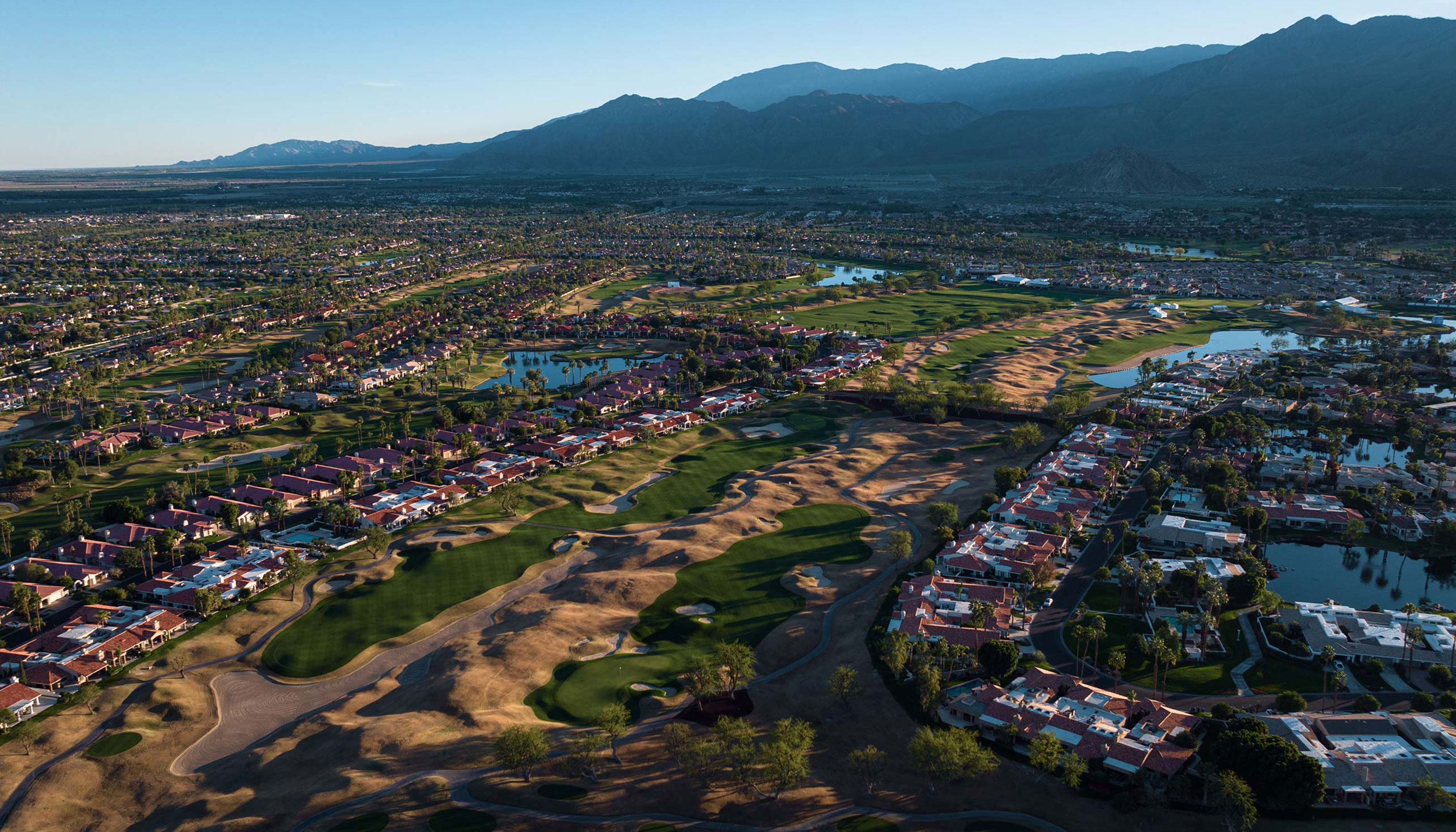
Pete Dye Stadium Course at PGA West
The Stadium Course at PGA West is an incredible engineering feat and a fun example of what can happen when a capable architect is given a clear prompt

La Quinta, California, USA
Pete Dye (original design, 1986); Tim Liddy (renovation, 2024)
Public

New Season, Same (Or Potentially Better?) Scottie Scheffler

Joe Walser and Ernie Vossler, two Oklahoma golf pros who built Oak Tree National with Pete Dye in 1976 (and, later, the Ocean Course at Kiawah Island), acquired the well-known La Quinta Hotel about 25 miles south of Palm Springs, California. After hiring Dye to design the Mountain and Dunes courses in 1980 and 1981, respectively, Walser and Vossler called him back out a few years later, this time with a more concise request: build “the hardest damn golf course in the world.”
The land was uninspiring. In his book "Bury Me in a Potbunker," Dye wrote, “Alice [his wife and design advisor] and I have built golf in cornfields, grazing meadows, swamps, and coal country, but the worst piece of land we ever started with was the featureless, barren acreage that became the TPC Stadium course at PGA West.” As he did at the Stadium Course at TPC Sawgrass five years earlier, Dye transformed a poor property into a stern PGA Tour venue, moving exceptional amounts of dirt in the process. When it opened ahead of the 1987 Bob Hope Classic, the Stadium Course at PGA West was considered extremely long for the time — nearly 7,300 yards — and featured the highest course rating the USGA had ever given (77.1). The professionals were not fans. On a few cold, windy days, the scoring average soared: pro John Adams shot 84 the day after a 69 at Indian Wells. Soon after the tournament, the pros revolted, signing a petition that got the Stadium Course removed from the schedule. It wouldn’t return until 2016.
{{pga-west-stadium-course-about}}
Take Note…
Desert Cup? The Stadium Course at PGA West was originally slated to host the 1991 Ryder Cup, but the event ended up at another brand-new Pete Dye design, the Ocean Course at Kiawah Island.
Deep trouble. Pete Dye notes in his book that developer Ernie Vossler was worried about the 19-foot bunker left of the 16th green. He dropped a handful of sand at the lowest point and told the architect if he could extract a ball from the spot, “then the damn bunker’s alright with me.”
The Rock. Before the famed mutiny following the 1987 Bob Hope Classic, the 1986 Skins Game was the first big event at the Stadium Course and featured Jack Nicklaus, Arnold Palmer, Fuzzy Zoeller, and Lee Trevino. Unlike the Hope, the Skins Game returned to PGA West the next year, when Lee Trevino aced the 17th, an island par 3 known as “Alcatraz,” to win $175,000.
Favorite Hole
12th hole, par 4, 363 yards
Outside of the par-5 16th, the short par 4s are PGA West’s strongest set of holes. The 12th is a good example. The concept is simple: pushing a drive as far up the left and as close to the deep fairway bunker as possible leaves the best angle into a well-guarded green, but the view is almost completely blind. Playing to the right opens up a look but creates a demanding wedge across the narrowest angle of the green, with the punishing “Moat” bunker waiting beyond. It’s a strategy employed throughout much of the course, forcing players to choose visibility over angles.
{{pga-west-stadium-course-favorite-hole-12-gallery}}
Favorite Hole
12th hole, par 4, 363 yards
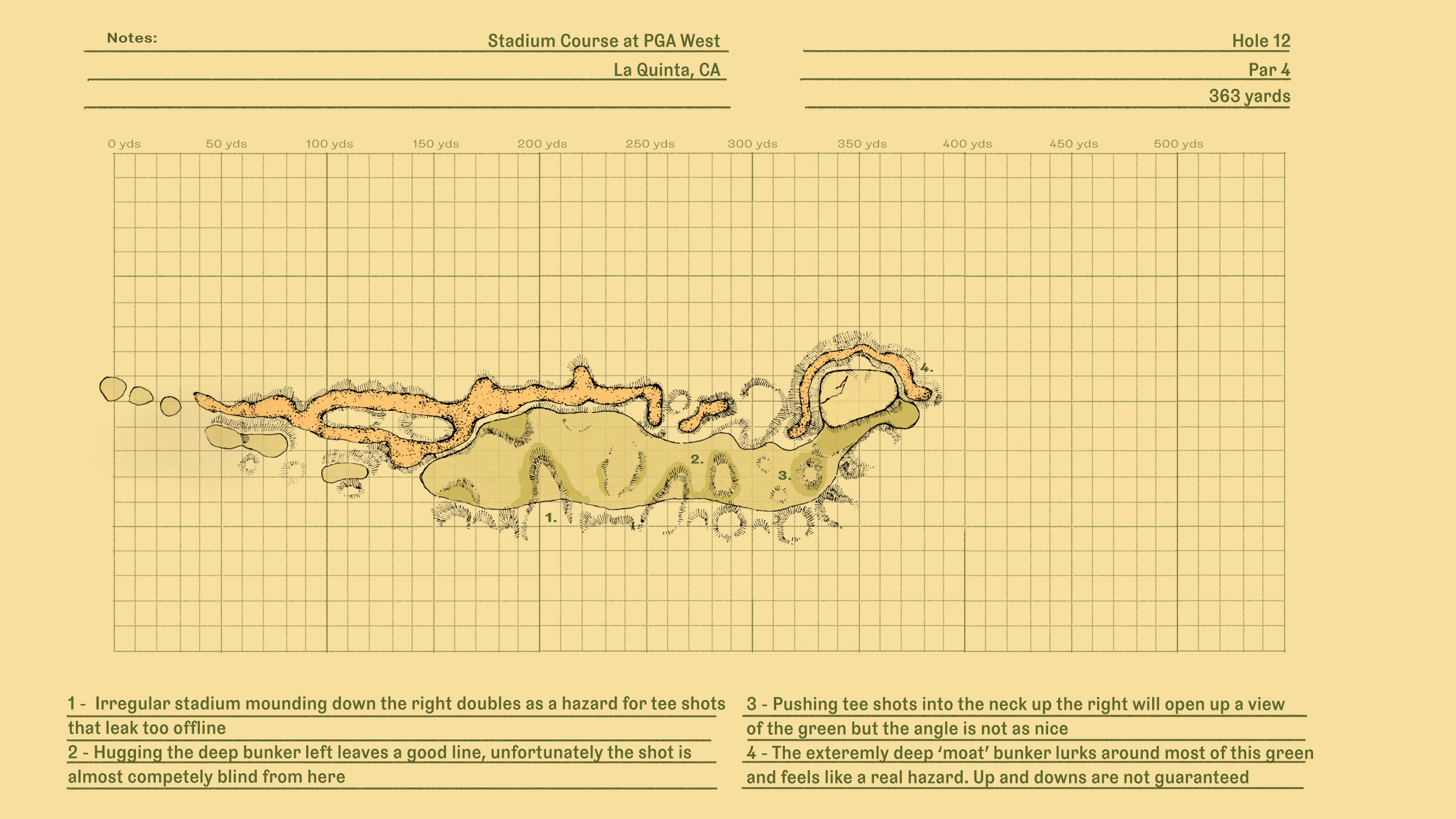
Outside of the par-5 16th, the short par 4s are PGA West’s strongest set of holes. The 12th is a good example. The concept is simple: pushing a drive as far up the left and as close to the deep fairway bunker as possible leaves the best angle into a well-guarded green, but the view is almost completely blind. Playing to the right opens up a look but creates a demanding wedge across the narrowest angle of the green, with the punishing “Moat” bunker waiting beyond. It’s a strategy employed throughout much of the course, forcing players to choose visibility over angles.
{{pga-west-stadium-course-favorite-hole-12-gallery}}
Overall Thoughts
As I noted earlier, Pete and Alice Dye worked on a lot of difficult sites. Turning nothing into something became their calling card. Perhaps that’s why, five years after dredging a Florida swamp into the Tournament Players Course at Sawgrass, Dye was solicited to do something similar in California, this time on dead-flat desert.
The stadium courses at TPC Sawgrass and PGA West were designed to be PGA Tour venues. Both were built in collaboration with the Tour (Deane Beman was involved in both projects) and, as a result, are often viewed as sibling projects. At first glance, the similarities are unmistakable: they are sculpted from featureless land, using awkward sightlines and visual deception via large-scale earthmoving to make players uncomfortable. Large spectator mounds line the hole corridors, creating ideal viewing for fans, and the finishing stretches look eerily similar: a dramatic par 5 followed by an island green 17th, with a tough par 4 finisher guarded by water up the left. (No. 17 at PGA West wasn't initially going to be an island green, but Dye changed his plan after Walser, Vossler, and Beman intervened.)
{{pga-west-sawgrass-finishing-stretches-gallery}}
Dye was clever in his desert design, though. From the ground, PGA West looks and feels different from TPC Sawgrass — maybe more like a cousin than a sister, taking aesthetic cues from the vertical mountain setting. Rocks line some of the water hazards instead of railroad ties, and sandy wasteland is favored over ponds. (But there’s still plenty of water, as fill had to be sourced from somewhere.) The internal contouring is irregular and the spectator mounding between holes bulges to absurd heights, mimicking the 10,000-foot peaks that sit a few miles in the distance. The raised features, synonymous with Pete Dye’s mid- to late-career work, are bold, with bunker faces stretched to near-vertical limits, playing off of the sharp canyons and deep shadows of the desert topography. This shaping looks terrifying in person, especially in the morning and evening, when dark shadows are cast across 10-foot faces.
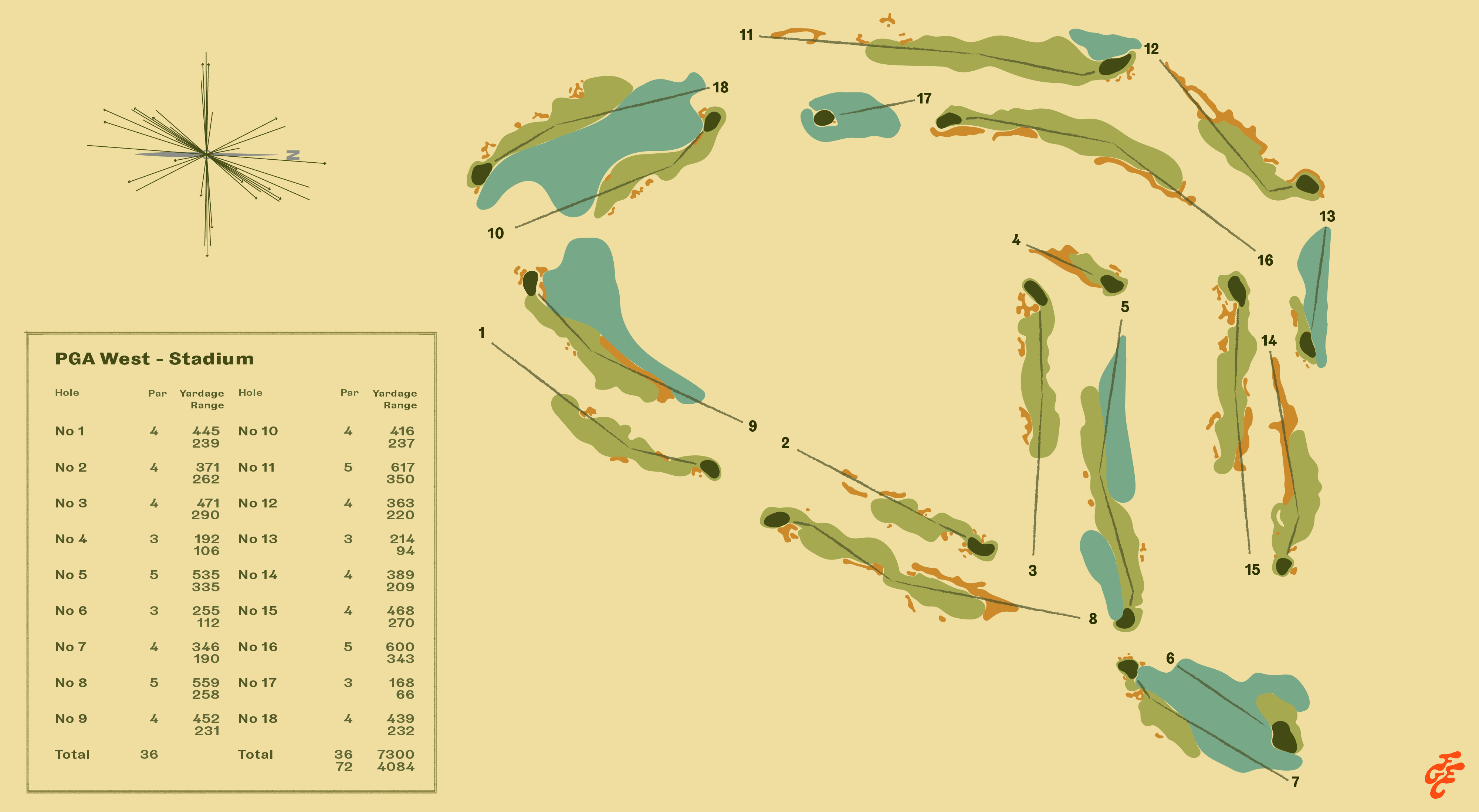
The key distinction between the two stadium courses, though, is PGA West’s real estate component. The need to line a majority of the course with housing clearly had an impact on the routing, with utilitarian efficiency resulting in two-hole-wide corridors looping out and back. It’s an easy way to allow fans easy access to different holes while also maximizing real estate frontage. However, it does create a redundant look from many tees, with houses left and stadium mounding right.
Most of the greens sit at angles, and opening up clear views often requires hitting into the tightest portion of the fairways. Conversely, taking conservative lines usually results in an obstructed view on the next shot. It’s a clever aspect of the design; the course almost mutates as aggression ramps up. On the front nine, holes like Nos. 1, 2, and 7 weave through their hazards while leaving ample room further back, at the penalty of a partially to fully obscured approach. This creates interest while also maintaining playability for average golfers, who can maneuver their way through the trouble.
Unfortunately, though, the questions Pete Dye asked top players off the tee in 1985 haven’t translated to the current era. Built to intimidate tour pros — something it did successfully in the mid-1980s — the Stadium Course no longer carries the same bite, and it’s not hard to see why. Average distances on the PGA Tour in the mid-1980s hovered around 260 yards. Now they exceed 300 yards. For skilled players these days, there’s little incentive to not blast driver over any and all trouble. Even if a current pro “lays back,” the fear generated by hitting a 9-iron into a well-protected green just isn’t the same as hitting a 5-iron.
Still, the punishment for missed shots is high, thanks especially to recent renovation work by Tim Liddy, a longtime associate of Dye’s. In the 30-plus years since construction, the greens shrank significantly, with grass buffers building up between the edges and adjacent hazards. Liddy’s expansions have pushed green pads back to the edge of disaster. Just look at hole Nos. 5-7, where the green surfaces and bulkheads seem to merge seamlessly. On holes like Nos. 12, 14, and the famed 16th, the greens are again cut hard against the deepest bunkers on the course.
{{pga-west-stadium-course-greens-gallery}}
What Pete (and Alice) Dye did so well, and what the best architects did before them, was generate excitement through decision-making. The Dyes give you a chance to hit exciting shots, but often at a severe risk. As he states in his book, “The professionals forget that the whole idea of a Pete Dye golf course is to require players to hit a wide variety of shots.” Love it or hate it, it is essential for interesting golf.
1 Egg
Before Tim Liddy’s recent restoration work, I don’t think this course would have been deserving of an Egg, but the green expansions have reintroduced some exciting strategic elements and fun contouring, especially when the wind picks up. The routing leaves a lot to be desired, and some design elements feel a little too duplicative of TPC Sawgrass, but all in all, the Stadium Course at PGA West is an incredible work of engineering and a fun example of what can happen when a capable architect is given a clear prompt.
Course Tour
{{pga-west-stadium-course-tour-01}}
Additional Content

Explore Related Content
Birck Boilermaker Golf Complex (Kampen-Cosler Course)
Birck Boilermaker Golf Complex (Ackerman-Allen Course)
Crooked Stick Golf Club

Brickyard Crossing
.jpeg)
Whistling Straits (Straits Course)

Harbour Town Golf Links
New Season, Same (Or Potentially Better?) Scottie Scheffler
Get full access to exclusive benefits from Fried Egg Golf
- Member-only content
- Community discussions forums
- Member-only experiences and early access to events