
Kingston Heath Golf Club
For those wanting to learn about the "strategic school" of golf architecture, Kingston Heath is one of the finest textbooks available

Melbourne, Victoria, Australia
Dan Soutar (original design, 1925); Alister MacKenzie (bunker renovation, 1926)
Private
$$$$

It’s hard to think of another golf course that wrings more excitement out of an unexciting piece of land than Kingston Heath Golf Club.
Designed by Scottish professional Dan Soutar and built by Royal Melbourne greenkeeper Mick Morcom, Kingston Heath makes the most of the property's paltry number of significant landforms. Nos. 14 through 16 all cling to a lone, handsome dune. But it's a testament to the course's quality that the holes on flatter land are just as compelling. When Alister MacKenzie visited the club in 1926 to draw up a plan for bunkers, he was effusive: "Never yet have I advised upon a course where, owing to the excellence of design and construction work, the problems have been so simple.”
The combination of Soutar's layout and MacKenzie's bunkering made Kingston Heath a showcase for risk-reward design: on every shot, the player can either steer toward safety at the cost of future difficulty or flirt with danger in pursuit of a subsequent reward. For those wanting to learn about the "strategic school" of golf architecture, Kingston Heath is one of the finest textbooks available. To this day, its subtle design, presented with firm Sandbelt conditions, remains capable of challenging the best players in the world: the club has been awarded eight Australian Opens, and it will be the site of the 2028 Presidents Cup.
{{kingston-heath-about-gallery}}
Take Note...
Strong stewardship. Kingston Heath is widely acknowledged as the first Sandbelt club to pursue a historically informed restoration plan. Starting in the early 1980s, superintendent Graeme Grant studied vintage aerial photographs of the course and set about reinstating bunkers and removing unwisely planted trees. His work reestablished Kingston Heath’s reputation as one of the world's greatest courses. After Grant's departure in the late 1990s, Mike Clayton — and, later, his former partners at OCM Golf — continued the refinements.
Shorties. In 2003, Kingston Heath added a 19th hole, a par 3 in the northeastern corner of the property. Since it seamlessly connects the first green with the second tee, the hole is sometimes used during member play to give one of the course's other par 3s a breather and during tournaments to help with gallery flow. In 2018, OCM Golf (then known as OCCM, as Mike Clayton had not yet left the firm) redesigned the hole to match Kingston Heath’s overall style. Five years later, OCM built a full short course, the Furrows, along the eastern edge of the site. The Furrows features nine par 3s ranging from approximately 50 to 150 yards.

Doctor's orders. Alister MacKenzie's other major contribution to Kingston Heath's design was to suggest that the 15th hole, originally a drive-and-pitch par 4, be shortened to an uphill par 3. Today's 15th, with its platform green and terrifying short-left bunker, is one of the stoutest and most memorable holes on the course, but the 150-plus-yard walk to the 16th tee is slightly awkward.
Favorite Hole
No. 11, par 4, 378 meters (~413 yards)
Kingston Heath’s 11th shows how much interest Soutar and MacKenzie could extract from flat ground. This mid-length par 4 plays slightly (very slightly) uphill and turns right, with two bunkers on the inside of the dogleg. The green is an exacting target: just 15 yards wide, pushed up from its surroundings, and guarded on the right by a curving chain of bunkers that begins 50 yards short.
The greenside bunkering may seem to favor an approach from the left side, but the actual advantage goes to tee shots that carry the bunkers on the right. From there, players can use the green’s full 30-yard depth and a friendly short-grass entry. They also earn a significant distance advantage: the bail-out to the left offers only about 260 yards of running room before native scrub and ti-tree cut in. The aggressive line demands more than a long carry, however. Around 290 yards from the back tee, the fairway pinches to 30 yards, with ti-tree on both sides.
The approach is a test of nerve. Seeing trouble right of the green, players often miss left, where steep runoffs and wavy contours harass up-and-down attempts.
Favorite Hole
No. 11, par 4, 413 yards
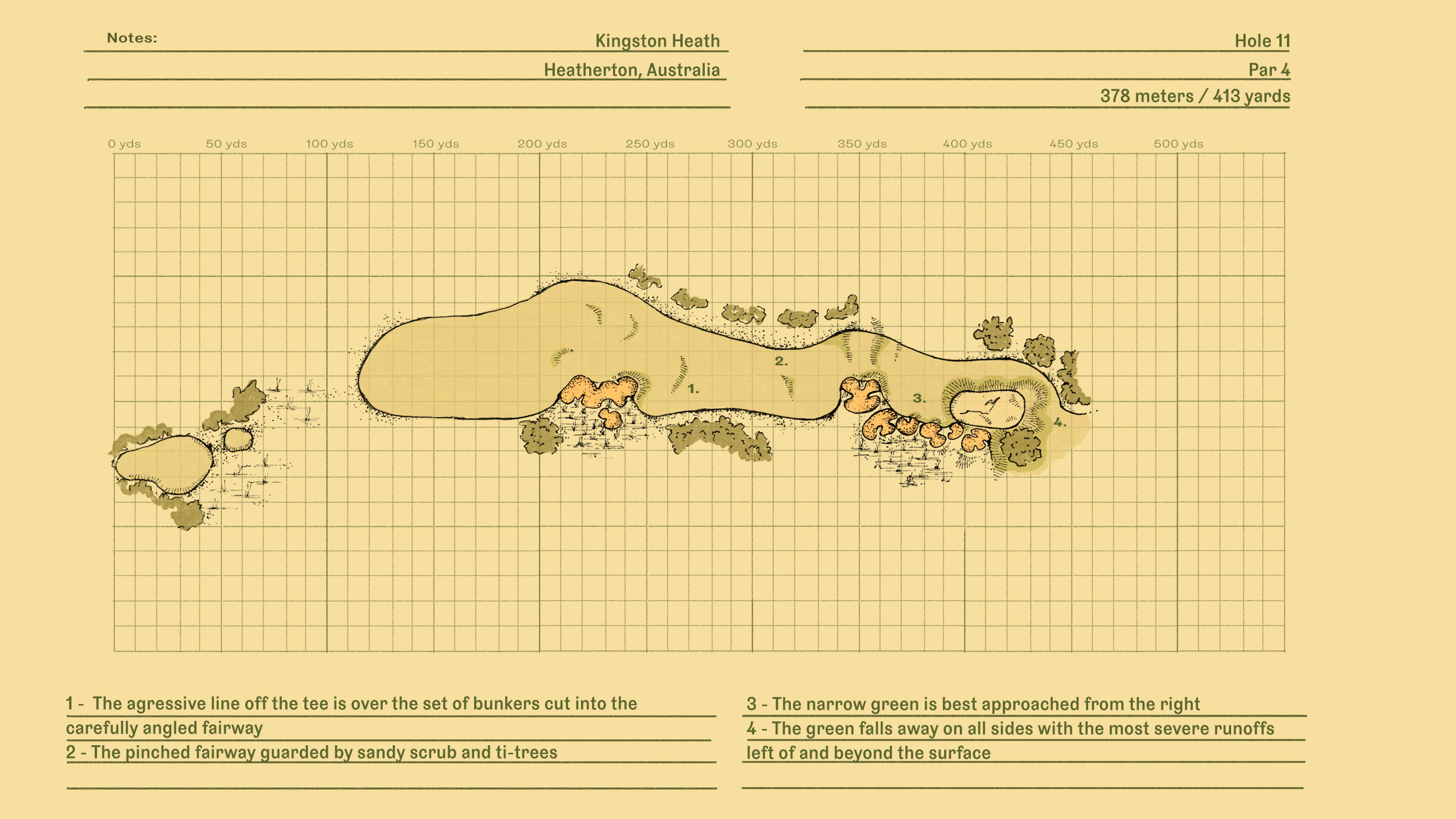
Kingston Heath’s 11th shows how much interest Soutar and MacKenzie could extract from flat ground. This mid-length par 4 plays slightly (very slightly) uphill and turns right, with two bunkers on the inside of the dogleg. The green is an exacting target: just 15 yards wide, pushed up from its surroundings, and guarded on the right by a curving chain of bunkers that begins 50 yards short.
The greenside bunkering may seem to favor an approach from the left side, but the actual advantage goes to tee shots that carry the bunkers on the right. From there, players can use the green’s full 30-yard depth and a friendly short-grass entry. They also earn a significant distance advantage: the bail-out to the left offers only about 260 yards of running room before native scrub and ti-tree cut in. The aggressive line demands more than a long carry, however. Around 290 yards from the back tee, the fairway pinches to 30 yards, with ti-tree on both sides.
The approach is a test of nerve. Seeing trouble right of the green, players often miss left, where steep runoffs and wavy contours harass up-and-down attempts.
{{kingston-heath-favorite-hole-11-gallery}}
Overall Thoughts
The best golfing terrain in the Melbourne Sandbelt is concentrated in one place: the central paddock at Royal Melbourne Golf Club, where 12 holes on the West Course and seven on the East occupy a dramatic dunescape. Generally, though, the Sandbelt, which encompasses roughly 200 square miles of the city’s south suburbs, is not topographically remarkable. Much of it is either broadly sloping or nearly flat. Kingston Heath Golf Club sits on the latter sort of land.
This is not to say it’s a poor golf property. It has a wonderful variety of vegetation, which gives the course’s off-corridor areas a beautiful color and texture. And most importantly, the soil is sandy loam — well draining yet sturdy, ideal for both building golf features and maintaining firm and fast conditions.
But there’s no denying that Kingston Heath is one of the flattest great courses in the world. Its only topographical feature of note is a large dune near the southeastern corner of the site. Plus, the property is quite small — about 50 hectares, or a little over 120 acres. (For reference, the famously petite East Course at Merion Golf Club shimmies into approximately 115 acres.)
On such a site, most golf architects would struggle to design a course with frequent changes of direction, a variety of hole types, and consistent visual and strategic interest. But at Kingston Heath, Dan Soutar and Alister MacKenzie achieved those tasks with aplomb.
Soutar’s routing is a masterwork. First, it maximizes the potential of the property’s single dune, saving it for the climax of the round: the par-5 14th hole plays around it, the par-3 15th climbs to the top, and the par-4 16th swoops back down. Soutar also located three holes — Nos. 8, 9, and 17 — on a wind-formed ridge that extends off the dune to the west (a “stoss slope,” as geologists call it).
But it’s on the mostly featureless ground of the northern two-thirds of the site that Kingston Heath’s routing does its most impressive work. The holes here could hardly be more tightly packed together.
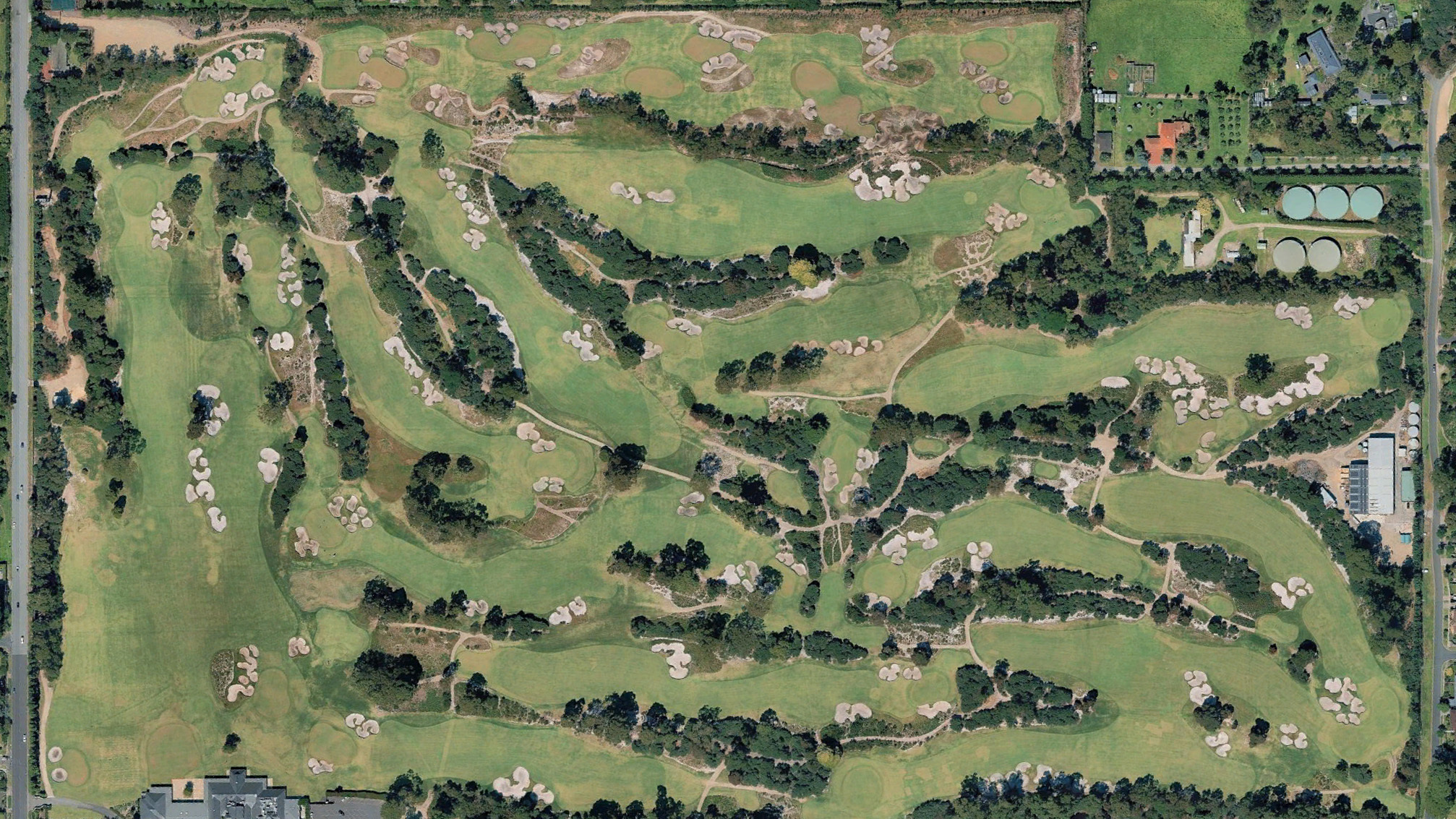
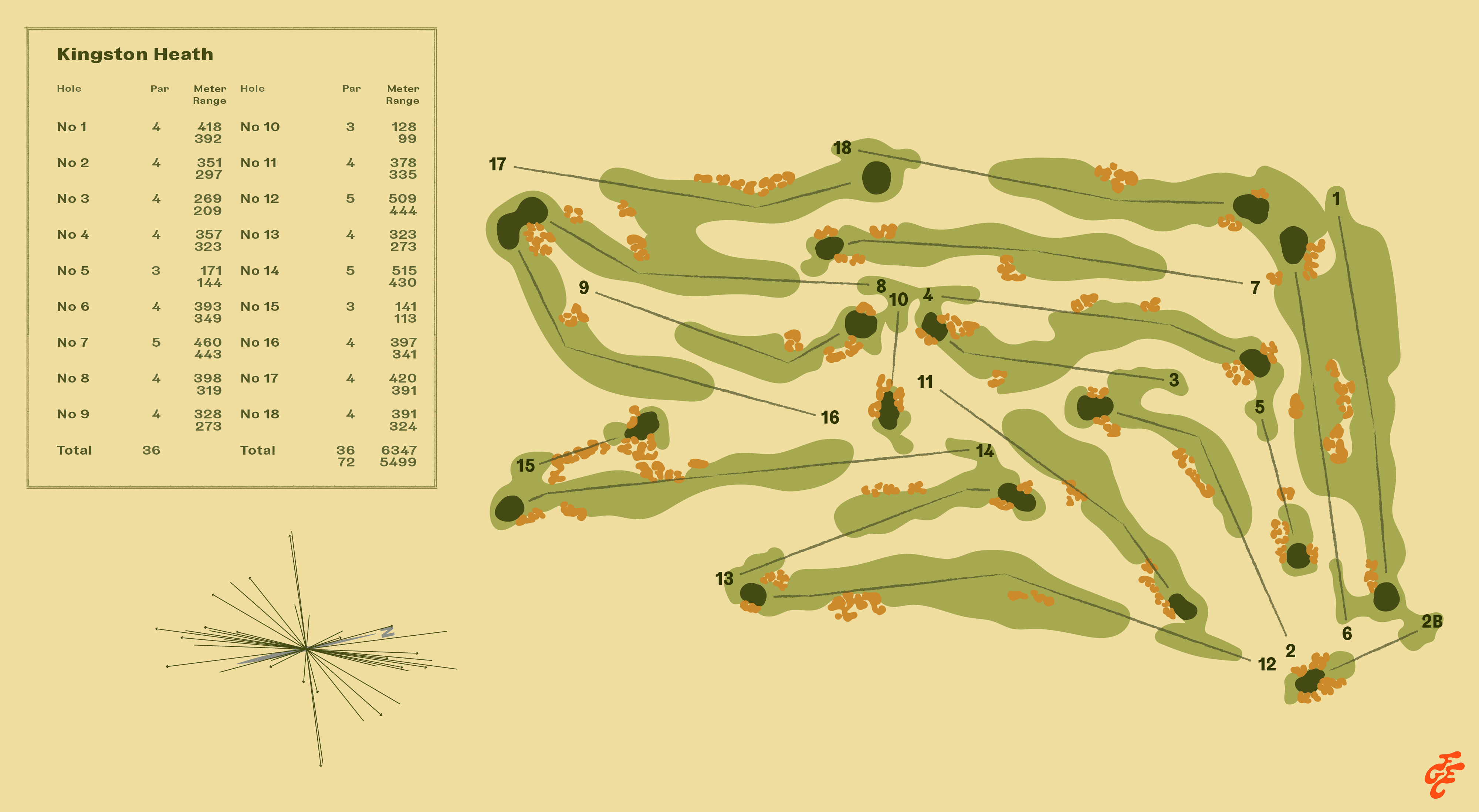
Yet, in playing the course, the golfer does not feel a sense of constriction or repetition. The routing tacks almost constantly; only two pairs of holes (Nos. 7-8 and 17-18, all stretching across the long axis of the property near the western boundary) head in the same direction consecutively. Otherwise, the player’s relationship to the wind shifts on nearly every shot. The course also alternates continually between different types and shapes of holes — long and short, straightaway and dogleg. Because of this variety, most players won’t notice the limitations of the land.
But the main reason Kingston Heath overcomes its weak topography is the quality and creativity of the hole designs.
MacKenzie’s bunkers do much of the heavy lifting. Their intricate yet elegant shapes, with native ornamentation along their brows, give the course its distinctive look. To amplify their visual impact, MacKenzie clustered them into vast, intertwining complexes; rarely does a bunker appear on its own. He used this approach at a few of his other courses, but never so aggressively. He must have concluded that Kingston Heath's quiet terrain could use some aesthetic clamor.
Of course, MacKenzie's bunkering is not just an artistic exercise. It also works in tandem with the course’s simple but shrewdly contoured and oriented greens to generate strategic dilemmas.
Classical strategic design can sometimes become formulaic: fairway bunker on one side, greenside bunker on the other, rinse, repeat. At Kingston Heath, however, Soutar and MacKenzie discover many different variations of risk-reward geometry.
Consider the course’s three shortest par 4s:
- The 294-yard third is a favorite of many Sandbelt golfers. The wide fairway accommodates a number of strategies from the tee: an iron short of the left fairway bunkers; a longer club to the left, carrying the bunkers but staying short of the ti-tree grove; and a conservative shot to the right, which leaves a wedge from an awkward angle against the orientation of the green. Going for the green, always an option for strong hitters, can lead to a long bunker shot or, worse, a lost ball to the left.
- Blind from the tee, the 358-yard ninth calls for a degree of local knowledge. A distant telecommunications tower provides an aiming point. About 250 yards out, a trio of bunkers eats into the left side of the fairway, so most players lay up short and right. The approach from here is tricky, though: the green is low-slung and obscured, and it runs away from the line of play. Unsatisfying pars after two good shots are common. As a result, some may be tempted to push their drives farther up, which brings an array of hazards into play.
- The 353-yard 13th is the simplest of the bunch, but it still offers a twist on traditional strategic architecture. The hole moves subtly right, but the ideal position in the fairway is not on the right edge, where a knowledgeable player might expect it. Instead, a string of four bunkers on the left guards the best angle into the green. Since these bunkers run on a gradual left-to-right diagonal, narrowing the fairway from 45 to 25 yards, players must carefully contemplate distance as well as line.
{{kingston-heath-overall-thoughts-gallery}}
At the 2025 Australian Open, Rory McIlroy ruffled some Royal Melbourne feathers when he said he preferred Kingston Heath to the vaunted West Course. Earlier this year, he explained himself: “I really have an appreciation for golf courses that maybe don’t have the best piece of land, and they have to come up with unique designs to make it interesting. And I think Kingston Heath… has really been able to do that.”
I still have the West at the top of my personal Sandbelt ranking. But I see McIlroy’s point. If Kingston Heath is not the best course in Melbourne, it’s certainly the most ingenious.
3 Eggs
The categories we consider in rating golf courses are land, design, and presentation. It might seem logical, then, to give Kingston Heath two Eggs; its land, particularly its topography, is far from world-class. But this course is more than the sum of its parts. Soutar and MacKenzie’s design makes beautiful use of the given property, and the club’s superintendents and consulting architects have done their jobs about as well as possible. It's high on my list of courses I wish I could play every day.
Course Tour
{{kingston-heath-course-tour-01-gallery}}

Explore Related Content

Victoria Golf Club (Australia)
Get full access to exclusive benefits from Fried Egg Golf
- Member-only content
- Community discussions forums
- Member-only experiences and early access to events