
Remembering Dan Hicks
The legendary golf broadcaster unexpectedly passed away at 64 years old.
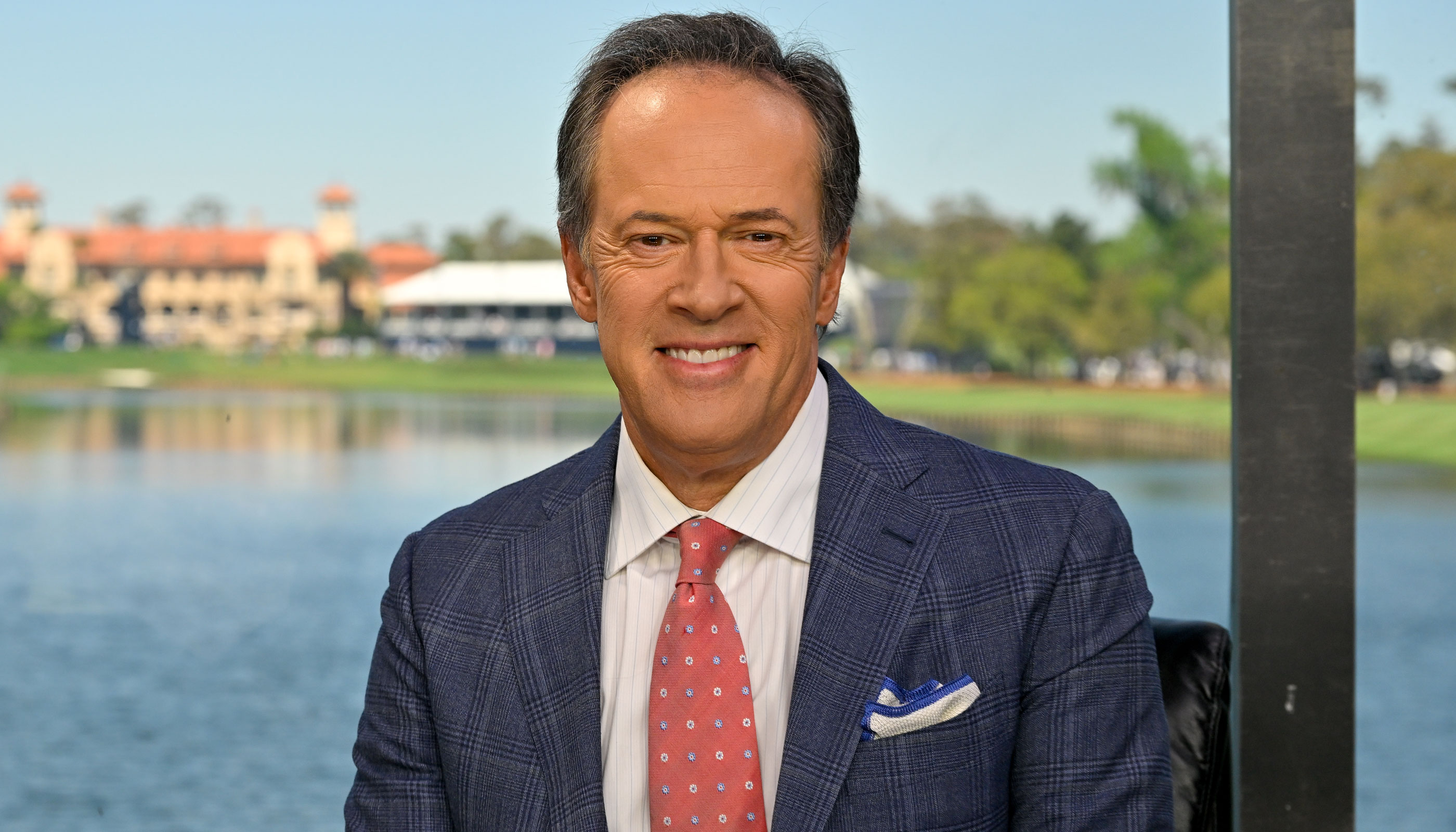
It’s always a little awkward to write an obituary for someone you barely knew. You can easily wade into performative waters. So I’ll begin this newsletter by saying I didn’t know Dan Hicks well. We met only a handful of times, despite traveling to the same cities and same tournaments. We often crossed paths like ships in the night. But the power of television is such that I felt like I knew him. I felt like he was a friend. That is why he was one of the best broadcasters of his era. He never detracted from big moments. He let them breathe, gently and colorfully, framing them as part of the historical record.
Hicks died Wednesday evening after an acute illness, according to his family. And though his passing was a shock to his NBC colleagues and to the world of golf, I cannot begin to fathom how devastating it must be for his wife, Hannah Storm, and his three daughters, Hannah, Ellery, and Riley.
Being around golf can fool you into thinking you’ll always have more time. Every April, we see Gary Player doing karate kicks and slapping his chest at age 91, or Jack Nicklaus hitting a baby fade off the first tee at Augusta National at 86. Even the clumsiest among us dream of one day shooting our age when we creep into our 70s. The fact that Dan Hicks got only 64 years feels achingly unfair.
His voice was soothing because of its profound competence, a quality that continues to be in short supply. He did not need a catch phrase. His best calls exuded both gravitas and grace, two qualities in a broadcaster that are easy to identify but nearly impossible to fake. But those professional qualities were just a reflection of his personal life, according to those who knew him best and loved him.
“Dan was a genuinely beautiful soul who lifted everyone in his world,” wrote Rich Lerner of the Golf Channel. “Ours now has a gaping hole.”
Roger Maltbie, in a tearful on-air interview with Lerner, speculated that he, Hicks and Jimmy Roberts had shared dinner with each other more often than with their families over the last thirty years. “This is not losing a colleague and a nice guy. This is losing a pal,” Maltbie said. “Danny was such a fun and wonderful guy. I love him. This is really hard. It’s really tough.”
In a business rife with insecurity, and one where gossip is often treated like currency, it says a lot that no one I know ever gossiped about Hicks, or had a bad thing to say about him.
“I remember he sent me a beautiful message shortly after my wife and I talked about her addiction to alcohol and her being in rehab,” said Billy Horschel on Thursday. “He was such an unbelievable person and broadcaster. We’re going to miss him. It’s a great hole that we’ve got to fill and I’m not sure we’re going to have anyone that can fill that anytime soon.”
“He was a lovely man,” said Max Homa. “I feel so bad for his family and friends. I have so many memories of listening to him. I know that will live on forever. The beauty of his job is we’ll all remember that voice and the stories he told, the experiences he gave us through calling golf.”
To imply Hicks was egoless isn’t quite right. You need to have an ego to own the lead chair of a golf broadcast, and to run the booth as smoothly as he did. But his confidence was earned through years of experience. He understood, particularly during his long partnership with Johnny Miller, that he was a point guard in their relationship. It was his job to see the floor and throw alley-oops to Miller, then get out of the way so Miller could dunk on someone two-handed, much to the delight of the audience.
Hicks’ most famous golf call, when Tiger Woods birdied the 72nd hole in the U.S. Open at Torrey Pines to claw his way into a playoff with Rocco Mediate, will live forever in broadcast lore for obvious reasons. It was an iconic moment, under pressure, by the world’s best golfer. But an underrated aspect of the call — “Expect anything different!” — is that Hicks put himself in the mind of both the audience and Mediate for a brief second. Whether you were rooting for Woods or rooting against him at that moment, you expected the ball to disappear into the hole. Maybe it was Woods’ aura, maybe it was destiny. But Hicks understood, amidst the pressure to say something profound, that we were witnessing a moment. It must have felt like kismet when the cameras cut to Mediate a few seconds later and he confirmed Hicks’ line. “I knew he’d make it,” Mediate said. We were all witnessing Tiger bend the game and the world to his will. I have no idea what Hicks might have said if that putt lipped out. Maybe he never came up with a fallback option. Sometimes in sports, you have to put your faith in what your gut is telling you.
We are a golf company and this is a golf newsletter, but I want to close with a few words about my favorite Hicks moment, one I also happened to be present for.
I was covering swimming in China at the 2008 Olympics when American Jason Lezak dove into the pool for the anchor leg of the 4x100-meter relay, trailing France’s Alain Bernard by almost a full body length. Unlike with Tiger at Torrey Pines, I was not expecting that I was about to witness one of the greatest moments in Olympic history. I was, in fact, resigned to the idea that Michael Phelps’ quest to win eight gold medals was all but over. Lezak was a fine swimmer, but he was not Phelps. And I was not alone in my skepticism. Both Hicks and Rowdy Gaines, calling the race for NBC, more or less wrote off Lezak’s chances as the two swimmers turned for home.
"I just don't think they can do it, Dan,” Gaines said.
"The United States trying to hang onto second,” Hicks said. “They should get the silver medal."
The reason I think it’s among the greatest calls in the history of sports broadcasting is precisely because Hicks did not sugarcoat what he was seeing for an American audience. He put it plainly what was clearly unfolding. It doesn’t look good, folks. That too was channeling the emotions of the audience.
I watch a replay of that race at least once a year, and I tear up almost every time. Not with patriotism, per se, but as a reminder that sometimes regular people are capable of extraordinary, out-of-body performances. I was poolside that day, so I didn’t get to hear Hicks’ commentary as it was unfolding. All I remember is a wall of sound, the chaos of deadline, and images of Phelps flexing like a conquering warrior king. But I’ve watched the replay so many times that Hicks’ words have become embedded in my brain. They are as essential to my memory as the images I witnessed with my own eyes.
"Lezak is closing a little bit on Bernard. Can the veteran chase him down? Bernard is losing some ground! Here comes Lezak! Unbelievable at the end! He’s done it! The U.S. has done it!”
I think the word “unbelievable” has become the biggest cliché in broadcasting, a phrase I’ve seen thrown around after quite believable par putts or third down conversations. But it is truly earned in that Lezak moment, especially with the way Hicks practically screams it. You can’t be surprised by anything if you’re always believing. In the two biggest moments of his career, Hicks intuitively understood that faith and doubt can be equally powerful. They aren’t enemies. They coexist in all of us.
I spent a lot of time staring at Hicks’ Instagram page on Thursday. It was clear how much he loved his family, and how proud he was of his three daughters. I hope the people who loved him will remember the core lesson of his Lezak call.
When you have a job to do, you call it like you see it.
Just don’t let anything close you off to the existence of miracles.


2027 Fried Egg Golf Events Schedule Reveal
Five Things: LPGA Bubble Watch and Rounding Out the Asia Swing
Fried Egg Golf Book Club: The Links by Robert Hunter
Reimagining Golf As College Football Conferences

An Ode to Odd Sets of Clubs

2027 Fried Egg & FEGC Event Lottery and Registration Process
Get full access to exclusive benefits from Fried Egg Golf
- Member-only content
- Community discussions forums
- Member-only experiences and early access to events