
Separating Schlock from Substance in Golf Entertainment
On "Stick," "The Hawk," and Ed Burns' new movie, "Finnegan's Foursome"
I don’t know about you, but I’ve never minded watching great athletes grow old.
I’m not lying when I tell you that I enjoyed watching Michael Jordan in a Wizards uniform. It was clear his body was breaking down, that he could no longer linger in the air for an extra half second the way he could when he carried the Bulls to six titles, but I loved watching him find other ways to defy logic and gravity. I loved seeing him summon different gifts, like the night he scored 51 against the Hornets at age 38. I recognized some of that same guile in Tiger Woods when he won the Masters in 2019. Even if they’re not the transcendent athlete they once were, you can still catch a glimpse of their remarkable gifts before they flicker out for good. Tom Watson didn’t win the Open Championship in 2009, but he made us believe a little magic continues to burn inside a great athlete, even when everyone else assumes it’s been extinguished.
I wanted to believe the same can be true of great comedic actors, which is why I gave a real chance to the two golf comedies that were released on streaming this year. I’m sad to report that neither rises to the level of Tiger at the Masters, or Watson at the Open.
In some instances, they’re a bit like watching Ian Baker-Finch struggle to break 90.
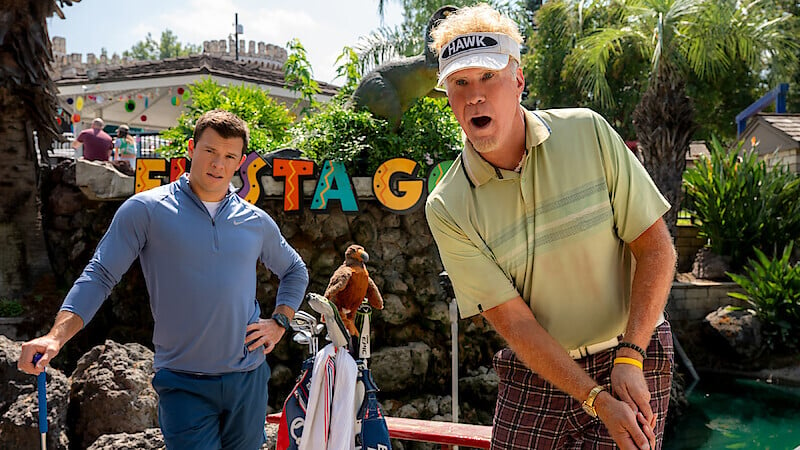
“Stick,” the Apple TV comedy starring Owen Wilson, and The Hawk, the Netflix comedy starring Will Ferrell, weirdly begin with a very similar premise. A washed-up former star finds himself at a crossroads in life after several years of burnout and hard living, and the plot moves forward only when the burnout decides golf is offering him one last shot at redemption.
“Stick” actually has some heart, and has a good enough supporting cast around Wilson that I didn’t hate it. It’s grounded in realism. Peter Dager — the actor who plays Santi, the young prodigy that Wilson is trying to mentor — somehow has a gorgeous, powerful golf swing despite never playing golf prior to landing the part. Marc Maron is perfect as a grizzled veteran caddie back reluctantly for one more rodeo. The show is like 75 percent there; I just couldn’t stop thinking about all the ways it could have been a little better.
“The Hawk,” on the other hand, feels like it was made by cynical, soulless people who heard how popular golf became during the pandemic. They responded by asking for a version of “Happy Gilmore 2” that wasn’t quite so highbrow.
Ferrell, playing the role of three-time major winner Lonnie Hawkins, is as broad and slapsticky as he’s ever been, with none of the occasional subtlety that made his performances in “Old School” and “Anchorman” memorable. In the third episode, there is an erection joke that is so blatantly stolen and recycled from “Anchorman,” I feel like Adam McKay — Ferrell’s old writing partner — ought to send him a cease-and-desist. I suppose there was a time in my life when I might have giggled at the idea of a Masters winner and Ryder Cup captain (two feats Hawk has supposedly accomplished in this universe) gyrating and humping the ground at a Korn Ferry Tour event while Sisqo’s “Thong Song” plays, but I was probably 15 years old. It makes sense because that is who this show was likely made for: 15-year-old boys.
(And their parents, of course, many of whom are still using Netflix as a pseudo-nanny).
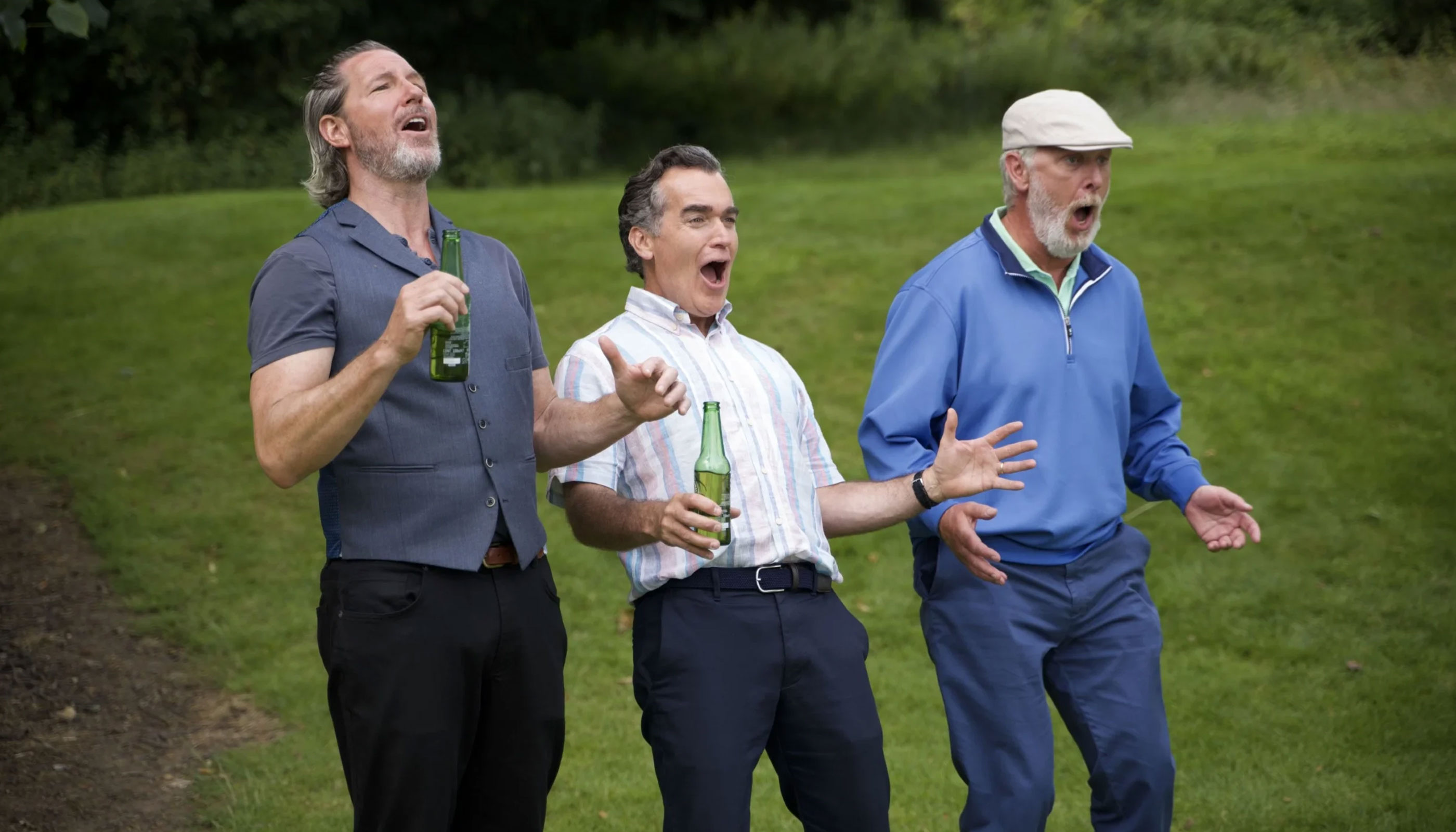
There was a golf story put to screen this year that didn’t receive the budget or the hype of “Stick” or “The Hawk,” but it does have twice the heart and authenticity. If you’re someone who likes to pour a drink and contemplate the ways in which golf can bring you closer to the people you love, I would recommend checking out “Finnegan’s Foursome,” a film written and directed by actor Ed Burns. He also stars in the film, which is essentially a love letter to Ireland and family.
Burns’ career has, in many ways, mirrored that of an athlete. He was initially the hot young prospect who caught everyone’s attention by writing and directing his own independent film, “The Brothers McMullen,” a semi-biographical story about an Irish Catholic family from Long Island. His career took off, and before long, he was starring in blockbuster movies like “Saving Private Ryan” and “27 Dresses.” But Burns never wavered in his desire to continue writing and producing his own films, so eventually he settled into a more manageable (and tolerable) level of fame in Hollywood. He made the decision to mostly work on projects he was passionate about.
He just never envisioned golf would be one of his subjects.
Burns’ father was a police officer in New York, but he was also a golf junkie. He tried to take Burns to the driving range several times as a kid, but it never clicked.
“I just wasn't comfortable sucking at something like this,” Burns said in a recent chat with Fried Egg Golf. “My father would take us to the range when we were 13 or 14, with no instruction, and it was painful.”
Burns’ perspective changed when he lost his mom to COVID-19. He realized he needed the game for mental health reasons. He started going to the range at night and hitting balls for two hours. Disappearing into a couple buckets of balls helped him process some of the hurt he was feeling.
“My dad is a sicko golfer,” Burns said. “So I was like, ‘Well, I want to try and spend as much time with him moving forward.’ He's 89, so he was 83 at the time. And the thing that I did not anticipate at all was all of the gifts that the game was going to give me.”
Burns started taking regular lessons. He began playing rounds with his brother and his dad, and eventually he invited his own son to join them.
“We played one Father's Day and I'm walking up the fairway and I look to my right and there's my 89-year-old dad getting ready to hit his approach shot,” Burns said. “And then I look to my left and there's my son. And the sun is low in the sky and it's a beautiful day on Long Island. And I'm like, ‘I'm sorry, what is better than this? This is a gift that I never thought I would get with my dad and my son and me and my brother.’ That’s when I started thinking about a golf movie. I was like, ‘I want to make a golf movie that's about those moments.’”
“Finnegan’s Foursome” isn’t one of the greatest sports movies ever made, but its premise is grounded by emotional truth. There are real adult themes at stake, like grief and love, family and memory. When Burns’ mother died, they couldn’t hold a service for 18 months because of the pandemic. His family wanted to spread her ashes around New York, but didn’t have permission from several of the places she loved, so they often had to go rogue. In the film, the patriarch of the Finnegan family — an old golf pro — dies the night before the annual family golf tournament. His sons decide to honor him by spreading his ashes throughout some of his favorite places in Ireland. Neither son is particularly good at golf, but playing bad golf together helps them wrestle with the impact their father had on their lives.
“I love going out with my buddies and breaking balls and busting chops and having stupid bets,” Burns said. “We all have a friend who is the dopey character that I play in the movie who ruins the round because he's a fucking asshole and is going to throw his clubs. So with all of those things I experienced, I was like, ‘How do I make a feel-good family therapy film set against the backdrop of the beauty and let's say the spirituality of the game?’ That was the goal.”
I suspect I have a soft spot for some of the subject matter here because (like Burns) I grew up Irish Catholic in a golf family that liked to sing, that liked to banter and argue, and that tried to split the G in bars whenever we drank Guinness. There are certainly some cliches here. But the film also culminates with a quiet round at Carne Golf Links in County Mayo. Of all the courses in Ireland Burns could have picked for his film to reach its emotional crescendo, I never would have guessed Carne, a course owned by the community and run as a non-profit. Burns admits he got some help on the location from writer Tom Coyne, who has championed Carne for years. But the authenticity of the choice fits the film perfectly.
“I mean the minute I saw the fourth hole, we just looked down and said, ‘Oh, I've never seen a course like this with those natural dunes that huge,’” Burns said. “I thought, ‘All right, this is where we have to shoot the final championship round.’ And look, I know we gave Carne a lot of screen time just because it was hard to cut anything because everywhere you pointed the camera, it's just gorgeous.”
By contrast, the dramatic culmination of “The Hawk” takes place at Pelican Hill in Newport Bay, a $50 million resort. A character’s ashes also get spread on the golf course, which connects these projects thematically, I suppose. They are each about golf and fathers and sons, at least in a literal sense.
But the golf courses where they conclude their story ultimately say more about them than my words ever could.


On Finding the Fun in Golf (Again)
Golf Needs More Good Stewards
Alt Shot: Golf vs. the Machines

Good Good and Bad Things
2026 Walker Cup Preview with Lahinch Golf Club Member
The Last Month of East Potomac (As We Know It)
Get full access to exclusive benefits from Fried Egg Golf
- Member-only content
- Community discussions forums
- Member-only experiences and early access to events