
How Can Team USA Solve a Problem Like Foursomes?
The Americans have gone 8-26 in foursomes since 2023
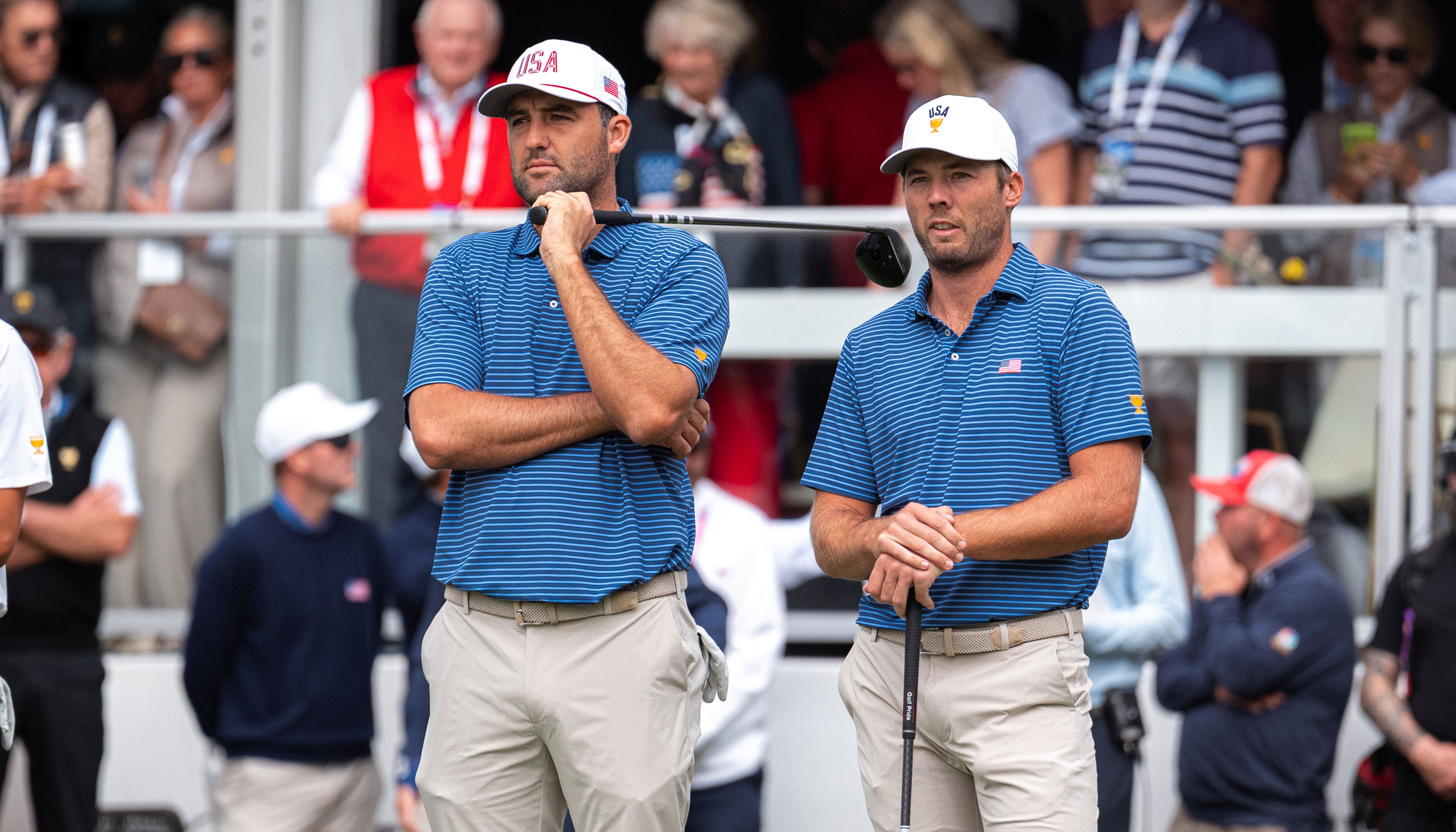
In the immediate aftermath of America’s victory in the 2026 Presidents Cup, captain Brandt Snedeker felt compelled to take a moment and forcefully defend his team — and really his country — against what must have felt like a wave of criticism that had been building for years.
“I’m just so damn proud of this team,” Snedeker said. “I'm tired of hearing how these guys aren't close. I'm tired of hearing how we can't play team golf. Guys just proved it right then and there."
I’m not sure how I feel about the Taylor Swiftian instinct to validate your haters by letting them know you’ve been bothered by their criticism all along, but allow me to throw a little cold water on Snedeker’s clapback.
You are going to keep hearing that this generation of U.S. players can’t play team golf until they prove otherwise. In fact, you can make a decent case that this generation is regressing.
The only thing Snedeker’s team proved at the Presidents Cup at Medinah is that they’re at their best when they don’t have to work together, when they don’t have to collaborate on strategy and execution, when they can treat golf as an individual pursuit.
And to be fair, those attributes make them dangerous.
{{related-articles}}
I suspect there is some frustration brewing amongst the American players that there has been very little positive coverage over the fact that they just delivered the greatest beatdown in the history of singles competition in a Presidents Cup or Ryder Cup, and if that’s true, I think they have a fair point. Americans are really good at singles, and singles is the most important part of the competition. It’s where the most points are available. No one takes the Europeans or Internationals to task for being traditionally weak in singles. There is instead a baseline assumption that the brutish Americans are just more talented and ought to win that session every time. It feeds into a lot of cultural biases (some admittedly grounded in truth) that the Americans are talented, selfish, and strategically inept, while the Europeans and Internationals are a cunning brotherhood of pluckish underdogs.
People who study statistics for a living are quick to point out that we are dealing with such a small enough sample size in these Cups, we ought to be careful about crafting narratives that feel absolute. We are ultimately talking about eight or nine matches of alternate shot that take place just once a year, and those matches are typically decided by just a couple of holes. If you played those matches out a hundred times, I am skeptical the Americans would have the same pitiful results they’ve had recently. We don’t even have to journey that far back in time to find a stretch when the United States seemed to have figured out the format. The Americans won the foursomes sessions 6-2 at Whistling Straits (2021) and 5½- 2½ at Hazeltine (2016). They won foursomes 6-3 at Quail Hollow (2022), 5½-3½ at Royal Melbourne (2019), and 7-2 at Liberty National (2017).
From 2015 to 2022, the U.S. went 38-22 in foursomes. For whatever reason, that stat got less attention and generated way less podcast fodder than going 2-6 at Le Golf National in France.
Europeans in particular love to point out how much more talent the American side has, but are then quick to talk themselves into a pretzel when asked to explain how exactly this superior talent gets muted or canceled out by the mere act of “taking turns hitting golf shots.” Yes, the Americans have gone 8-26 in foursomes since 2023. But there is a real chance this variance begins to course correct at some point, and I hope I’m around to see golf media wrestle with rewriting certain Ryder Cup narratives that they have recently held up as gospel, almost as if they were carved into stone tablets.
Thankfully, we don’t decide golf tournaments on spreadsheets. There are humans involved, each of them susceptible to their own nerves, egos, mistakes and desires. Stats and past results are a helpful tool when it comes to making predictions, but they don’t decide outcomes. That’s the reason we still watch instead of simply feeding probabilities into a computer.
It’s possible the United States could travel to the Ryder Cup next year and dominate foursomes. As Snedeker said: “This team is going to be a problem in Ireland.” They do have a talent advantage, after all. But for that to happen, they need to — at minimum — lean away from talk of variance and acknowledge that their current approach really isn’t working.
First, let’s deal with the facts:
The United States went 2-7 in foursomes this year at Medinah.
They went 2-6 in foursomes at Bethpage.
They went 3-6 in foursomes at Royal Montreal.
They went 1-7 in foursomes at Marco Simone.
Whenever American captains are asked by the media to unpack another disappointing foursomes session, they tend to fall back to the banal-but-maddening explanation that the other team “just made more putts.”
What never seems to be addressed is WHY.
Why, at least lately, does the other team make more putts? Particularly in foursomes? I think a hint of the answer can be found in something else Snedeker said this past weekend, something he was trying to articulate as a way to explain his controversial decision to sit Scottie Scheffler in foursomes. “Scottie’s got the weight of the world on his shoulders carrying Team USA,” Snedeker said. “I think it’s time for us to carry him for a session.”
If there is one thing Europe has figured out in recent years, particularly under Luke Donald, it’s that no one superstar can or should even try to carry a team to a cup. Nobody’s shoulders are that broad. When you are part of Team Europe, you are playing for something bigger than yourself. Your ego, your status, your majors won, your career earnings, they all mean nothing once you put on the uniform. Crucial putts do not feel like a referendum on your personal legacy, they are seen as an opportunity to contribute to the cause. And because of that, there is a serenity and confidence that washes over them.
I think one reason why Jon Rahm has become such an incredible Ryder Cup performer (he’s 6-0 in foursomes) is that he doesn’t feel like he has the weight of the world on his shoulders. I have watched Rahm and Rory McIlroy up close for the majority of their careers, and there is a mutual respect there, but the only time I’ve ever seen genuine warmth and camaraderie between the two of them is at Bethpage, the night the Ryder Cup ended, when McIlroy was leaving the victory press conference. Rahm swooped in behind McIlroy and wrapped him up from behind in a bear hug and lifted him off his feet. It was a beautiful scene, two alpha dogs who had spent the better part of a year on opposite sides of golf’s cold war, briefly united and humbled by a shared goal.
The United States spent nearly two decades begging for Tiger Woods and Phil Mickelson to show up at these events and just be their amazing selves, catering to their every desire. It doesn’t feel like a coincidence that the U.S. experienced its greatest Ryder Cup success at Whistling Straits, when neither Phil nor Tiger had any role on the team. With the exception of Hal Sutton, American captains let Tiger and Phil choose their partner, their strategy, their prep. At one point, they even staged a coup so they could choose the captains.
Scheffler seems unlikely to ever want that kind of power. But unfortunately, it feels like the American brain trust is repeating the same delicate but convoluted approach with him. It’s no wonder he doesn’t perform his best in these events. He is being asked to play the role of Michael Jordan (perhaps literally at times by Ryder Cup gadfly Michael Jordan) in a sport that never rewards that kind of alpha mentality in team events. Look no further than Zach Johnson throwing Scheffler into a last-second foursomes pairing with Brooks Koepka at Marco Simone. Asking him to play the hero and save them resulted in a 9-and-7 beating at the hands of Ludvig Aberg and Viktor Hovland.
The rest of the golf world has honed in on this idea that Americans can’t play foursomes because they’re selfish and oafish and the format requires the ultimate ego death. It’s almost certainly nonsense — we’re just talking about golf after all, not culture or politics — but it makes for a great story. If Snedeker, Jim Furyk and the rest of the boys are tired of hearing it, they’ve got a year to figure out how to rewrite the script.
The next foursomes session is 352 days away.




If Not Now, Then When for the Internationals?
Team USA Avoids Major Upset With 2026 Presidents Cup Comeback Win
2026 Presidents Cup Grades
Internationals on Verge of Historic Upset at 2026 Presidents Cup
Internationals Sweep Friday Foursomes at 2026 Presidents Cup
What Would a Mixed Team Presidents Cup Look Like?
Get full access to exclusive benefits from Fried Egg Golf
- Member-only content
- Community discussions forums
- Member-only experiences and early access to events