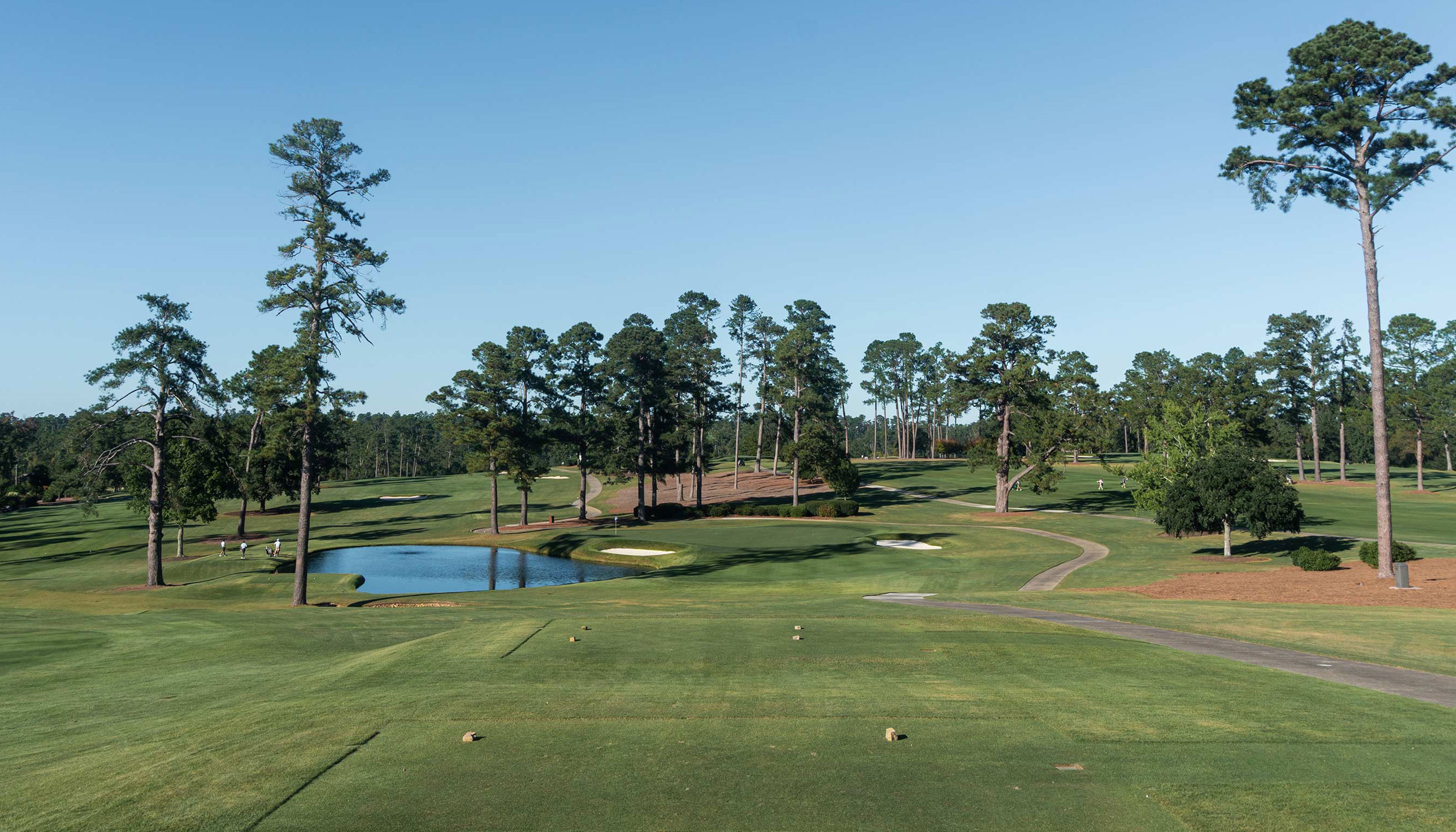
Augusta Country Club
With its varied landscape and familiar routing, Augusta Country Club boasts a course that anyone would be happy to play every day.

Augusta, Georgia, USA
Donald Ross (original design, 1927), Bob Cupp (renovation, 1986, 1996), Brian Silva (restoration, 2000), Tripp Davis (restoration, 2022)
Private

When you’re around the Augusta, Georgia, golf scene, you’ll often hear the phrases “The National” and “The Country Club.” Although the SEO experts are still working on the separation online, Augusta Country Club and Augusta National Golf Club are not to be confused. They share many characteristics — members and a zip code among them — even if their global reputations are very different.
Founded in the late 1800s, Augusta Country Club predates its more famous neighbor and has its own complex history. Modern-day ACC includes one course designed by Donald Ross, but in the 1920s there were 36 holes with the Hill and Lake Courses. The Hill Course was originally built in the early 1900s but was renovated and rerouted by Ross in 1927. The Lake Course was a Seth Raynor design from 1926 that sat north of the modern-day 18th hole. High winter demand at that time allowed for two courses, but demand began to wane after the Great Depression. In 1937, the club sold the Lake Course’s land.
While the club only retains half of its original courses, what stands today is a very enjoyable example of both a southern landscape and hospitality.
Take Note…
We need some space. Walking from the ninth green to the 10th tee, players will notice an awkward walk back around a road. In 2017, neighboring Augusta National purchased a few acres of land on the northernmost part of Augusta Country Club to lengthen the iconic 13th hole. But as illustrated in a 2017 Golf Digest piece, the negotiations over the land weren’t simple.
The real Rae’s Creek. A small thrill for golf nuts, Augusta Country Club features two shots (the approach into No. 8 and the tee shot on No. 9) that play over Rae’s Creek before it flows onto Augusta National’s property. You could try sending a message in a bottle down the waterway, but it probably won’t make it to ANGC.
“Live from Augusta.” While it’s no longer their home, the Wallace House at Augusta Country Club used to be the Masters broadcast headquarters. Located just off the putting green and driving range, the Wallace House is a historic building where previous broadcast crews would come on the air and say they were “live from Augusta,” not “live from Augusta National.”
Hammer time. The club offers a very laid-back environment throughout the experience, as is evident by its signature cocktail, the Velvet Hammer. Effectively an alcoholic milkshake, it’s certainly a unique experience.
{{augusta-country-club-about-gallery}}
Favorite Hole
No. 13, Par 4, 433 yards
Those who don’t enjoy visual deception may hate No. 13 as it features two blind shots, but the rest of us can love this hole for its incredible demands. Playing on the side of the hill that defines the property’s gathering point, the 13th is a long par 4 with a multitude of challenges. The tee shot plays uphill to a blind landing area that slopes right to left. Most tee shots will get near the top of the hill, but they won’t go far enough to reward the player with a view of the green. With the ball above a right-hander's feet, the approach shot feeds into a Redan green that again feeds balls to the left. If you get the ball moving too quickly right to left, it will feed all the way to the back.
Favorite Hole
No. 13, Par 4, 433 yards

Those who don’t enjoy visual deception may hate No. 13 as it features two blind shots, but the rest of us can love this hole for its incredible demands. Playing on the side of the hill that defines the property’s gathering point, the 13th is a long par 4 with a multitude of challenges. The tee shot plays uphill to a blind landing area that slopes right to left. Most tee shots will get near the top of the hill, but they won’t go far enough to reward the player with a view of the green. With the ball above a right-hander's feet, the approach shot feeds into a Redan green that again feeds balls to the left. If you get the ball moving too quickly right to left, it will feed all the way to the back.
{{augusta-country-club-favorite-hole-13-gallery}}
Overall Thoughts
Comparison is the thief of joy, especially when you are being compared to Augusta National Golf Club. Alas, given its name and its location, Augusta Country Club is inevitably thought of as the little brother to the Masters venue. While that certainly isn’t fair to ACC, the widespread familiarity golf fans have with Augusta National is actually constructive when it comes to breaking down the architecture of Augusta Country Club.
Let’s use three of Augusta National’s defining features — a focal point, sidehill lies, and visual deception — to break down Augusta Country Club.
Focal Point
Augusta National is famous for its crowd roars that echo through the pine trees. These cheers are especially loud in places where the routing gathers. As Garrett Morrison previously explained for our website, Alister MacKenzie often used focal points in his routings. These areas bring many holes together in close proximity, usually on a natural land feature that the architect wanted to highlight. According to Garrett, the Augusta National focal point is “a hill where the second, seventh, and 17th greens — as well as the third, eighth, and 18th tees — converge.”
Over at Augusta Country Club, the property is in the shape of a capital L. The routing heads west for the first three holes and then turns north. There are 11 holes that then play up to, around, alongside, and off the property’s focal high point. The high point itself encompasses the fifth, seventh, and 14th greens along with the sixth, eighth, and 15th tees. On the hillside, you’ll also find the majority of the 13th hole, the new ninth green, and the second half of No. 10.
By returning to a focal point, Augusta CC’s routing makes the most of its defining feature and keeps the golfer grounded in their location on the course. Personally, I enjoy a routing that goes on more of an adventure, but this technique offers a certain sense of comfort and familiarity throughout the round.
With the other holes in the southern corridor of the course’s property that tackle a very different landform, there is enough variety in the focal point holes to justify this routing decision. This path also means golfers pass the halfway house multiple times. I highly doubt Donald Ross considered that in his routing, but I know the routine access to refreshments is something the members appreciate.
Uneven Lies
As anyone who has watched the Masters will know, there are some big, broad hills to be traversed in Augusta. The first major of the year puts a high demand on players to hit shots with the ball well below and above their feet, with both downhill and uphill lies. While the hills at Augusta Country Club aren’t as dramatic as those at Augusta National, they still provide very interesting terrain to test a golfer.
The holes that encircle the focal point offer elements of this, but it is actually the southern corridor of the property that boasts the most distinct examples. This area features the first three and final three holes of the course, playing directly away from and back towards the clubhouse. Heading west, the first three holes all feature approach shots with the ball below the feet of a right-handed player, while the closing stretch poses the opposite test. Nos. 2, 3, 16, and 17 are the most dramatic as they really tackle the ridge that cuts off the western corridor from the clubhouse side of the property. Together, these six holes provide a rather uncomfortable start and finish to the round. Misses to the right of the greens on Nos. 2 and 3 are sure-fire ways to make a bogey, and you don’t want to get the ball going left of Nos. 16 and 17. A lesser architect could have really messed up this section of the property, but Ross executed varied and exciting stretches of golf.
Visual Deception
The undulations and blindness off the tee at Augusta National take a lot of time to adjust to as a fan, let alone a player. That sense of uncertainty keeps everyone on their toes for championship golf, and it's just as fun to play for the everyday golfer.
Augusta Country Club is a great case study in off-the-tee design. In fact, it features common themes that Donald Ross employed throughout his career as an architect. Off the tee, Ross frequently used bunkers and bunker layering as a way to deceive the eye. He also employed blindness in some of his best designs to really put the player off kilter. Many tee shots at Augusta Country Club are especially uncomfortable. Nos. 2, 3, 7, 13, and 17 all have landing areas that are at least partially obstructed from the tee, and many other holes use bunkers to throw off your starting line.
{{augusta-country-club-uphill-tee-shots}}
What’s Missing
While Augusta Country Club has many similarities that put its architecture on par with its neighbor, there is a reason it isn’t thought of as highly. Its property, while enjoyable and a good walk, just isn’t the world-class land you find up the hill. But what really sets Augusta National apart from most courses in the world are its green complexes and the way they interact with the shot required. The greens at ANGC are some of the best in the world, and they often reward the opposite shot that’s encouraged by the fairway. While Augusta Country Club’s greens are by no means boring, they are not among Ross’ best or most interesting. They are fun to play, but sometimes lack in intricacy. This isn’t really a knock on the golf course. It’s just a more everyday approach to green design.
It should also be noted that the modern-day Augusta Country Club features a few holes that aren’t Ross originals. The most notable of those changes is the ninth hole, which was shifted when Augusta National purchased a portion of the property to extend its 13th hole. Ross’ original routing wouldn’t have used the hillside for No. 9 and would have instead offered a worthwhile break from the focal point. The new ninth hole means you have three consecutive uphill approach shots (Nos. 9-11), a somewhat tiring element that would have been better served with its original version. It would also prevent the only bad walk on the course, back to the 10th tee. Still, the club made a business decision, and the new hole is an enjoyable test.
1 Egg
While I just spent 1,000 words doing so, it is wholly unfair to compare Augusta Country Club to Augusta National. They exist for very different purposes. On its own merits, ACC’s land and routing are very enjoyable and provide a terrific canvas for golf. It's not an elite property, but it features a varied landscape on which you hit many different shots throughout your round. The course is well-maintained, which highlights its architecture, and it is certainly deserving of an egg for its design.
It’s a golf course that anyone would be happy to play every day.
Course Tour
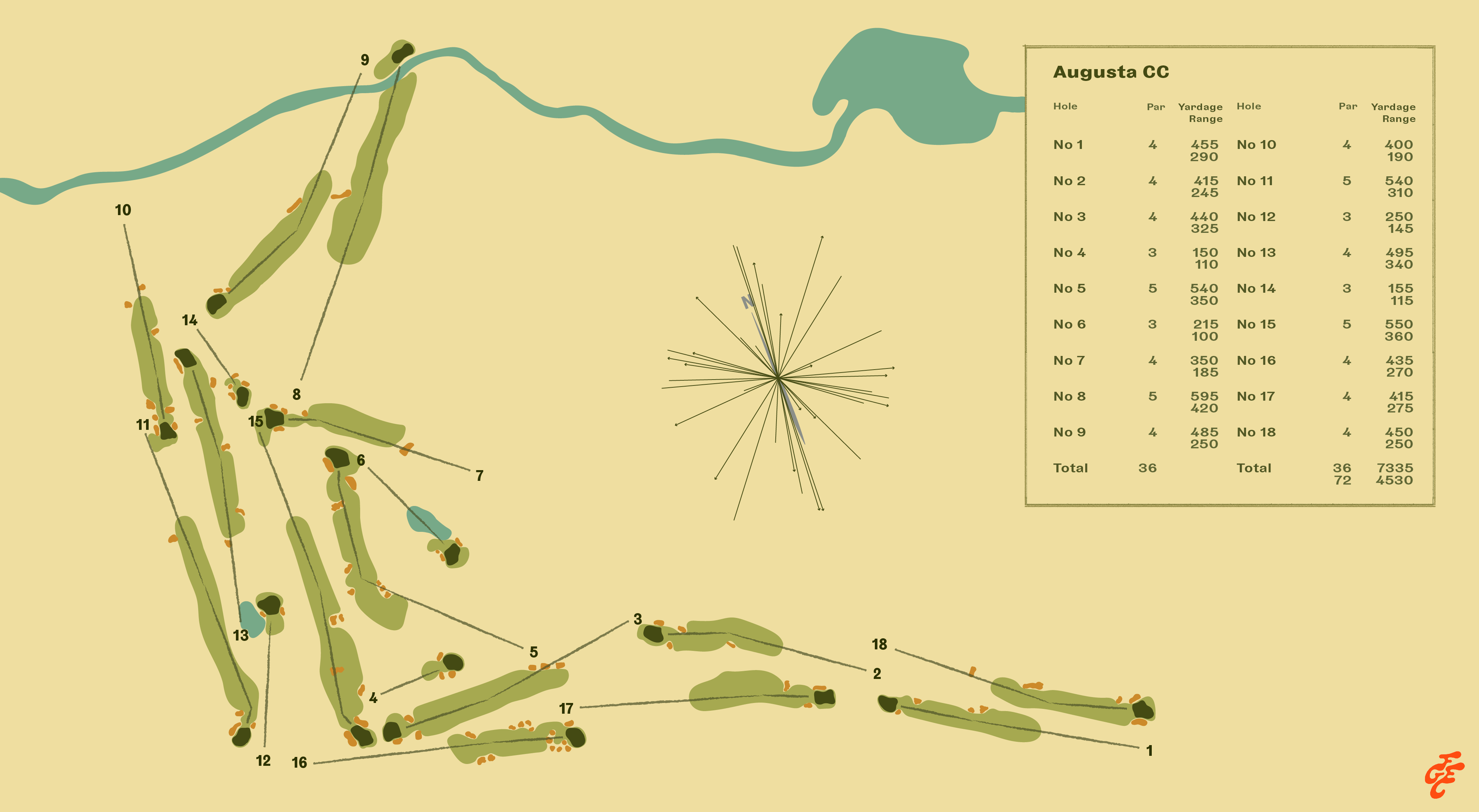
{{augusta-country-club-course-tour-01}}

Explore Related Content
Aronimink Golf Club

Mountain Ridge Country Club

Belleair Country Club (West Course)

Mid Pines Golf Club

Scioto Country Club

Interlachen Country Club
Get full access to exclusive benefits from Fried Egg Golf
- Member-only content
- Community discussions forums
- Member-only experiences and early access to events