Crooked Stick Golf Club
There’s architecture from Pete Dye’s earliest days as a designer to his very last at Crooked Stick, nearly 50 years of trial, error, and evolution from one of golf’s best designers

House of Dye | The Story of Crooked Stick Golf Club

After competing in the 1963 British Amateur at the Old Course, Pete and Alice Dye toured all over Scotland, visiting over 30 courses and gaining inspiration for their own club outside Indianapolis. Crooked Stick represents the sole golf course that the couple designed and built for themselves. There wasn’t a client asking for an island green or to punish the best players in the world. This was their home and their brainchild. Over time, the course became Pete Dye's personal playground, where he would constantly tinker with new concepts. Between a dramatic overhaul for the 1991 PGA Championship and Pete’s obsession with working out new ideas, Crooked Stick was constantly evolving to suit championship needs and agronomic advances, even until Pete’s and Alice’s last days.
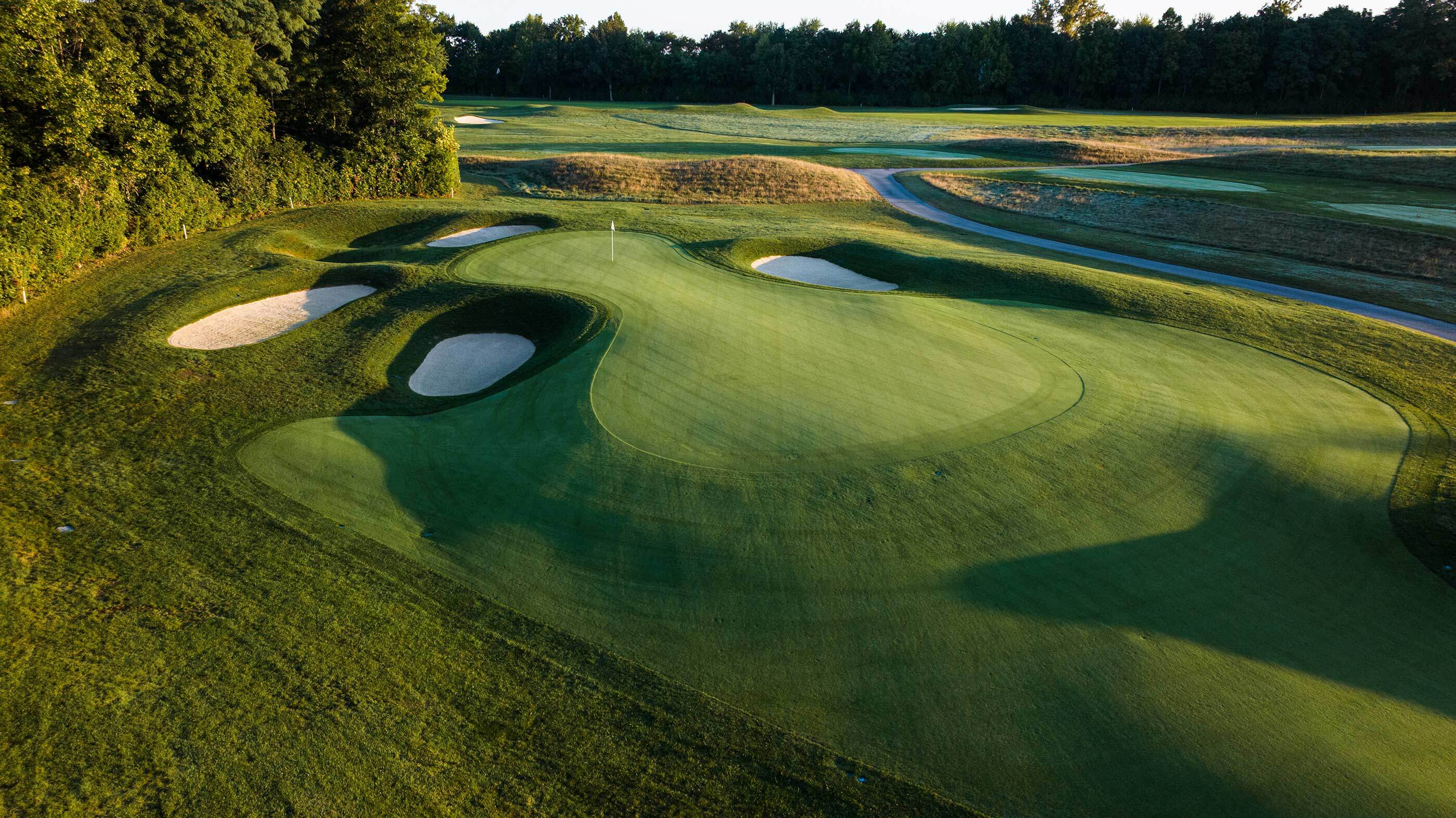
The gentle, farmland terrain gives the golf course at Crooked Stick an unassuming appearance upon first glance, but the design remains quite eccentric. Pete borrowed hole concepts and ideas from the greats like Alister MacKenzie, A.W. Tillinghast, Donald Ross, Perry Maxwell, and William B. Langford, creating a conglomeration of styles and appearances across the course. Each hole has a refined and distinct identity because of this, which makes for a captivating 18-hole quest. You’ll find tried and true Dye classics like S-curving fairways, quirky bunkering, and water features, but in a much quieter and more sophisticated manner than, say, TPC Sawgrass or the Ocean Course.
Most recently in 2024, consulting architect Tom Doak, alongside Eric Iverson, led a restoration project to rebuild the greens, update outdated infrastructure, and recapture some lost features.
Take Note…
Reject Material. Reilly Tar & Chemical Corporation dumped loads of its reject railroad ties and telephone poles on site for the Dye to use in the construction of the golf course. This was all thanks to P.C. Reilly, a founding member, gifting the material to Pete so he could mimic the embankments he recently saw in Scotland. Pete would then truck the extra material to the Golf Club in Ohio to use there, as well.
The Stick. Originally, the club was to be called the Golf Club of Indianapolis, but this all changed when Pete and co-director Bill Wick walked the site in the fall of 1964. When Pete stumbled upon a fallen tree branch that resembled a golf club, he started whacking rocks around in the dirt. The two joked that this was probably how the game originated. Shortly after, Wick wrote an essay describing the name of the club to present to the membership, and Crooked Stick was ratified in the Spring of 1965.
{{crooked-stick-about-gallery}}
All quotes in this profile come from the book “Crooked Stick Golf Club” by Chris Wirthwein.
.jpg)
Favorite Hole
No. 12, par 4, 423 yards
“Pete and I both admired the architecture. We wanted 12 at Crooked Stick to look like the fifth at Maxinkuckee Country Club. We liked the way it just dropped off to nothing behind the green. We intended it to be a replica of the fifth green at Maxinkuckee.” –Alice Dye
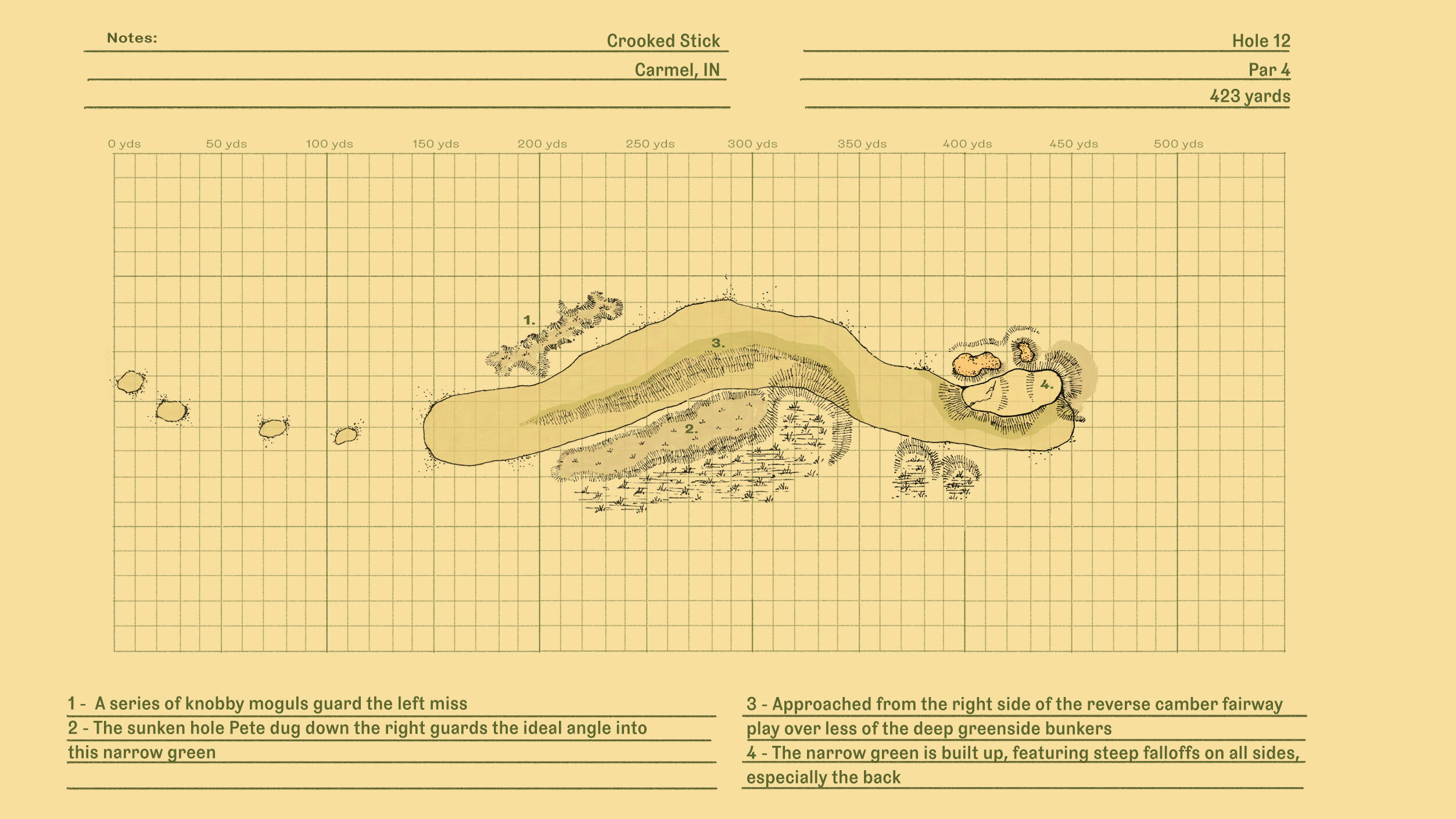
The 12th is not only a splendid golf hole but also symbolic of many things at Crooked Stick. Pete knew he wanted to get to the corner where 13 sits, so the 12th inevitably follows the boundary line towards that corner. He needed to create separation from the 11th, so he decided to build a large hill to create a right-to-left banking fairway. He quickly realized they didn’t have enough dirt to create his vision properly until an uneducated construction worker making $2 a day suggested “...put a hole in the middle of it,” in response to Dye’s confounded mutter. Problem solved.
A massive hole to the right of the 12th fairway generated enough dirt to create the banking that Pete wanted, and in turn fortified No. 12’s design strategy. Hugging the sunken pit gives players the best angle into the narrow green and negates a forced carry over greenside bunkers. Additionally, it favors a fade off the tee and draw into the green.
The last piece of the puzzle was the green, and that’s where Pete turned to Langford and Moreau for inspiration.
Favorite Hole
No. 12, par 4, 423 yards
“Pete and I both admired the architecture. We wanted 12 at Crooked Stick to look like the fifth at Maxinkuckee Country Club. We liked the way it just dropped off to nothing behind the green. We intended it to be a replica of the fifth green at Maxinkuckee.” –Alice Dye
The 12th is not only a splendid golf hole but also symbolic of many things at Crooked Stick. Pete knew he wanted to get to the corner where 13 sits, so the 12th inevitably follows the boundary line towards that corner. He needed to create separation from the 11th, so he decided to build a large hill to create a right-to-left banking fairway. He quickly realized they didn’t have enough dirt to create his vision properly until an uneducated construction worker making $2 a day suggested “...put a hole in the middle of it,” in response to Dye’s confounded mutter. Problem solved.
A massive hole to the right of the 12th fairway generated enough dirt to create the banking that Pete wanted, and in turn fortified No. 12’s design strategy. Hugging the sunken pit gives players the best angle into the narrow green and negates a forced carry over greenside bunkers. Additionally, it favors a fade off the tee and draw into the green.
The last piece of the puzzle was the green, and that’s where Pete turned to Langford and Moreau for inspiration.
{{crooked-stick-favorite-hole-12-gallery}}
Overall Thoughts
Many architects throughout history have made a home on one of their own designs. For Alister MacKenzie it was Pasatiempo. For Donald Ross, Pinehurst No. 2. For Pete and Alice Dye, it’s Crooked Stick.
What began as the Dye’s ideal version of a golf club gradually turned into something of a third child to them. Anytime Pete was back home at his house bordering the 18th fairway, he was on the golf course, chatting with members and their guests, tinkering with the design, or hitting balls on the driving range. Crooked Stick was everything to him and Alice, and the course design continues to harbor some of their earliest golf influences.
During the early 1960s when Pete’s design career began, he visited many of the great golf courses across the U.S. and Scotland. These courses had enough of an impact on him that he openly and directly borrowed from them and adapted the concepts at his own course. From 1964 to 1967, he pieced together his own Frankenstein-esque creation just outside of Indianapolis.
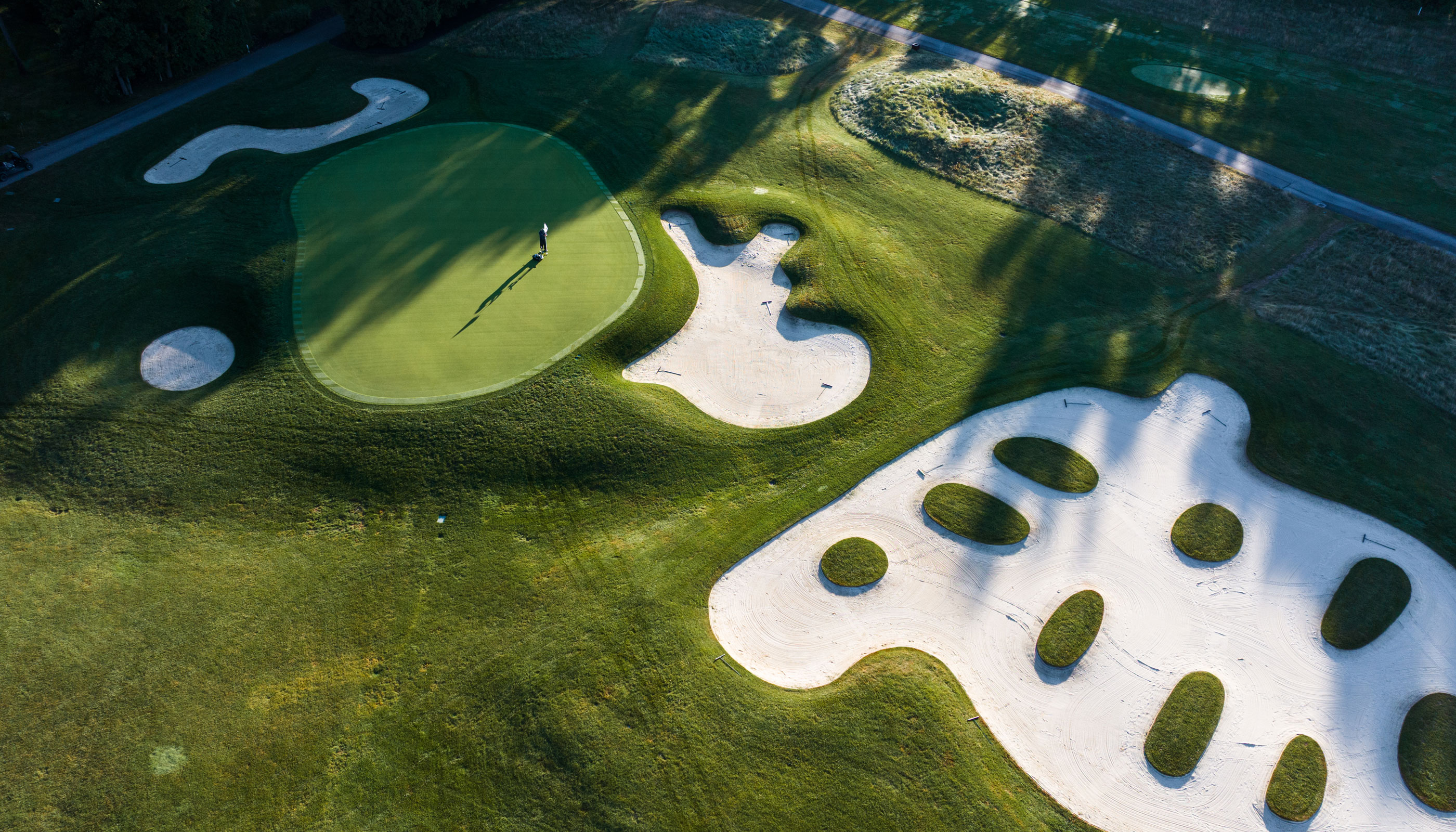
Construction of the back nine occurred about the same time that Pete was working on his Radrick Farms design for the University of Michigan, and he spent a lot of time at the university’s nearby MacKenzie-designed course that opened 30 years earlier in 1931. Pete was captivated by MacKenzie’s work, and much of Crooked Stick’s back nine draws inspiration from the Good Doctor. The most flamboyant aspect is the 60-yard-long 15th green, which was directly adopted from the boomerang sixth green at the University of Michigan. “I guess I was on kind of a MacKenzie kick at the time,” Pete said. Another stand-out feature includes the massive waste area in front of the 11th green. Pete modeled that bunker after Oakmont’s Church Pews, which he first saw when playing the 1959 Western Open. During the front nine construction, Pete had been traveling around to many Ross and Tillinghast courses, and the course shows it. Here’s a quick synopsis of all the documented inspiration behind much of Crooked Stick, with quotes from Pete Dye himself:
{{crooked-stick-inspirations-gallery}}
No. 1
The first green was inspired by Donald Ross.
“I’d just gotten back from Pinehurst.”
No. 2
The left-to-right approach, right greenside bunker, and tilted green were all inspired by Ross.
“I saw a lot of Donald Ross courses do that — which tells you why his courses are difficult to play.”
No. 3
I personally see a strong resemblance to No. 17 at Pebble Beach, but this green was inspired by Dye himself! It also originally featured sod-wall pot bunkers he saw in Scotland.
{{crooked-stick-no-3-quote}}
No. 4
The fourth green was inspired by the Biarritz template.
“I saw that golf hole in a book.”
No. 5
The fifth green features a Seth Raynor-inspired deep, grass-faced bunker left of the green.
No. 6
The sixth uses railroad ties as an embankment.
“I was always impressed with Old Prestwick. They had railroad ties in the banks that they used to stop the erosion … ”

No. 8
The steep, back-to-front green tilt was inspired by Ross.
No. 9
The ninth green was inspired by Ross.
“An old, Ross-styled green — similar to a lot of his.”

No. 10
The 10th boasts a MacKenzie-styled green.
“I was thinking strictly of MacKenzie’s work when I built the 10th green.”
No. 13
The 13th is also a MacKenzie-styled green.
“Thirteen is a dead replica of a MacKenzie at University of Michigan. Until there, I’d never seen a green that went away from you like that.”
No. 14
The 14th features a MacKenzie/Maxwell-styled green.
{{crooked-stick-no-14-quote}}
No. 18
The rumpled fairway is similar to what you’d see on a Scottish links course.
“All the rolls and contours they have over there — they’re completely natural … I saw those rumpled fairways in my mind, and that’s how 18 got created.”
While the notion of an architect borrowing concepts and features from courses they admire isn’t some groundbreaking idea, it is one of the only instances where Pete had full freedom to adapt and create what he wanted in a golf course. This is extremely noteworthy because it sets Crooked Stick apart from the “Pete Dye style” that so many golfers have grown accustomed to. While some of these original inspirations have been altered, modified, or softened over the years, a lot of the bones are still there today. You just have to search for them. Crooked Stick isn’t as flashy on the surface as Whistling Straits, or nearly as dramatic a site as Teeth of the Dog, but it’s ingrained with intriguing architecture. There’s architecture from Dye’s earliest days as a designer to his very last. Nearly 50 years of trial, error, and evolution from one of golf’s most historic designers certainly has more than what meets the eye.
1 Egg
What Crooked Stick lacks in quality land it makes up for in its design. The Dyes were able to meticulously mold their cornfield canvas so well that each hole is memorable. The delightful walk and varied strategy leave you wanting more after the 18th, and for that, it gets an Egg.
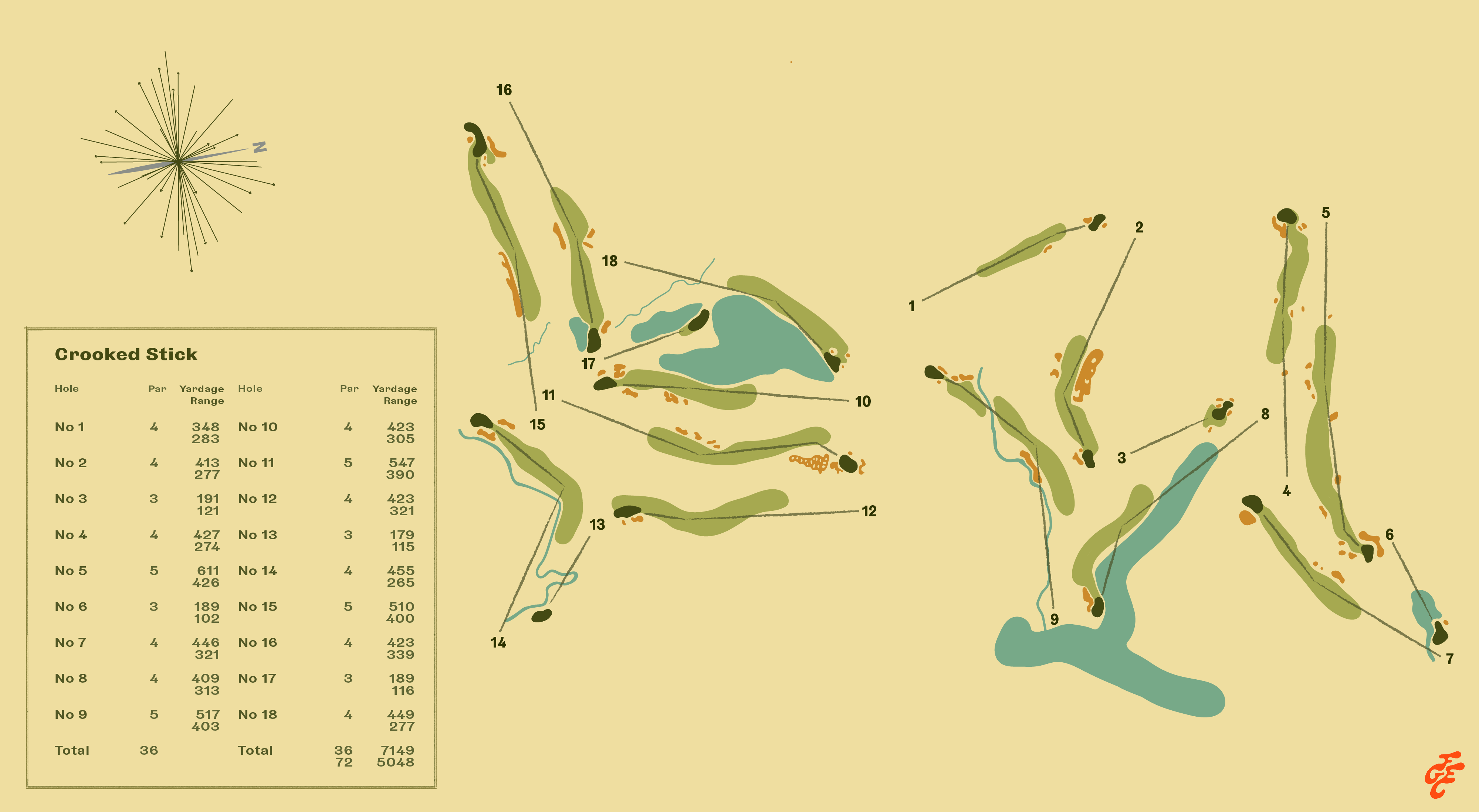
Course Tour
{{crooked-stick-course-tour-01}}

Explore Related Content
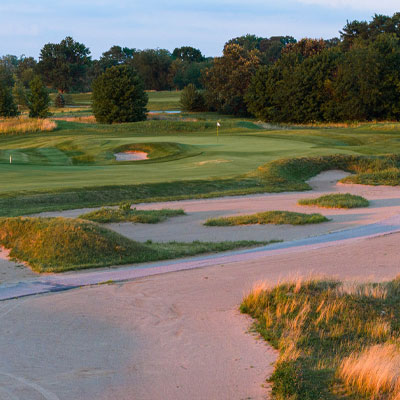
Birck Boilermaker Golf Complex (Kampen-Cosler Course)
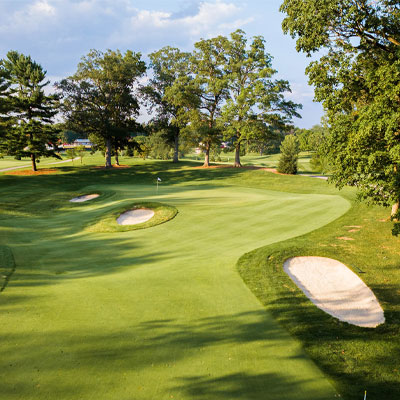
Birck Boilermaker Golf Complex (Ackerman-Allen Course)
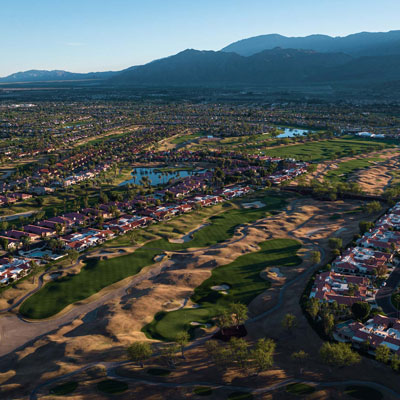
Pete Dye Stadium Course at PGA West

Brickyard Crossing
.jpeg)
Whistling Straits (Straits Course)

Harbour Town Golf Links
Get full access to exclusive benefits from Fried Egg Golf
- Member-only content
- Community discussions forums
- Member-only experiences and early access to events