Lookout Mountain Golf Club
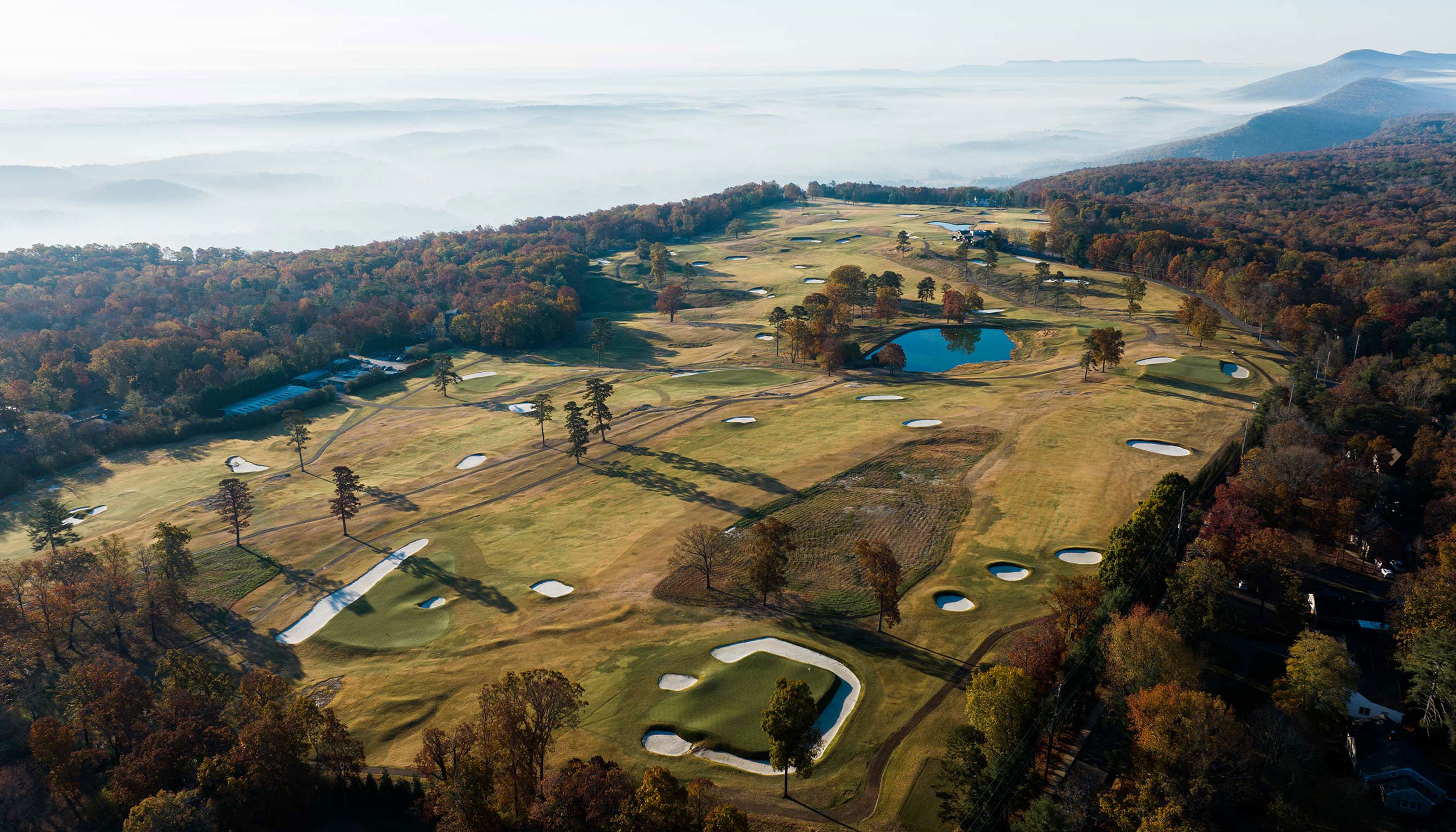
Truly golf on a mountain, there’s no shortage of classic templates in grand scale at Lookout Mountain, one of Seth Raynor’s most bold and daring courses.

Lookout Mountain, Georgia, USA
Seth Raynor (original design,1927)
Private


Discovering template golf: Lookout Mountain

Originally founded as the Fairyland Club, the golf course at Lookout Mountain Club was built as part of a grand resort community atop Lookout Mountain on the Tennessee-Georgia border. Local and longtime member Doug Stein would describe the origin story as “nothing but a series of catastrophes.” Legendary architect Seth Raynor died shortly after drawing the plans, solid granite rock caused an arduous and expensive construction period, and the grass seed and topsoil hauled atop the mountain washed away several times before completion. Raynor’s tenured protege completed the course on his behalf, but the design was never fully realized to what Raynor had envisioned. Over the next 100 years, the course would slowly fade away to a shell of its original self, then gradually be reimagined and fully realized to the 1925 Raynor drawing that never made it into the ground. Stein’s drive and passion for the golf course – alongside King Oehmig, Brian Silva, Gil Hanse, Tyler Rae, and Kyle Franz – eventually completed the course that never was.
Lookout Mountain truly is golf on a mountain. Heavily tilting slopes, undulating terrain, and massive, bold features define the course. Long views of adjacent mountains and multiple states dominate the horizon, as does the occasional cloud rolling through. There’s no shortage of classic Macdonald-Raynor templates in grand scale, including the Bottle, Biarritz, Short, Cape, Alps, Redan, Road, Eden, Double Plateau, and Maiden. Recent tree clearing has opened up long views across the entire golf course, showing off the severity of the landforms. Lookout Mountain is certainly one of Raynor’s most bold and daring golf courses.
Take note…
Lost in Fairyland. In the mid-1990s, the club came across a replica of Raynor’s original plan drawing, which was thought to have been lost. Through some clever sleuthing, Doug Stein located the original at the Edward E. Betts Engineering office, which helped produce the land survey for Raynor 70 years prior. This extremely detailed drawing was six feet wide by four feet tall.
Boulder Tee. At the par-3 sixth, players will begin the shortest hole on the course by teeing off atop a gigantic boulder. A series of steps carved into the rock transports golfers to a small patch of turf 12 feet high, providing a one-of-a-kind experience.
{{lookout-mountain-about-gallery}}
Favorite Hole
No. 3, Par 4, 382 yards, “Bottle”
While there are plenty more eye-catching holes than the third, the narrowing driving zone and perched green site make for a delightful test. The sectioned green sorts shots into distinct areas while also tilting away slightly in the rear. I would describe the approach shot as a mid-range jumper. Delicacy and touch are needed to get the ball close on this exciting putting surface.
{{lookout-mountain-favorite-hole-3-gallery}}
Favorite Hole
No. 3, Par 4, 382 yards, “Bottle”
While there are plenty more eye-catching holes than the third, the narrowing driving zone and perched green site make for a delightful test. The sectioned green sorts shots into distinct areas while also tilting away slightly in the rear. I would describe the approach shot as a mid-range jumper. Delicacy and touch are needed to get the ball close on this exciting putting surface.
{{lookout-mountain-favorite-hole-3-gallery}}
Overall Thoughts
Lookout Mountain is unlike any other Raynor golf course in that it was never truly finished. The tees, fairways, and greens were placed in the locations he desired, but the entire bunker scheme was withheld due to the immense cost of construction. Over $400,000 was spent to haul railcars full of topsoil up the mountain and construct the bunkerless golf course. This made it the second most expensive golf course built to date, behind Yale’s course.
For most of its life, Lookout Mountain was behind the eight ball. It was unfinished and continued to wear away over the years. Greens shrunk, trees became overgrown, and improvements were seldom made. When Stein entered the picture in the mid-90s, a long-term plan was set in place by Brian Silva, who slowly but surely chipped away at the bedrock and inched closer to Raynor’s vision. By the early 2000s, up-and-coming architect Gil Hanse would carry on with a revised plan. The unexpected golf boom of the 2020s ushered in the desire to finally overhaul the course and fully realize the unfinished design in one fell swoop.
Today, the act of golf course restoration typically revolves around studying detailed images of what the golf course looked like long ago. Talented golf architects and shapers then attempt to rebuild what once was, as best as they can. But what if what once was, was never actually there? It leaves a lot up for interpretation and forces those rebuilding the golf course to put themselves in the shoes of Seth Raynor and Charles Banks. By visiting several existing Raynor courses, the design team was equipped with bountiful examples of Raynor’s unique stylistic work and went all in at Lookout Mountain.
The work from Rae, Franz, and associate Ben Warren instantly revitalized the design and paired the scale of the property with the golf course and its features. A new life was injected into the land with all of Raynor’s intended bunkers added. The course had finally reached its potential and did so in a striking manner. Expansive greens now boast extreme slopes, pronounced ridges, and deep channels. The shaping of the putting surfaces is adventurous to put it lightly and depicts some of the most audacious Raynor templates you’ll find. Lookout Mountain is unforgettable, but is it one of Raynor’s best?
Anyone who traverses this mountainous design is sure to be thrilled by the many instances of heroism and memorability. No golf shot is off the table here because the severity of the land dictates it. Slinging draws, delicate wedge shots, daring putts, and oodles of time spent watching the ball dance along steep slopes will make their way into your round. While several of the holes are quite spectacular, it’s evident that some concessions were made to accommodate the rocky terrain. There’s less refinement and cohesion to the design compared to many of Raynor’s previous works and lauded designs. Lookout lacks the elegance of courses like Chicago Golf Club and Shoreacres, which feel melded into the landscape rather than built atop it. One can reasonably attribute this to Raynor having no hand in the construction of the course. Additionally, after the first two holes, much of the round consists of uphill climbs, making for a strenuous but achievable walk. Could Raynor have routed the course better? I’m not sure one could make that claim. Could Rae and Franz’s teams have done more with what they were given? Perhaps not.
Lookout Mountain is remarkable in many ways, but not complete enough to be categorized as truly great. While the site isn’t ideal for golf, it has a lot going for it, but it doesn’t overcome the inherent pitfalls. The immense effort to finally bring Raynor’s design to fruition should be praised because the course is greatly improved and entertaining to play.
0 Eggs
You should never turn down the opportunity to play Lookout Mountain. Its audacious design is a sight to behold, but the severe land and poor soils hold back the design and presentation. Perhaps the site itself has always been what’s hindered its greatness, but that exact thing is also what makes it so memorable.
Course Tour

{{lookout-mountain-course-tour-01}}
Play Lookout Mountain
One of the most unique experiences in golf, Lookout Mountain Club plays host to a Fried Egg Golf Event on May 18, 2026. With additional playing opportunities at Black Creek Club and The Course at Sewanee, this is a spring kick off you won't want to miss. DETAILS AND REGISTRATION

Explore Related Content
Brookville Country Club
Piping Rock Club
Westhampton Country Club

Fishers Island Club

Mountain Lake
Shinnecock Hills Golf Club
Discovering template golf: Lookout Mountain
Get full access to exclusive benefits from Fried Egg Golf
- Member-only content
- Community discussions forums
- Member-only experiences and early access to events