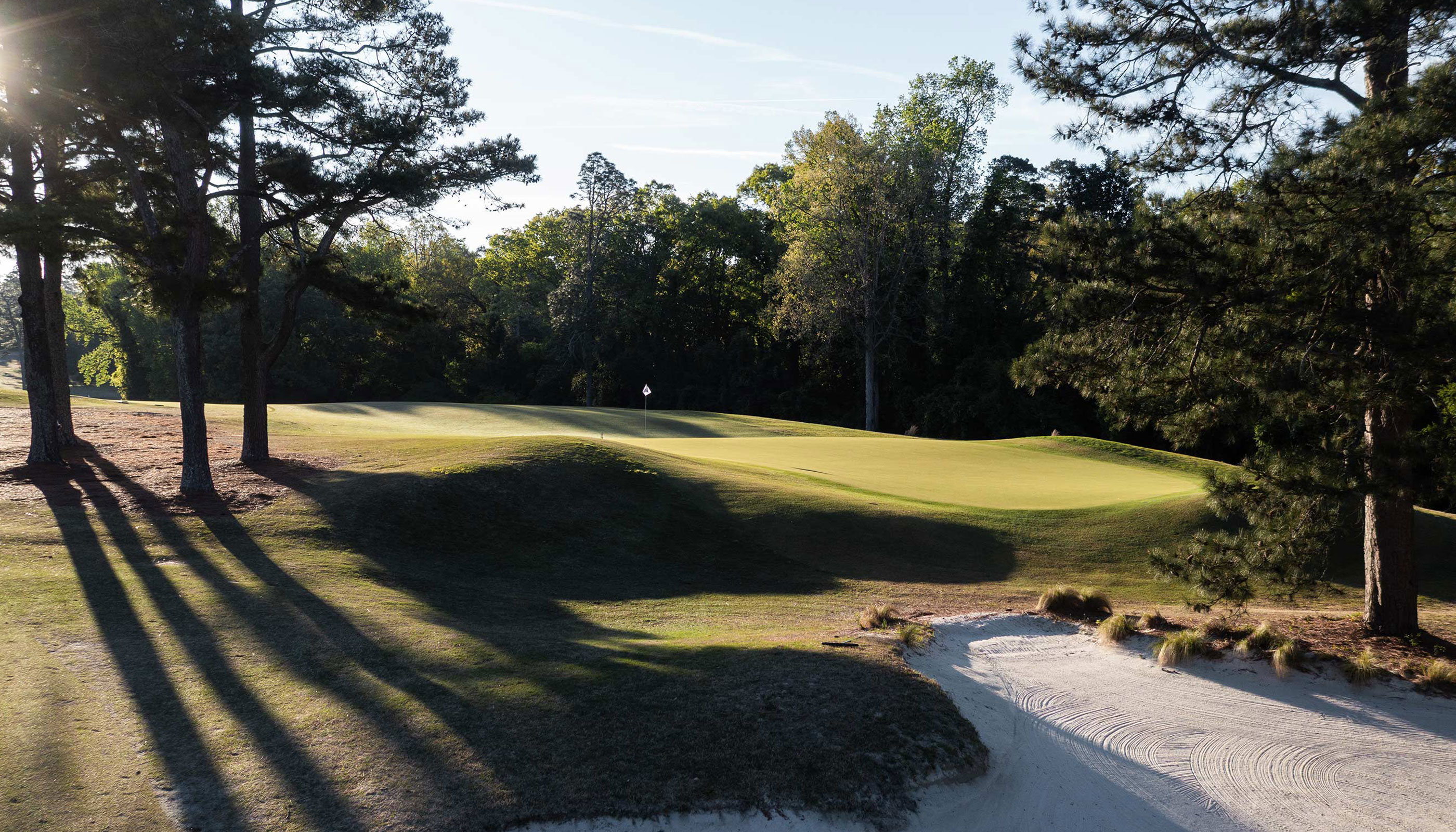
Palmetto Golf Club
With its Golden Age-inflected design, simple but well-tuned maintenance, and relaxed atmosphere, Palmetto offers one of the Southeast's most enjoyable days of golf.

Aiken, South Carolina, USA
Herbert Leeds and Thomas Hitchcock (original nine-hole design, 1892); Herbert Leeds and James Mackrell (expansion to 18 holes, 1895); Alister MacKenzie (bunker and greens renovation, 1932)
Private

Forty minutes from Augusta National, Palmetto Golf Club originated the now-robust golf culture of Aiken, South Carolina. It also established the business model that many clubs in the area have since followed: attracting wealthy northeasterners in search of a warm winter retreat. Palmetto dates back to 1892, when founder Thomas Hitchcock laid out the first four holes. Herbert Leeds, the architect behind Myopia Hunt Club in Boston, completed the initial nine. Leeds returned in 1895 to help golf professional James Mackrell expand the course to 18 holes.
The club is rightfully proud of its architectural pedigree. Donald Ross is thought to have visited in 1928 to install irrigation; Alister MacKenzie drew up plans to convert sand greens to grass, re-bunker the course, and add length in 1932, while simultaneously designing Augusta National; Rees Jones advised on bunker renovations in the late 1980s; Tom Doak made recommendations in the early 2000s for restoring some of MacKenzie's features; and Gil Hanse currently serves as consulting architect. With its Golden Age-inflected design, simple but well-tuned maintenance, and relaxed atmosphere, Palmetto offers one of the Southeast's most enjoyable days of golf.
Take Note…
Another tradition unlike any other. During the week of the Masters, Palmetto Golf Club opens its doors for limited public play. The green fee is hefty (approximately $400, as of 2025) but not unreasonable given the quality of the course and the club experience.
Sticks. Palmetto has long been a favorite tune-up course for Masters competitors. Ben Hogan was a devoted fan; he listed Nos. 5, 7, and 13 among his 18 favorite holes for Golf World magazine, and he is said to have referred to Nos. 3-5 as the best back-to-back-to-back par 4s he ever played. Today, PGA Tour pro Kevin Kisner has a house just off the 17th fairway. Kisner is back in the club’s good graces after serving a brief suspension for starring in a raucous Vice Sports video filmed on the property in 2016.
The Aiken circuit. If you visit Palmetto on Masters week, I would recommend adding rounds at the Aiken Golf Club (public, affordable, and tucked into the city’s downtown district) and Old Barnwell (private but available to non-members for a premium in early April). The Tree Farm is another terrific option, albeit pricier. And keep an eye out for new Aiken County course openings in the near future. New Holland Golf Club, 21 Golf Club, and Old Barnwell’s second 18-hole course, The Gilroy, will soon come online.
{{palmetto-golf-club-about-gallery}}
Favorite Hole
No. 4, par 4, 388 yards
This mid-length par 4 sits elegantly on the land: from the tee, the hole works downhill and across a left-to-right slope before turning subtly left, in reverse camber, as it climbs to a green benched into a rise. This strategic geometry rewards players who resist the terrain. Drives that hold the high left side of the fairway open up the most direct look at the angled green. Let the ball drift toward the outside of the dogleg, though, and the approach becomes semi-blind, with a forced carry over a large hollow that guards the front-right corner of the putting surface. The lone fairway bunker is perfectly positioned. If you were to remove it, longer hitters chasing the ideal angle would aim for exactly that spot. In typical Palmetto fashion, the green’s short-grass surrounds are intricately shaped, creating a range of short-game possibilities.
The fourth at Palmetto provides a lesson in restrained golf architecture, generating ample interest with just one bunker, a natural slope, and a skillfully contoured green complex.
Favorite Hole
No. 4, par 4, 388 yards
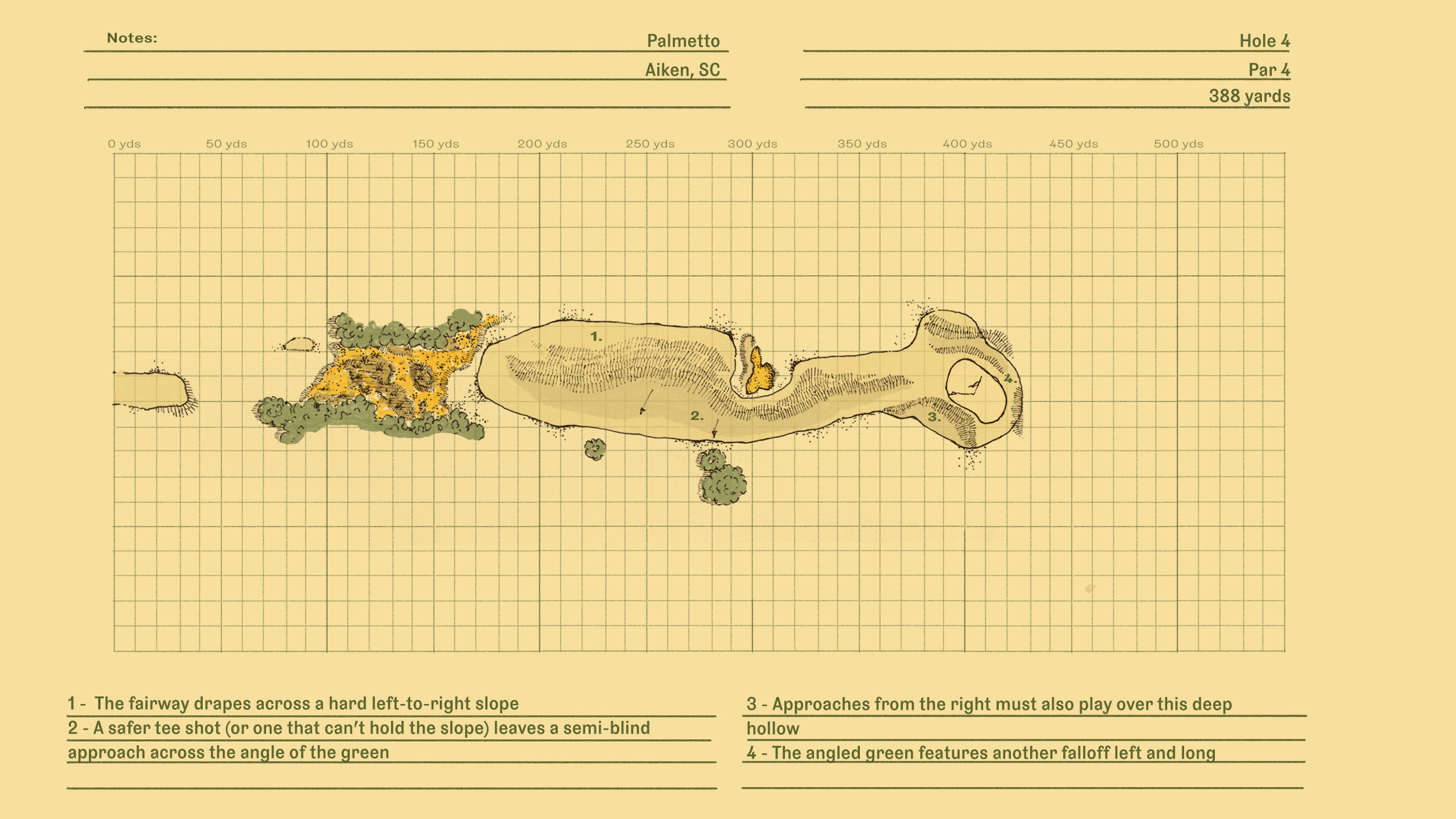
This mid-length par 4 sits elegantly on the land: from the tee, the hole works downhill and across a left-to-right slope before turning subtly left, in reverse camber, as it climbs to a green benched into a rise. This strategic geometry rewards players who resist the terrain. Drives that hold the high left side of the fairway open up the most direct look at the angled green. Let the ball drift toward the outside of the dogleg, though, and the approach becomes semi-blind, with a forced carry over a large hollow that guards the front-right corner of the putting surface. The lone fairway bunker is perfectly positioned. If you were to remove it, longer hitters chasing the ideal angle would aim for exactly that spot. In typical Palmetto fashion, the green’s short-grass surrounds are intricately shaped, creating a range of short-game possibilities.
The fourth at Palmetto provides a lesson in restrained golf architecture, generating ample interest with just one bunker, a natural slope, and a skillfully contoured green complex.
{{palmetto-golf-club-favorite-hole-4-gallery}}
Overall Thoughts
Lately I’ve been thinking about how the concept of “design language” pertains to golf architecture. The term comes from the world of branding, where it refers to the visual system that defines a brand's personality. Certain watch brands, for instance, have ultra-recognizable design languages — Rolex with its sporty Oyster cases and “cyclops” date-window lenses; Nomos with its minimalist, Bauhaus-influenced dials. Each Rolex and Nomos watch operates within an idiom that the brand has developed over time.
I’ve realized recently that the best sets of greens are similar: they express a coherent, distinctive architectural vocabulary.
Take Palmetto Golf Club’s greens. What defines their design language is not so much their internal contouring as their surrounds: the prominent mounds, spines, swales, and channels of closely mown turf that border almost every putting surface on the course. When you miss a green at Palmetto, you'll typically have to navigate one of these features on your next shot, and you’ll be able to use almost any club in the bag for the purpose, from putter to lob wedge to hybrid. Formal greenside bunkering is relatively sparse; the primary hazard is the combination of contour and short grass. Memorable examples include the sixth green, which is propped against the slope on the left with a pair of flanking mounds on the right, and the 11th, where a single knob eats into the back of the kidney-shaped putting surface, causing difficulties after long misses.
{{palmetto-golf-club-greens-gallery}}
Who deserves credit for these greens isn't entirely clear to me. While it's well-documented that Alister MacKenzie converted Palmetto’s 19th-century sand greens to grass in 1932, I don’t know how much he altered the originals.* But the answer is probably: quite a bit. Sand greens were usually flat and oval-shaped for ease of maintenance; Palmetto's current greens, on the other hand, have knobby shoulders, sharp tilts, and interior shelves. Indeed, they bear a family resemblance to what MacKenzie built in the early 1930s at Augusta National. I doubt that is a coincidence.
(*If anyone has more detailed information on this issue, let me know in the comments, and I'll update this paragraph.)
The routing, however, is not as accomplished as what MacKenzie might have produced on the same property. One trademark of MacKenzie’s routings — or any successful routing, really — is that the greens consistently occupy compelling natural landforms. At Palmetto, a number of greens sit on fairly nondescript ground. Since the property contains plenty of topographical variety, I have to assume that Herbert Leeds and his collaborators missed a few suitable green sites. Also, the three-hole finish on the west side of the clubhouse, a remnant of the club's original four-hole loop, feels cramped and cut off from the rest of the round.

Still, Palmetto’s routing succeeds in one important respect: finding outstanding natural holes. The fourth, sixth, eighth, and 12th use their terrain to especially striking effect. And on holes that occupy less inspiring land — such as the second and third — strategic bunkering and inventive green designs carry the day.
Much of Palmetto’s charm, though, should be credited to the club's careful stewardship over the past 25 years. Working with Tom Doak and Gil Hanse, the club has restored MacKenzie's naturalized bunkering and recaptured the scale of the fairways and greens. The agronomy matches these architectural nods to the past, with maintained turf at the center of the playing corridors fading into scruffy expanses of sand, scrub, and pine at the edges.
Many clubs in the Southeast strain toward Augusta National's wall-to-wall perfection. Palmetto does something more interesting: it shows what the best golf courses in this region looked like before they went upscale.
2 Eggs
Palmetto shares many characteristics with Woking Golf Club: roots in the Victorian Era, a star-studded design lineage, a max yardage under 6,700, bold green architecture, a handful of world-class par 4s, refined but unfussy maintenance, a few clunky holes, a lived-in sense of place, a polite resistance to modernization, and an elegant yet unpretentious club culture.
Woking, as I indicated in my recent profile, is very much my cup of tea. So is Palmetto. I am actively biased in favor of this type of old-fashioned, subtle, quirky, sporty, play-it-every-day-and-never-get-bored golf course. Is two Eggs a little high? Perhaps. But I can’t bring myself to give it just one.
Course Tour
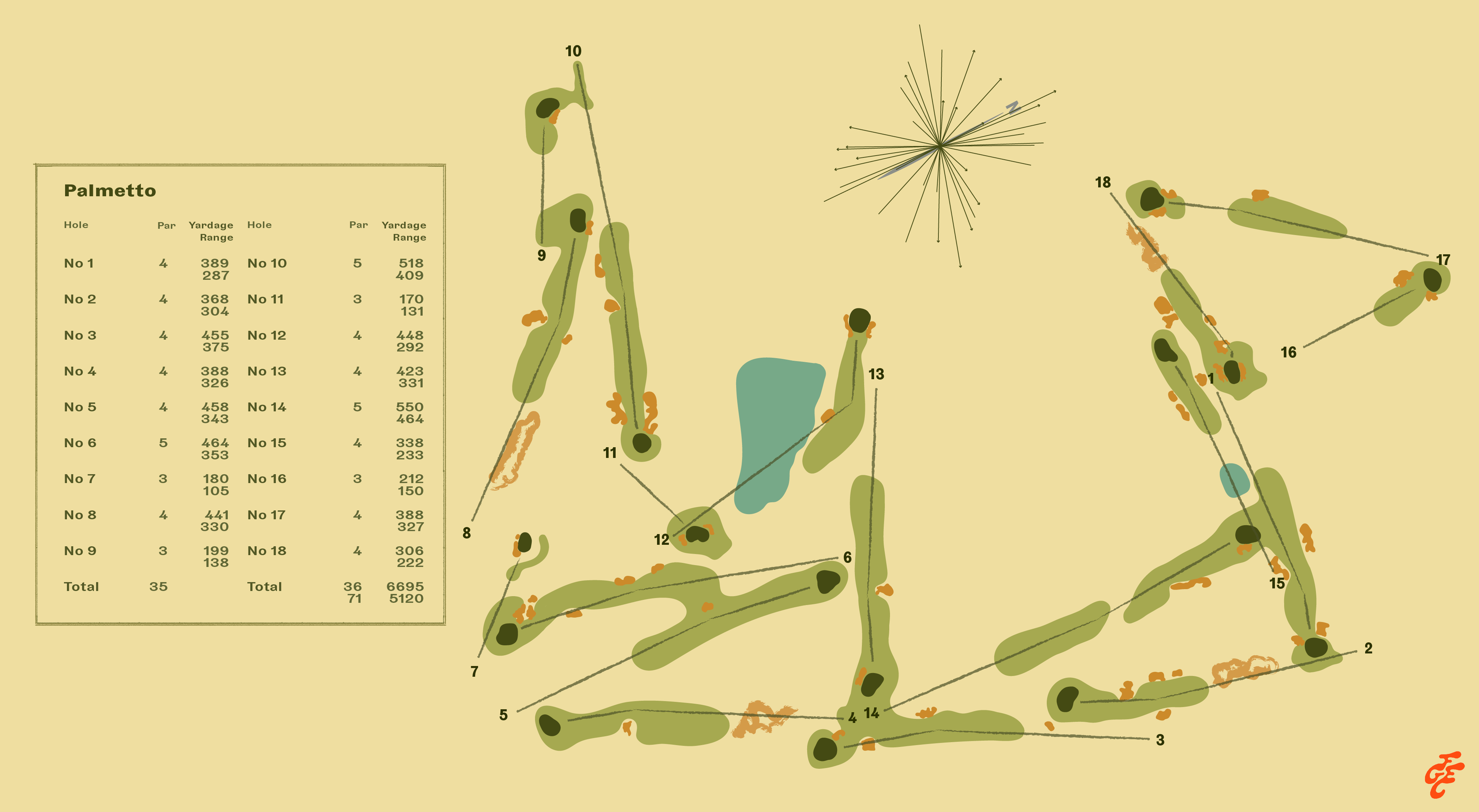
{{palmetto-golf-club-course-tour-01}}

Explore Related Content

Royal Melbourne (West Course)
Cypress Point Club

Pasatiempo Golf Club

Crystal Downs

Augusta National Golf Club

Victoria Golf Club (Australia)
Get full access to exclusive benefits from Fried Egg Golf
- Member-only content
- Community discussions forums
- Member-only experiences and early access to events