Woking Golf Club
Established during the “Great English Golf Boom” of the late 1800s, Woking Golf Club went on to become the epicenter of the revolt against the “dark ages” of Victorian golf course design


The Bunker That Changed Golf: No. 4 at Woking

Golf Architecture 101: The Golden Age

Founded in 1893, Woking Golf Club was the first golf club to be established in the heathlands south and east of London, England. Later, Woking would be joined by the likes of Sunningdale, St. George’s Hill, Walton Heath, and Swinley Forest, forming one of the world’s greatest golf regions. Woking’s origins were humble, however. The club’s original 18 was designed by Tom Dunn, who laid out dozens of courses in England during the “Great English Golf Boom” of the 1880s and 90s. By the turn of the century, many British golfers had come to regard Dunn’s work as somewhat slapdash and rudimentary. One of these golfers was a Woking member named Stuart Paton. Over the next four decades, Paton — with the support of new-school luminaries like John Low, Bernard Darwin, and Tom Simpson — turned the course into a remarkable incubator for fresh architectural ideas. Because of Paton’s work, this obscure heathland club became the epicenter of the revolt against the “dark ages” of Victorian golf course design.
However, a golfer need not be aware of these historical matters to enjoy Woking. The course’s clever design and beautiful heathland terrain make for an engaging, rejuvenating round of golf.
Take Note…
Required reading. One of the finest pieces of 21st-century golf architecture writing is Bob Crosby’s article in Through the Green on Stuart Paton and John Low’s 1901 redesign of the fourth hole at Woking. Crosby argues that these changes introduced a radically new philosophy of golf course design, which ended up defining the ensuing “Golden Age.”
Golf and the railway. Like many 19th-century golf courses, Woking was built within reach of a train station. When Woking Common Station opened in May 1838, it was surrounded by uninhabited heathland. By the end of the century, it had become a bustling suburban hub, used by London professionals seeking escape from the discomforts and dangers of the city.
The neighbo(u)rhood. Woking is one of a trio of golf courses occupying Hook Heath, once intended to be the site of a massive national cemetery. The other courses are Worplesdon, designed in 1908 by J.F. Abercromby and Willie Park, Jr., and West Hill, designed in 1909 by Park and Jack White.
{{woking-about-gallery}}
Favorite Hole
No. 4, par 4, 352 yards
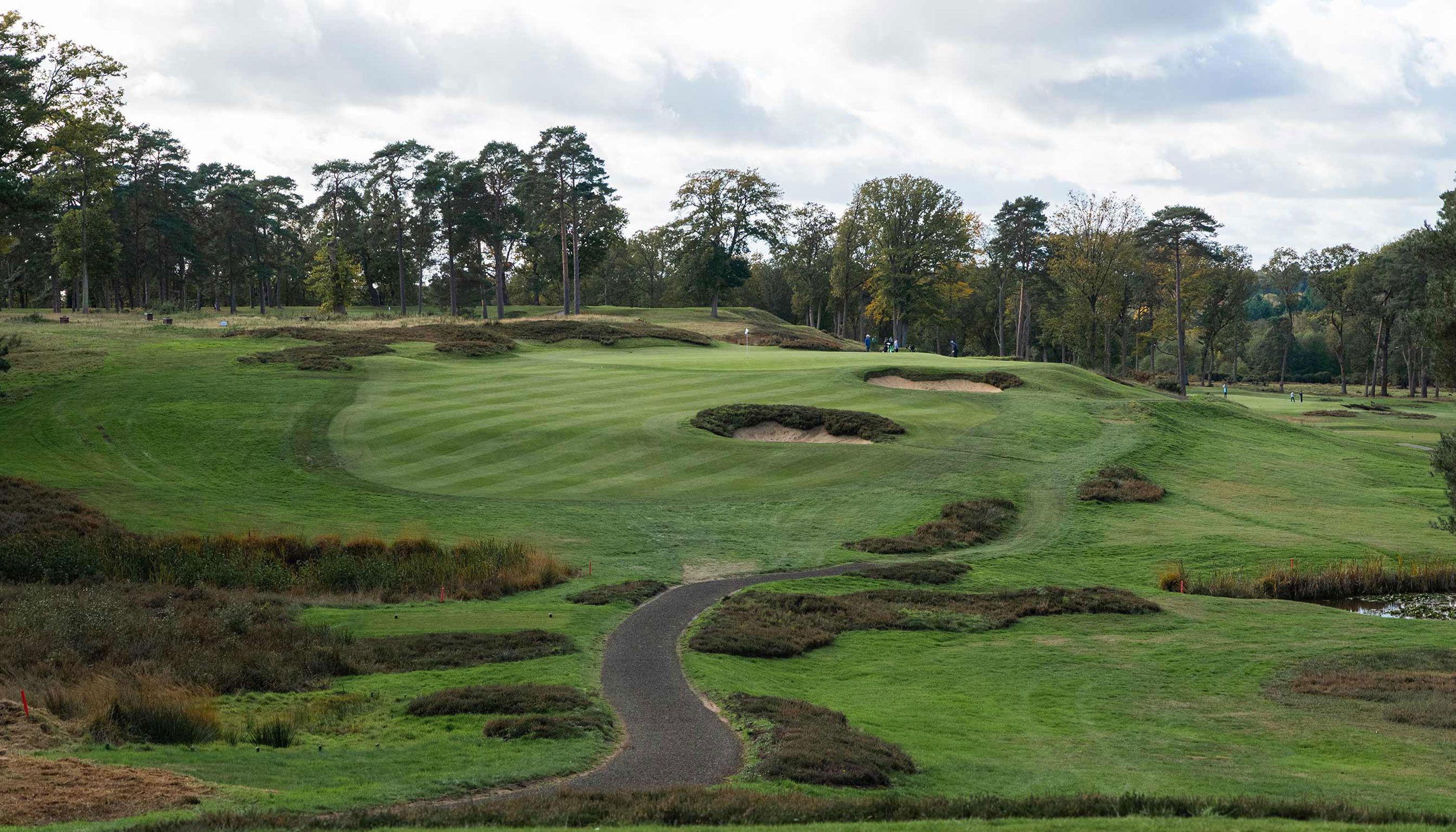
There are more beautiful holes at Woking than the fourth, such as the resplendent sixth and eighth. There are also several holes with more interesting greens: take your pick from the stretch of Nos. 12-15. But no other hole on the course matches the strategic tension of the fourth.
The story behind the design of No. 4 at Woking is famous. Initially, the hole was a straightforward par 4 right out of Tom Dunn’s playbook. The fairway was wide, bordered by heather on the left and by the London and Southampton Railway on the right. A single cross bunker guarded the front of the green.
In 1901, likely under the influence of ideas promoted by Woking resident John Low, Stuart Paton made two simple yet seismic changes to the hole: he dug a pair of bunkers into the middle of the fairway, and he replaced the cross bunker with a pair of small bunkers (now a single bunker) cut into the front-left corner of the green. The hole now resembled the 16th at St. Andrews. Players had to commit to a strategy from the tee: either place their tee shot between the "Principal's Nose" bunkers and the railroad for a clean look at the green, or play left, trading immediate safety for a difficult approach over the green-side bunkers.
The concept still works. Because of how severely the green pitches away from the front-left bunker and toward the back-right bunkers, even high-ball hitters will find themselves shaky-kneed over wedges from the left half of the fairway. The advantage of being on the right side is as unmistakable as the risk.
Favorite Hole
No. 4, par 4, 352 yards
There are more beautiful holes at Woking than the fourth, such as the resplendent sixth and eighth. There are also several holes with more interesting greens: just take your pick from the stretch of Nos. 12-15. But no other hole on the course matches the strategic tension that the fourth generates.
The story behind the design of No. 4 at Woking is famous. Initially, the hole was a straightforward par 4 right out of Tom Dunn’s playbook. The fairway was wide, bordered by heather on the left and the London and Southampton Railway on the right. A single cross bunker guarded the front of the green.
In 1901, likely under the influence of ideas promoted by Woking resident John Low, Stuart Paton made two simple yet seismic changes to the hole: he dug a pair of bunkers into the middle of the fairway, and he replaced the cross bunker with a pair of small bunkers (now a single bunker) cut into the front-left corner of the green. The hole now resembled the 16th at St. Andrews. Players had to commit to a strategy from the tee: either place their tee shot between the "Principal's Nose" bunkers and the railroad for a clean look at the green, or play left, trading immediate safety for a difficult approach over the green-side bunkers.
The concept still works. Because of how severely the green pitches away from the front-left bunker and toward the back-right bunkers, even high-ball hitters will find themselves shaky-kneed over wedges from the left half of the fairway. The advantage of being on the right side is as unmistakable as the risk.
{{woking-favorite-hole-4-gallery}}
Overall Thoughts
Recently, I spoke with the writer Geoff Shackelford about his novel system for evaluating golf courses, which he laid out in his 2023 book “Golf Architecture for Normal People.” After he plays a new course, he asks three questions, each represented by a letter:
R — Can you Remember something about each hole?
E — Could you play the course Every day and never tire of it?
D — Is this a course where you would gladly take a Dog for a walk?
I like that the “RED” system focuses on enduring pleasure rather than immediate excitement. Mainstream top-100 rankings tend to overrate traits that impress at first but don't tend to resonate on repeat visits: championship scale, glossy conditioning, photogenic fields of bunkers. It’s useful to remind ourselves that lasting enjoyment in golf usually comes from humbler sources.
Woking might not fare well in the rankings, but it is a killer “RED” course. Let’s go letter by letter:
R — Can you remember something about each hole?
A moderately attentive golfer won’t have trouble remembering every hole at Woking after playing the course once.
The routing finds excellent variety in the land. On the front nine, most of the holes either play into or off of a large ridge running northeast to southwest through the property. Each hole uses this dominant landform slightly differently. The back nine sits on top of the ridge, winding through the rolling heathland. Until Nos. 17 and 18, no two consecutive holes play in the same direction.
Woking's architecture balances subtlety and boldness. The holes are simple and unadorned but typically have one feature that sticks in the memory.
On the par-4 third hole, for example, the fairway is broad and un-bunkered, traveling along the base of the central ridge before turning right and climbing to the green. What golfers will remember, though, is the wonderfully inventive green complex. A heather-rimmed bunker sits front and center, concealing most of the putting surface. But savvy players will note a kicker slope feeding onto the green from the right. Any decently accurate low-trajectory approach will ride this slope around the bunker and toward the center of the green. It’s an outrageously fun shot.
{{woking-third-hole}}
E — Could you play the course every day and never tire of it?
Woking excels as an everyday course. It is eminently playable — with generous fairways and greens, and a maximum length of 6,606 yards — yet challenging and strategically sophisticated enough to retain the attention of a skilled golfer over many rounds. While the course may yield low scores, it doesn’t feel completely solvable. Players will want to go back over and over to try to hit the perfect running approach on the third hole, or figure out the right answer to the question posed by the center-line bunkers on the fourth, or find the right section of the double plateau 13th green, or keep their ball from skidding through the ferocious fallaway 17th green.
{{woking-everyday-course}}
The club is also the kind of place I wouldn’t mind visiting seven times a week. It’s elegant but not opulent, rooted in tradition but not stuffy.
D — Is this a course where you would gladly take a dog for a walk?
Woking’s varied topography, Goldilocks scale (not too big, not too small), mixture of wooded and open areas, and lived-in naturalness make it an ideal environment for a dog walk. During my round last October, I saw several residents with their four-legged companions, taking advantage of the walking trails that run along several of the holes. Heathland, like linksland, has been used for this purpose for centuries.

Woking couldn’t host a men’s major championship. It doesn’t pop on Instagram, and it will likely never be a darling of magazine rating panels. But Geoff Shackelford’s “RED” criteria help us see the course for what it is: a place where average golfers might actually enjoy themselves.
2 Eggs
Compared to fully realized heathland masterpieces like the Old and New courses at Sunningdale or the Red/Blue 18 at St. George’s Hill, Woking is a bit inconsistent. Some holes are slightly dull off the tee (1, 12, 15); others a touch too modernized (7, 9, 10, 16). But the highs are high, and the property — modestly but effectively maintained by the club’s staff, and recently opened up through tree removal — is ineffably charming. I’m giving it two Eggs for strengths across the categories of land, design, and presentation.
Course Tour
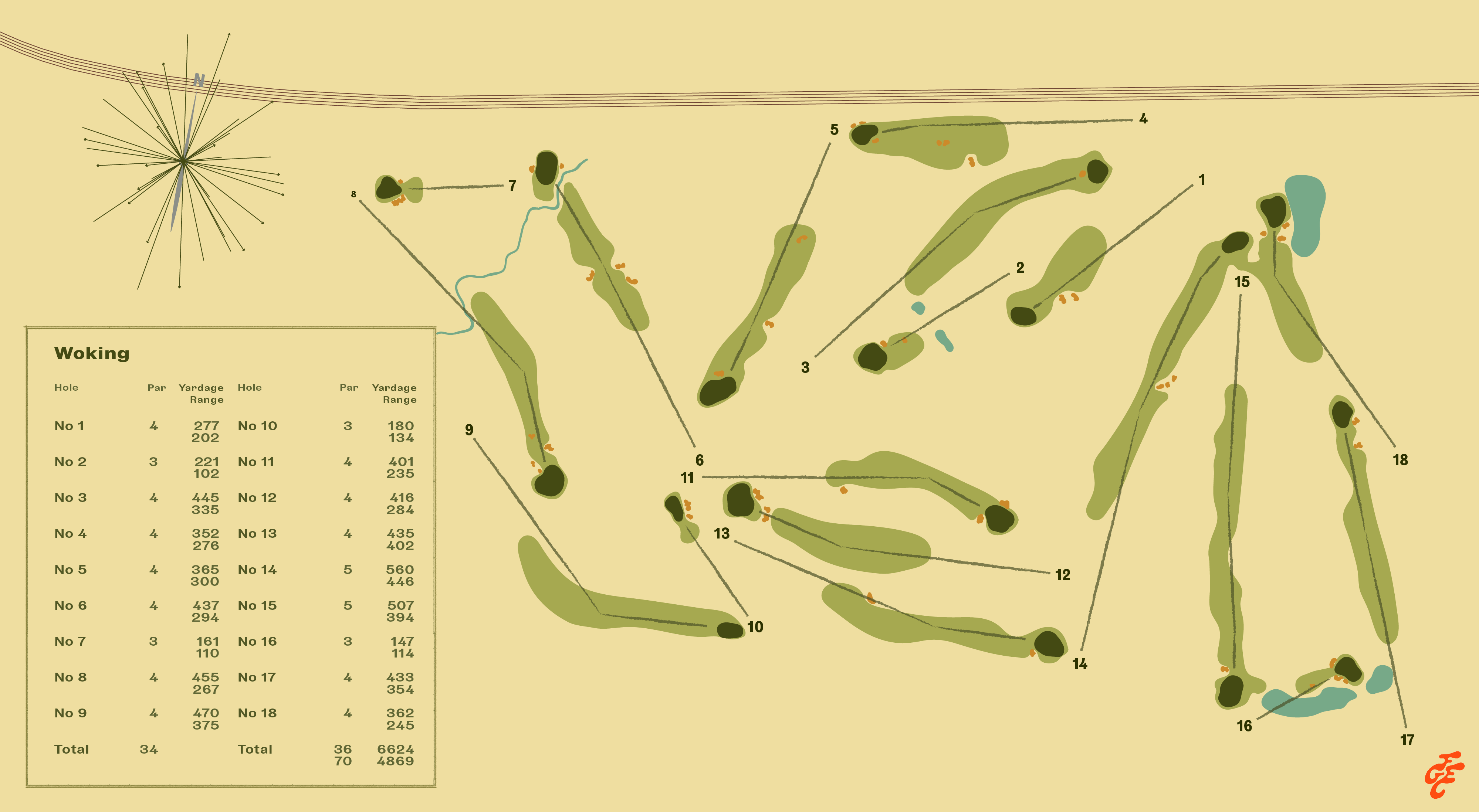
{{woking-course-tour-01}}
Additional Content
The Bunker That Changed Golf (Article)
Golf Architecture 101: Golden Age (Designing Golf Podcast)
Robert Crosby on the Influence of John Low (Fried Egg Golf Podcast)

Explore Related Content
The Bunker That Changed Golf: No. 4 at Woking
Get full access to exclusive benefits from Fried Egg Golf
- Member-only content
- Community discussions forums
- Member-only experiences and early access to events