
East Potomac FAQs: What's Happening, What's Next, and Who Will Pay?
All the latest news after recent court hearings on the future of the D.C. muni


Over the past two weeks, the battle over East Potomac Golf Links in Washington, D.C., has exploded into a national news story. It has received coverage in the Washington Post, the New York Times, and the Wall Street Journal. It has become fodder for the culture wars on social media. And, of course, it has been one of the primary subjects of President Donald Trump’s own prolific posting.
Not long ago, Fried Egg Golf was the only media outlet that seemed interested in East Potomac’s century-old, National Park Service-owned golf courses. Ah, 2019.
Anyway, now that the drama has reached a much larger audience, I figure it’s time for an explainer. I’ll answer some questions I’ve gotten over the past several days, along with a few that I’ll just ask myself for the sake of convenience. You know how this genre of article works.
I’m confused. What’s the backstory here?
So glad you asked this question! Gives me a chance to do some exposition.
This imbroglio has been ramping up for about 15 months. In August 2025, officials at the Department of the Interior (DOI), including Secretary Doug Burgum, first pitched President Trump on the notion of transforming East Potomac, a bustling municipal golf facility on a manmade island in the Potomac River, into an upscale championship venue. Soon the DOI moved to unseat East Potomac’s nonprofit operator, the National Links Trust (NLT), from its 50-year lease.
The NLT — which still manages D.C.’s other two federal golf properties, Rock Creek Park and Langston — had planned to restore East Potomac’s original Walter Travis design while retaining the facility’s affordability and 36-hole golf offering. However, after starting its lease in late 2020, the NLT ran into regulatory hurdles and fell behind schedule on its projects. The government, citing these delays (which the government itself had helped create), voided the NLT’s contract in December 2025.
For the first several months of 2026, the NLT continued to operate East Potomac on an interim basis while the DOI worked with golf architect Tom Fazio on renovation plans. Workers for the National Park Service (NPS) slowly removed diseased and invasive trees from the property. Meanwhile, local pushback grew. In February, the D.C. Preservation League, along with two area golfers, sued the DOI and the NPS in District Court, alleging that a redesign would be illegal.
That brings us to Saturday, October 10, when NPS workers and a contractor named RTEC Treecare descended on East Potomac Golf Links and cut down approximately 430 trees, most of which were healthy and non-invasive. The next day, rain stopped further work. On Monday, Judge Ana Reyes, who is overseeing the D.C. Preservation League’s lawsuit, issued a temporary restraining order to prevent more tree-cutting. She also convened a virtual hearing, where she called in NPS officials to testify under oath and excoriated the government’s attorneys for giving too little notice of the tree-removal operation.
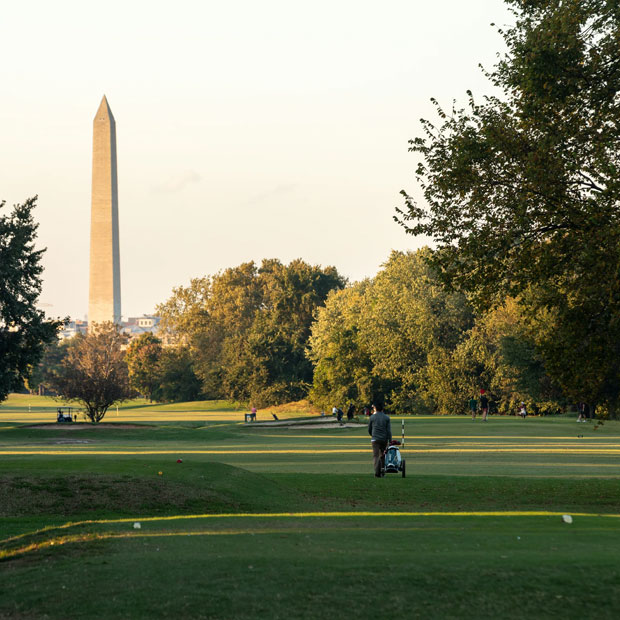
On Sunday, October 18, President Trump shared a new plan for the East Potomac renovation on Truth Social and declared that work would begin on November 15. The plan showed a single 18-hole course taking up an area currently occupied by a 36-hole golf facility, a perimeter road and bike trail, and recreational areas.
The next day, at another hearing, Judge Reyes and the D.C. Preservation League’s attorneys questioned NPS and DOI higher-ups about the recent activities at East Potomac and the President’s stated plans. The witnesses claimed that no final action had been taken on the renovation project and that they weren’t aware of what the White House intended to do.
How does removing hundreds of trees not constitute a “final action” in the renovation project?
Yeah, that’s a tough one!
The basic argument from the Department of Justice (DOJ) is that the October 10 tree work was done in response to a Cultural Landscape Report (CLR) prepared by the NPS in 2019. The CLR called for treating D.C.’s federally owned golf courses as “historic resources” and recommended restoration work, including tree removal and general vegetation management at all three properties.
Until this point, the DOJ had never cited the CLR as a significant support for the government’s actions. In fact, NPS director Jessica Bowron testified that she had not even heard of the CLR until September 29, when DOI deputy chief of staff Greg Wischer informed her that it would provide the basis for a massive, imminent tree-removal project.
So this is the DOJ’s position: Yes, the President is out there on Truth Social saying that the DOI and Tom Fazio have a renovation plan, which he says will go into effect in less than a month; yes, that plan would require extensive clearing of vegetation to create room for a brand-new, much larger golf course; but no, this tree-toppling frenzy had nothing to do with that plan! In fact, what plan? All we know about is this seven-year-old CLR that we’ve hardly mentioned before.
Judge Reyes is understandably skeptical of this argument and has pressed witnesses on the connection between the tree removal and the announced renovation project. So far, though, NPS and DOI officials have claimed ignorance of the Trump administration’s stated plans.
What’s next in the legal fight?
Judge Reyes’s temporary restraining order will remain in place until Monday, October 26. Sometime before then, she will probably issue a ruling on the plaintiff’s Motion for a Preliminary Injunction. If Judge Reyes were to grant the injunction, the pause on construction would be extended. At that point, the DOJ would likely appeal to the U.S. Court of Appeals for the D.C. Circuit. Eventually, the case could end up in the U.S. Supreme Court.
On the other hand, Judge Reyes could decline the motion and just wait for the Trump administration to take definitive action at East Potomac beyond the CLR.
So we’ve got a long way to go.
Who’s going to win the case?
Hard to say, especially for someone as far from being a lawyer as I am.
In the recent hearings, the government’s arguments have started to come into focus. DOJ attorneys will no doubt challenge the standing of the D.C. Preservation League and the two local golfers. They will also argue that the Administrative Procedure Act gives government agencies like the DOI and NPS broad latitude to redesign their facilities.
This insistence on broad executive powers may find a friendly audience in higher courts. See this Supreme Court ruling from two months ago on the White House ballroom project.
My intuition? The D.C. Preservation League faces an uphill battle.
Let’s take a step back here. Why should I be mad about the Trump administration trying to make this golf course better?
Better? I mean, the proposed renovation would certainly make the course more luxurious. The problem is that it would alter the fundamental purpose of the golf facility and the larger park.
From its beginnings in the early 20th century, East Potomac Park has been a multi-use property where people from all walks of life can gather and enjoy the outdoors. The golf facility welcomes all ages and all levels of playing ability. It has putting greens, a driving range, a mini-golf course, a nine-hole par-3 course, a nine-hole executive course, and an 18-hole regulation course. The pro shop rings up roughly 125,000 rounds per year. Along the perimeter of East Potomac Golf Links, the public has access to Ohio Drive SW, the Potomac Heritage Trail, historic groves of cherry blossom trees, and a 15-acre green space at Hains Point. These non-golf amenities are beloved and heavily used by D.C. residents.
The plan President Trump posted on Sunday would replace this varied, democratic offering with one thing: a championship golf venue featuring a three-sided driving range and a 7,500-yard-plus 18-hole course.
The gravest shortcoming of this idea is that it misunderstands the park’s basic value to the public. But it’s also dubious from a golf perspective. In the 1920s, East Potomac Golf Links was an innovative Walter Travis design, with 27 holes that could be played in alternate directions on different days. This “reversible” concept fell by the wayside in the 1960s.
The NLT was working with golf architect Tom Doak to restore Travis’s original architecture. Fazio has no such ambitions. His design disregards East Potomac’s history in favor of what appears to be a cookie-cutter modern championship layout.
Wait, is Tom Fazio bad? Doesn’t he have like 87 courses in Golf Digest’s top 100?
Oy, can I punt on this one? I’d need at least 1,000 words. Tell you what: if you join Fried Egg Golf Club and ask nicely in the app, I’ll give you my Fazio rant.
Okay, well, I’ve heard East Potomac is a dump.
People who say that may not spend much time at municipal golf courses. Sure, East Potomac could use some TLC and an architectural refresh. But in recent years, under the care of the NLT and superintendent Timothy Zurybida, conditions have steadily improved. The turf is strong, consistent, and surprisingly firm considering it’s rooted in river sludge.
Don’t believe everything you read on social media. East Potomac is in fine shape, and it’s a fun place to play.
How much would the proposed renovation cost?
More than you think.
And more than the number you just thought of when I said, “More than you think.”
First, as President Trump himself has noted, the sea wall preventing East Potomac Park from sinking into the Potomac River needs to be rebuilt. This project alone is likely to cost hundreds of millions of dollars.
Second, the Fazio plan doesn’t just call for sprucing up some golf holes. It would entail a complete teardown of the existing park — golf courses, driving range, clubhouse, parking lots, road, trail, and other park infrastructure — and the construction of an entirely new high-end golf complex.
So, as I said: more than you think.
Who would pay for it?
The administration hasn’t said. Earlier this year, a Trumpworld fundraiser set up a foundation to raise money for work in the East and West Potomac parks. That’s all we know for now.
The current peak rate at East Potomac is $48 for 18 holes. If the renovation happens, will that number go up?
On Monday, Secretary Doug Burgum got exactly this question from a Fox News host, and he did not answer directly. You know what that means.
Burgum went on to say that he envisions a tiered fee structure at the new East Potomac, where locals would pay a lower rate than out-of-towners. He cited Torrey Pines ($90 peak for residents at the South Course, $322 for non-residents), Bethpage Black ($80 peak for residents at the Black Course, $160 for non-residents), and Memorial Park ($38 peak for residents, $140 for non-residents) as examples of facilities where this strategy works.
What he didn’t say, though, is that the renovation would eliminate East Potomac’s cheapest golf options, the Red and White nines. Today, the top rates at those courses are $20 and $25, respectively. Military personnel and seniors pay $16 and $18; juniors, $9 and $13. Those options would be gone.
And that gets to the heart of why I and others have become so passionately invested in this story. East Potomac Park has always been for everyone — kids with a Top Flite set and a little pocket change, skilled players looking for a match at the Blue Course, driving-range hardos, and yes, non-golfers, including bikers, runners, picknickers, bird-watchers, and semi-legal fishermen.
The place is a little run-down, but it’s beautiful. It’s supremely American. And it deserves to be protected.


President Trump Announces New Plan for East Potomac Golf Links

Redefining Modern Amateurism in Golf's Reinstated Amateur Era
Q&A: Neil Hutchinson, Superintendent at the Evans at Canal Shores
Chicago Golf Eclectic 18
New-Look Medinah in the Spotlight at 2026 Presidents Cup
Cabot Announces New Resort in Nova Scotia
Get full access to exclusive benefits from Fried Egg Golf
- Member-only content
- Community discussions forums
- Member-only experiences and early access to events