
Royal Dornoch, the classic 1877 Jack Nicklaus design

Latest:
0
0
0
0
Courses and Architecture
1
I wanted to pass along some unfortunate news about Winter Park 9. The course closed temporarily on April 27 after a maintenance worker sprayed greens with the wrong chemical. This caused irreparable damage to 5 greens. The course is supposed to re-open in a couple of weeks with temporary greens with a full re-opening planned for July. In the meantime, the greens will be resurfaced. I last played the course on March 22 and the greens were in good shape as the course was prepping for its annual City Am the first weekend of May. The tournament has been postponed until October. This comes about a decade after the highly successful renovation by Keith Rhebb and Riley Johns.
I’m including a photo of the 6th green, taken by a friend on April 17. I’ll also include the link to a local news story about this.
I live an hour from the course and it’s my favorite place to play. Naturally I hope all of the work on the greens goes as planned and the course returns to its stellar form.
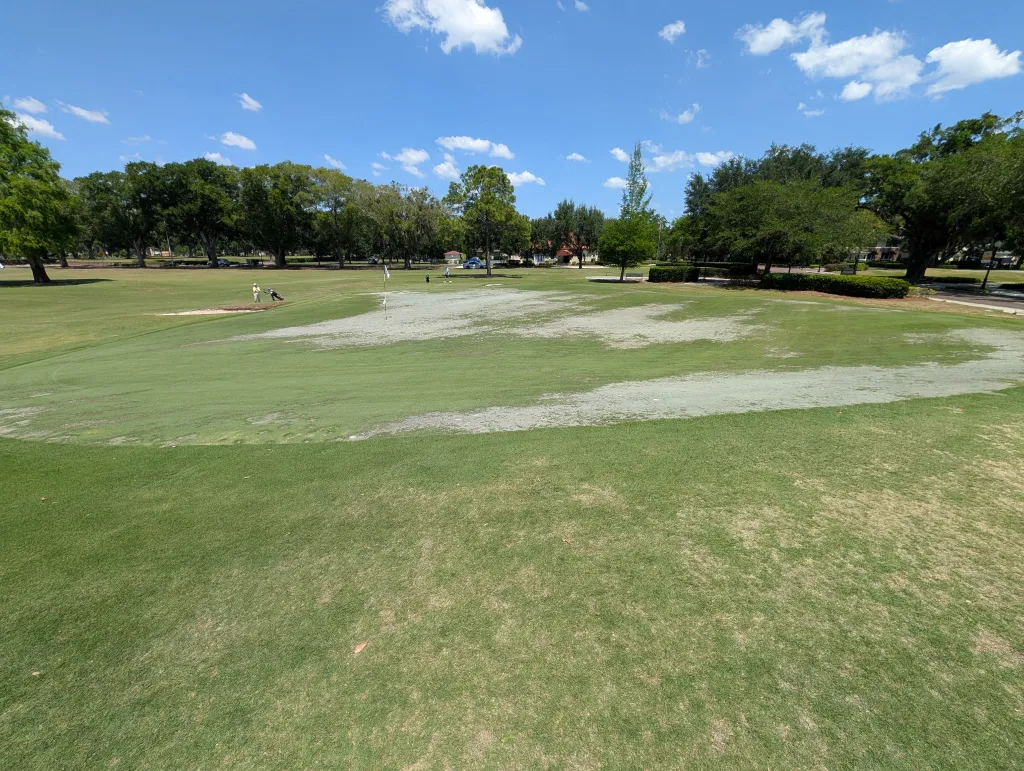
I wanted to pass along some unfortunate news about Winter Park 9. The course closed temporarily on April 27 after a maintenance worker sprayed greens with the wrong chemical. This caused irreparable damage to 5 greens. The course is supposed to re-open in a couple of weeks with temporary greens with a full re-opening planned for July. In the meantime, the greens will be resurfaced. I last played the course on March 22 and the greens were in good shape as the course was prepping for its annual City Am the first weekend of May. The tournament has been postponed until October. This comes about a decade after the highly successful renovation by Keith Rhebb and Riley Johns.
I’m including a photo of the 6th green, taken by a friend on April 17. I’ll also include the link to a local news story about this.
I live an hour from the course and it’s my favorite place to play. Naturally I hope all of the work on the greens goes as planned and the course returns to its stellar form.
My buddy and I will be in the Twin Cities on 6/16 and have an open afternoon for a round. I’ve done a fair amount of research, but with how many great public options there are, I figured I’d ask here for some help prioritizing.
Right now, it seems like Keller and Braemar are two of the top municipal options. I’ve also heard great things about Chaska Town Course, Rush Creek, Baker National, Legends, and Stoneridge.
If you had one afternoon and could only pick one, what would you prioritize and why?
My buddy and I will be in the Twin Cities on 6/16 and have an open afternoon for a round. I’ve done a fair amount of research, but with how many great public options there are, I figured I’d ask here for some help prioritizing.
Right now, it seems like Keller and Braemar are two of the top municipal options. I’ve also heard great things about Chaska Town Course, Rush Creek, Baker National, Legends, and Stoneridge.
If you had one afternoon and could only pick one, what would you prioritize and why?
Golf season is officially underway across the country. Where are you looking forward to playing this summer? Somewhere new or somewhere you are returning? Perhaps a long awaited trip or an invite to a special place.
For me, June brings my annual buddies (16 of us) trip where the 54 holes of golf is less of note, but the comradery and general debauchery makes for one of the best weekends of the year. Followed a week later by my first FE event at Prairie Dunes and then an always special round at Chicago GC.
What excites you about the season ahead?
Golf season is officially underway across the country. Where are you looking forward to playing this summer? Somewhere new or somewhere you are returning? Perhaps a long awaited trip or an invite to a special place.
For me, June brings my annual buddies (16 of us) trip where the 54 holes of golf is less of note, but the comradery and general debauchery makes for one of the best weekends of the year. Followed a week later by my first FE event at Prairie Dunes and then an always special round at Chicago GC.
What excites you about the season ahead?
I'm on the green committee of my local club, and we have a master plan that was created by Kevin Hargrave back around 2019 before I was involved. We used LaBar to execute part of the plan for the range, practice green, and part of the 1st hole.
We're now looking to execute some or all of the bunker renovations in the master plan, and collecting input/bids from builders. We don't necessarily need a big firm like LaBar to complete this project quickly, nor do we need strict adherence to the master plan.
I think we would do well to hire a shaper with good background to come in with a small-ish team that is knowledgeable enough to give their own recommendations on style (flash face vs grass face and flat bottom), placement, and how decisions will impact maintenance practices (we're in an area susceptible to wash outs). Whoever we hire will have some freedom of creative input, but more than anything we need them to function.
Any suggestions who I should be talking to are welcome.
I'm on the green committee of my local club, and we have a master plan that was created by Kevin Hargrave back around 2019 before I was involved. We used LaBar to execute part of the plan for the range, practice green, and part of the 1st hole.
We're now looking to execute some or all of the bunker renovations in the master plan, and collecting input/bids from builders. We don't necessarily need a big firm like LaBar to complete this project quickly, nor do we need strict adherence to the master plan.
I think we would do well to hire a shaper with good background to come in with a small-ish team that is knowledgeable enough to give their own recommendations on style (flash face vs grass face and flat bottom), placement, and how decisions will impact maintenance practices (we're in an area susceptible to wash outs). Whoever we hire will have some freedom of creative input, but more than anything we need them to function.
Any suggestions who I should be talking to are welcome.
Having looked over Garrett's Twitter feed as all this conflicting information about East Potomac flies about the past week or so, I just wanted to leave a note of appreciation for all the reporting he has done and the unbelievable levels of patience he has for setting the record straight with bad faith social media trolls. Keep up the fight, Garrett!
Having looked over Garrett's Twitter feed as all this conflicting information about East Potomac flies about the past week or so, I just wanted to leave a note of appreciation for all the reporting he has done and the unbelievable levels of patience he has for setting the record straight with bad faith social media trolls. Keep up the fight, Garrett!
Just wanted to highlight that in the most recent episode of Designing Golf (Spotify, YouTube, Apple), Bradley Klein was full of praise for the quality of the Donald Ross-themed questions asked by FEGC members. He was genuinely impressed! Thanks to all who participated.
I was lucky enough to get drawn for the old course reversed. Essentially less than a 1% chance to get drawn I believe. Played it a few days after the gang did but was in the town at the same time. Very excited for all content that is going to be coming out. Have a few days off to get back on schedule and thought I'd share a few thoughts and do an AMA.
The package (for us non influencers or Links Ticketholders) included 3 rounds, Castle, Reversed and Old. We added Eden and did a warm up round at Balgove one morning. I used hickories for the Eden, Balgove and Old Course regular. I agree with Andy from the Bacon pod, you should submit to the lottery every year and make it happen if drawn. What an experience. Hard to put into words but I'm going to try over the next week. It makes you appreciate TOC so much more and firmly ranks it as a top 3 course in the world for me. Playing hickories on the Old and a half set (odds) on the reverse was a true brainexploading.gif. We also brought our wives who enjoyed the town while we played. Let me know if you have any questions on anything.
I was lucky enough to get drawn for the old course reversed. Essentially less than a 1% chance to get drawn I believe. Played it a few days after the gang did but was in the town at the same time. Very excited for all content that is going to be coming out. Have a few days off to get back on schedule and thought I'd share a few thoughts and do an AMA.
The package (for us non influencers or Links Ticketholders) included 3 rounds, Castle, Reversed and Old. We added Eden and did a warm up round at Balgove one morning. I used hickories for the Eden, Balgove and Old Course regular. I agree with Andy from the Bacon pod, you should submit to the lottery every year and make it happen if drawn. What an experience. Hard to put into words but I'm going to try over the next week. It makes you appreciate TOC so much more and firmly ranks it as a top 3 course in the world for me. Playing hickories on the Old and a half set (odds) on the reverse was a true brainexploading.gif. We also brought our wives who enjoyed the town while we played. Let me know if you have any questions on anything.
Hey FEGC — With the PGA at Aronimink approaching, I'm prepping an episode of Designing Golf all about Donald Ross. I'd like to devote a section of it to any questions you have about Ross's life, architectural philosophy/style, business, specific courses, or whatever else. Fire away!
Hey FEGC — With the PGA at Aronimink approaching, I'm prepping an episode of Designing Golf all about Donald Ross. I'd like to devote a section of it to any questions you have about Ross's life, architectural philosophy/style, business, specific courses, or whatever else. Fire away!
I am very sad because my course is starting to transition all the bunkers to white sand. The members and ownership basically feel that your course isn't nice until it has white sand. And the best players at the course are all part of the fair police squad because they think it has 'better consistency' when in actuality they were embarrassed by hitting poor shots because the lie wasn't 'perfect'.
I'm inevitably going to be asked my thoughts. I hate white sand and I'm not good at lying. What are some good arguments against white sand that I can use without offending these people?
Thanks!
I am very sad because my course is starting to transition all the bunkers to white sand. The members and ownership basically feel that your course isn't nice until it has white sand. And the best players at the course are all part of the fair police squad because they think it has 'better consistency' when in actuality they were embarrassed by hitting poor shots because the lie wasn't 'perfect'.
I'm inevitably going to be asked my thoughts. I hate white sand and I'm not good at lying. What are some good arguments against white sand that I can use without offending these people?
Thanks!
I thought it was an interesting discussion, but there was a piece missing for me. Specifically, when talking about "where the money goes" on expensive club renovations, they didn't really talk about the underlying problem -- which is that there isn't really a place in the market for "middle class golf clubs" anymore.
Clubs that aren't Top 100 courses need to become upscale, lifestyle country clubs that offer a lot of amenities (and some prestige), or they're gonna be in financial trouble. There doesn't seem to be much of a market for a decent golf club with few other amenities and low initiation/dues. Those clubs, at least where I live (in CA) are dying (even in the golf boom).
So hiring the big designer and doing the big project is, at least in part, an attempt to leapfrog up a tier or two in the club hierarchy more than it's about bunker drainage and fairway corridors, etc.
Just a thought while I was listening to the episode, which I really enjoyed.
I thought it was an interesting discussion, but there was a piece missing for me. Specifically, when talking about "where the money goes" on expensive club renovations, they didn't really talk about the underlying problem -- which is that there isn't really a place in the market for "middle class golf clubs" anymore.
Clubs that aren't Top 100 courses need to become upscale, lifestyle country clubs that offer a lot of amenities (and some prestige), or they're gonna be in financial trouble. There doesn't seem to be much of a market for a decent golf club with few other amenities and low initiation/dues. Those clubs, at least where I live (in CA) are dying (even in the golf boom).
So hiring the big designer and doing the big project is, at least in part, an attempt to leapfrog up a tier or two in the club hierarchy more than it's about bunker drainage and fairway corridors, etc.
Just a thought while I was listening to the episode, which I really enjoyed.
One of my favorite old fried egg series was the Bang for Your Buck discussions they would do for each state. Since we have a forum now, I think it'd be worth while to have it as a thread. I don't want to limit anything to being "it has to be cheap" I just think it's about value.
I'll start:
#1 for me is probably Machrihanish. I really was blown away by that course, and at £160 in the high season, it's downright affordable when compared to other Scottish classics. They even sell a weekly ticket that ends up making it cost about £90 per day, which seems like an absolute steal.
One of my favorite old fried egg series was the Bang for Your Buck discussions they would do for each state. Since we have a forum now, I think it'd be worth while to have it as a thread. I don't want to limit anything to being "it has to be cheap" I just think it's about value.
I'll start:
#1 for me is probably Machrihanish. I really was blown away by that course, and at £160 in the high season, it's downright affordable when compared to other Scottish classics. They even sell a weekly ticket that ends up making it cost about £90 per day, which seems like an absolute steal.
Was watching some of the Western Intercollegiate this week and noticed that Pasatiempo chose to use a different grass type for the green surrounds (very noticeable on overhead shots). I’ve played the course years ago before the restoration and don’t recall that setup. Does anyone know the purpose of this and which grass type used?
Was watching some of the Western Intercollegiate this week and noticed that Pasatiempo chose to use a different grass type for the green surrounds (very noticeable on overhead shots). I’ve played the course years ago before the restoration and don’t recall that setup. Does anyone know the purpose of this and which grass type used?
One thing that really struck me reading the reaction to Chairman Ridley’s rollback comments earlier this week was just how poor the general literacy on this subject is. Just look at the comments on this post, and you’ll see all kinds of logical fallacies, debunked myths and braindead reactions. And while we know there are bad actors out there facilitating this to a degree, I just think it’s really hard for the average person to find good, clear, introductory information on the topic. Even though I think the USGA’s Distance Insights Report does a good job of this, no one wants to go read that.
For as much good work as I think podcasts like Designing Golf, FEG and others have done combatting this, it’s also pretty common whenever the rollback discourse hits the news cycle to hear something like ‘we don’t have time to get into a whole rollback discussion here.’ I’m not suggesting that’s a failure, but it’s emblematic of the problem; you could have an interested listener come across that statement and be interested in hearing more, but then need to wade into the depths of the internet to try and find decent answers.
With that in mind and given this is probably a pro-rollback leaning space, I’m working on a more accessible version of an FAQ/explainer guide to earnestly try to understand the worst logical fallacies and bad-faith arguments, and then pick them apart in an accessible way. I’m aiming to publish this in a space that focuses on approachable breakdowns of course strategy and design. Would appreciate any feedback or criticisms of the explainers, or any arguments I’m missing!
“People Like Watching Bombs!”
The argument: Limiting the distance players can hit the ball would come at the expense of one of the most entertaining parts of the game. Who doesn’t love watching bombs? Seeing players pull off herculean feats like driving par-4s, covering a heroic carry or taking a mighty lash at the ball is a sight that can appeal to sports fans and explains much of the mainstream appeal of players like Tiger Woods, John Daly, Rory McIlroy. If we limit how far the ball goes, we’re limiting the chances for more entertaining moments and appealing athletes to showcase their skills.
Why it’s wrong: The appeal of watching players hit bombs is that it’s a relative accomplishment. It has nothing to do with the absolute distance they hit it; It’s the relative length compared to the course and competition that make such feats notable and entertaining. No one cares that a drive went 350 yards because it went 350 yards; they care because that’s a bigger number than they’re used to seeing. It wasn’t long ago that John Daly was a cult figure because he was the only player to average 300 yards off the tee, but 115 PGA Tour players averaged more than that in 2025 - you wouldn’t argue that they’re all as exciting as JD, would you?
Bryson’s famous drive on #6 at Bay Hill wasn’t just impressive because he hit it over a body of water; it’s because he hit it on a line we had never seen another player successfully take in decades of watching tournaments there. Rory driving it to 3’ on the 18th hole at the Match Play a couple of years ago wasn’t exciting just because he hit a great shot from a long distance; he accomplished something that no one else had been able to do at that event, and that you wouldn’t expect someone to be able to do with a driver.
The more common that kind of accomplishment becomes, the longer holes have to be set up to continue making that accomplishment special. It’s the same reason that a player shooting 59, on any tour, used to make a player a household name; it’s been done 13 times since 2020 - how many of those can you even name?
“Playing the same equipment as the pros is what makes golf great.”
The argument: This one is mostly relevant for proposals to bifurcate equipment, but it’s one of my favourites nonetheless. The argument goes, one of the greatest things about the game of golf is that you can play the exact same equipment, and in many cases on the same courses, as the pros. Being able to play the same driver as your favourite player keeps people playing the game, and taking that away comes at the expense of the game’s popularity
Why it’s wrong: Unless you have exactly the same swing and golf game as your favourite tour player, there’s absolutely no reason you should be playing the exact same equipment as them, even if it’s made by the same brand. If you went to a club or ball fitting and said to the fitter, “I really like the way Justin Thomas hits low spinners, so give me his ProV1x” or “I love how Scottie hits slider cuts with his driver, can you build me his exact Qi4D?” they’d look at you like you had two heads. Even if you really want to hit those shots, there’s a comically low chance that the right equipment to help you do that is going to be the same as that pro’s setup.
Now, there’s an idea that equipment companies need to market their clubs based on tour-proven performance, and I’m supportive of that. But that’s not the same thing as playing literally the same clubs or balls as your favourite player. If equipment companies can’t find a way to say, ‘the same technology that helps Rory in his driver can help you in a driver that’s fit for your game,’ that’s on them.
“Most courses don’t host tour events, so why should a rollback apply to them?”
The argument: Most courses have no chance of ever hosting a tour event or major championship, so if they want to keep lengthening their courses and building new tee boxes and moving bunkers to keep up with the pro game, that’s on them. Don’t bother legislating something that’s meant to address the concerns of 1% of golf courses.
Why it’s wrong: Have you ever heard a course described as a ‘championship’ golf course, even if it’s obviously not a venue for any kind of championship event? Do you even know what a ‘championship’ golf course means? Of course not, it’s just marketing, but there’s a reason it’s so prevalent.
Ask yourself this: If a new golf course opened today a maxed out length of 6,100 yards, would much of the golfing public perceive it as flawed or inferior in some way? Of course they would.
In marketing speak, most golf courses compete on Points of Parity, essentially the attributes that are required to be a legitimate competitor in a market category. If you’re a developer building a new high-end public course with a premium green fee, you’re taking on a lot of risk if you don’t build a course that’s as long as the other new “championship” public courses. That’s not to validate the argument, but the incentives for anyone putting capital into course construction point strongly in the direction of building courses longer and longer. I’m sure there’s a name for this, like ‘competitive creep’ or something like that.
I appreciate that there are new courses like Sedge Valley which are a direct rebuke of this concept, and hope to see more courses like this become part of the public consciousness. But there’s a reason that course is as radical and noteworthy as it is.
Why does it even matter? What’s the problem with courses getting longer and the ball going farther?
The argument: Who cares if courses are longer and the ball goes farther? I don’t care about romantic notions of shotmaking, and the game is just played differently now.
Why it’s wrong: As explained above, course developers and operators are incentivized to keep making their courses longer. When that happens, it means more turf to maintain, and expense to do that is passed on to the golfer. It means it takes longer to walk or drive courses, which makes pace of play worse. It means it takes more acreage to build a new course, which pushes what new development there is farther away from population centres and makes the game less accessible, if it even happens at all.
“If the ball is rolled back, players will just speed train up to hit it the same distance as they do now.”
The argument: I took a crack at this one earlier this year when Dr. Sasho Mackenzie made some head-scratching points on the NLU podcast, so I can relay this one word-for-word: “I think you will see if you slow the ball down, that little bit they're slowing it down, you will see a lot of players overnight instantly jack up their clubhead speed to start getting the ball to go back to that distance."
Why it’s wrong: If players could truly make such meaningful speed gains ‘overnight’ at no cost to accuracy (let alone the physical impact on their bodies), why wouldn’t they do it now? The answer is, of course, that there ARE risks and factors to be weighed when trying to hit it farther. If the rolled back ball goes 15% shorter on average and players want to speed train to get back to the same ball speed numbers they’re at now, that is absolutely going to make them hit drives at that same speed with a much wider dispersion, and require them to push their bodies further to do so. Would SOME players be able to successfully speed train to get back to pre-rollback levels? Probably! And doing so would require skill and hard work - I’d much rather reward that than reward a player for putting a new driver in the bag.
“I agree with the rollback argument, but don’t take away from the game just as it’s gotten so popular! Now is not the time.”
The argument: Golf is on a popularity boom, and making the game harder for the average player now would be an own goal. We shouldn’t turn away new golfers that have just picked up the game.
Why it’s wrong: Putting aside the likelihood that a rolled back ball would have a negligible impact on the vast majority of new golfers, this one might be the most disingenuous. Would it be better to roll the ball back when the game’s popularity is at its lowest? Of course not.
I recently got into this on Instagram with someone, who said they didn’t want their ‘hard-won distance gains’ taken away. The last time I checked, there’s no spot on the scorecard for how far you hit your 7-iron. If the thing about golf that gets you satisfaction is hitting a 7-iron over a bunker to a tucked pin, and you’re worried about not being able to do that with a rolled back ball, then just move up a set of tees! Which, if everyone did, would help golf take less time.
“I agree with the rollback, but think it should be done to drivers and clubs, not balls/I agree with the rollback, but the current proposal isn’t going to address anything”
The argument: Even if you support a rollback, the proposal tabled by the USGA won’t accomplish anything because the real problem is that the drivers are too big, hot and forgiving.
Why it’s wrong: This is true, and we never should have let drivers and woods get to where they are now, but that ship has sailed. Let’s say you did nothing to the ball and imposed a size limit of 280cc on drivers. Would players with a great mini driver or 3-wood be severely impacted? Probably not, though this would be a good reason to support bifurcation - part of the reason players can speed train as aggressively as they do now is the forgiveness of modern drivers. Go ahead tell me Ludvig’s toe ball on 11 at The Players would have gone 320 down the middle if that strike was on a mini driver.
But in any case, manufacturers will find some incredible new engineering feat to make whatever limitations they have to work around work. The golf ball is the one piece of equipment everyone uses, and a real change to the ball negates the inevitable engineering gains the club makers will find.
“Rollback should be done through course design, not equipment regulation.”
The argument: Courses like Harbour Town and Augusta effectively limit distance by having well-placed trees, and this should be the model for disincentivizing distance gains. Guys like Scottie Scheffler have expressed their disdain for modern, open-air courses, and we need more trees.
Why it’s wrong: Anyone who makes this argument should also be fine with worse turf conditions and slower greens, as well as more chemical and pesticide usage on courses, because more trees mean more shade, worse air flow and more root problems - a superintendent’s nightmare, and a sure contributor to making the game more expensive.
There’s obviously a place in the game for these kinds of courses. But if every course as like Harbour Town, would it be as beloved? Of course not. Heavily-treed, narrow courses dictate a certain style of play, and make an angles-based, strategic style of golf where thinking about your route to the hole is just as important as physically accomplishing the shots. This is what Chairman Ridley was getting at - the essence of golf is that it’s a game based on strategy, tact and thought. If we limit that ‘strategy’ to “I have to hit hybrid off the tee instead of driver because there’s a tree blocking the line where I can drive it,” we’re dumbing the game down and missing out a huge part of what makes it so great.
Also, why should the courses (most of which are small, family-owned businesses) bear the cost of adjusting to the game instead of the large, publicly-traded equipment companies?
One thing that really struck me reading the reaction to Chairman Ridley’s rollback comments earlier this week was just how poor the general literacy on this subject is. Just look at the comments on this post, and you’ll see all kinds of logical fallacies, debunked myths and braindead reactions. And while we know there are bad actors out there facilitating this to a degree, I just think it’s really hard for the average person to find good, clear, introductory information on the topic. Even though I think the USGA’s Distance Insights Report does a good job of this, no one wants to go read that.
For as much good work as I think podcasts like Designing Golf, FEG and others have done combatting this, it’s also pretty common whenever the rollback discourse hits the news cycle to hear something like ‘we don’t have time to get into a whole rollback discussion here.’ I’m not suggesting that’s a failure, but it’s emblematic of the problem; you could have an interested listener come across that statement and be interested in hearing more, but then need to wade into the depths of the internet to try and find decent answers.
With that in mind and given this is probably a pro-rollback leaning space, I’m working on a more accessible version of an FAQ/explainer guide to earnestly try to understand the worst logical fallacies and bad-faith arguments, and then pick them apart in an accessible way. I’m aiming to publish this in a space that focuses on approachable breakdowns of course strategy and design. Would appreciate any feedback or criticisms of the explainers, or any arguments I’m missing!
“People Like Watching Bombs!”
The argument: Limiting the distance players can hit the ball would come at the expense of one of the most entertaining parts of the game. Who doesn’t love watching bombs? Seeing players pull off herculean feats like driving par-4s, covering a heroic carry or taking a mighty lash at the ball is a sight that can appeal to sports fans and explains much of the mainstream appeal of players like Tiger Woods, John Daly, Rory McIlroy. If we limit how far the ball goes, we’re limiting the chances for more entertaining moments and appealing athletes to showcase their skills.
Why it’s wrong: The appeal of watching players hit bombs is that it’s a relative accomplishment. It has nothing to do with the absolute distance they hit it; It’s the relative length compared to the course and competition that make such feats notable and entertaining. No one cares that a drive went 350 yards because it went 350 yards; they care because that’s a bigger number than they’re used to seeing. It wasn’t long ago that John Daly was a cult figure because he was the only player to average 300 yards off the tee, but 115 PGA Tour players averaged more than that in 2025 - you wouldn’t argue that they’re all as exciting as JD, would you?
Bryson’s famous drive on #6 at Bay Hill wasn’t just impressive because he hit it over a body of water; it’s because he hit it on a line we had never seen another player successfully take in decades of watching tournaments there. Rory driving it to 3’ on the 18th hole at the Match Play a couple of years ago wasn’t exciting just because he hit a great shot from a long distance; he accomplished something that no one else had been able to do at that event, and that you wouldn’t expect someone to be able to do with a driver.
The more common that kind of accomplishment becomes, the longer holes have to be set up to continue making that accomplishment special. It’s the same reason that a player shooting 59, on any tour, used to make a player a household name; it’s been done 13 times since 2020 - how many of those can you even name?
“Playing the same equipment as the pros is what makes golf great.”
The argument: This one is mostly relevant for proposals to bifurcate equipment, but it’s one of my favourites nonetheless. The argument goes, one of the greatest things about the game of golf is that you can play the exact same equipment, and in many cases on the same courses, as the pros. Being able to play the same driver as your favourite player keeps people playing the game, and taking that away comes at the expense of the game’s popularity
Why it’s wrong: Unless you have exactly the same swing and golf game as your favourite tour player, there’s absolutely no reason you should be playing the exact same equipment as them, even if it’s made by the same brand. If you went to a club or ball fitting and said to the fitter, “I really like the way Justin Thomas hits low spinners, so give me his ProV1x” or “I love how Scottie hits slider cuts with his driver, can you build me his exact Qi4D?” they’d look at you like you had two heads. Even if you really want to hit those shots, there’s a comically low chance that the right equipment to help you do that is going to be the same as that pro’s setup.
Now, there’s an idea that equipment companies need to market their clubs based on tour-proven performance, and I’m supportive of that. But that’s not the same thing as playing literally the same clubs or balls as your favourite player. If equipment companies can’t find a way to say, ‘the same technology that helps Rory in his driver can help you in a driver that’s fit for your game,’ that’s on them.
“Most courses don’t host tour events, so why should a rollback apply to them?”
The argument: Most courses have no chance of ever hosting a tour event or major championship, so if they want to keep lengthening their courses and building new tee boxes and moving bunkers to keep up with the pro game, that’s on them. Don’t bother legislating something that’s meant to address the concerns of 1% of golf courses.
Why it’s wrong: Have you ever heard a course described as a ‘championship’ golf course, even if it’s obviously not a venue for any kind of championship event? Do you even know what a ‘championship’ golf course means? Of course not, it’s just marketing, but there’s a reason it’s so prevalent.
Ask yourself this: If a new golf course opened today a maxed out length of 6,100 yards, would much of the golfing public perceive it as flawed or inferior in some way? Of course they would.
In marketing speak, most golf courses compete on Points of Parity, essentially the attributes that are required to be a legitimate competitor in a market category. If you’re a developer building a new high-end public course with a premium green fee, you’re taking on a lot of risk if you don’t build a course that’s as long as the other new “championship” public courses. That’s not to validate the argument, but the incentives for anyone putting capital into course construction point strongly in the direction of building courses longer and longer. I’m sure there’s a name for this, like ‘competitive creep’ or something like that.
I appreciate that there are new courses like Sedge Valley which are a direct rebuke of this concept, and hope to see more courses like this become part of the public consciousness. But there’s a reason that course is as radical and noteworthy as it is.
Why does it even matter? What’s the problem with courses getting longer and the ball going farther?
The argument: Who cares if courses are longer and the ball goes farther? I don’t care about romantic notions of shotmaking, and the game is just played differently now.
Why it’s wrong: As explained above, course developers and operators are incentivized to keep making their courses longer. When that happens, it means more turf to maintain, and expense to do that is passed on to the golfer. It means it takes longer to walk or drive courses, which makes pace of play worse. It means it takes more acreage to build a new course, which pushes what new development there is farther away from population centres and makes the game less accessible, if it even happens at all.
“If the ball is rolled back, players will just speed train up to hit it the same distance as they do now.”
The argument: I took a crack at this one earlier this year when Dr. Sasho Mackenzie made some head-scratching points on the NLU podcast, so I can relay this one word-for-word: “I think you will see if you slow the ball down, that little bit they're slowing it down, you will see a lot of players overnight instantly jack up their clubhead speed to start getting the ball to go back to that distance."
Why it’s wrong: If players could truly make such meaningful speed gains ‘overnight’ at no cost to accuracy (let alone the physical impact on their bodies), why wouldn’t they do it now? The answer is, of course, that there ARE risks and factors to be weighed when trying to hit it farther. If the rolled back ball goes 15% shorter on average and players want to speed train to get back to the same ball speed numbers they’re at now, that is absolutely going to make them hit drives at that same speed with a much wider dispersion, and require them to push their bodies further to do so. Would SOME players be able to successfully speed train to get back to pre-rollback levels? Probably! And doing so would require skill and hard work - I’d much rather reward that than reward a player for putting a new driver in the bag.
“I agree with the rollback argument, but don’t take away from the game just as it’s gotten so popular! Now is not the time.”
The argument: Golf is on a popularity boom, and making the game harder for the average player now would be an own goal. We shouldn’t turn away new golfers that have just picked up the game.
Why it’s wrong: Putting aside the likelihood that a rolled back ball would have a negligible impact on the vast majority of new golfers, this one might be the most disingenuous. Would it be better to roll the ball back when the game’s popularity is at its lowest? Of course not.
I recently got into this on Instagram with someone, who said they didn’t want their ‘hard-won distance gains’ taken away. The last time I checked, there’s no spot on the scorecard for how far you hit your 7-iron. If the thing about golf that gets you satisfaction is hitting a 7-iron over a bunker to a tucked pin, and you’re worried about not being able to do that with a rolled back ball, then just move up a set of tees! Which, if everyone did, would help golf take less time.
“I agree with the rollback, but think it should be done to drivers and clubs, not balls/I agree with the rollback, but the current proposal isn’t going to address anything”
The argument: Even if you support a rollback, the proposal tabled by the USGA won’t accomplish anything because the real problem is that the drivers are too big, hot and forgiving.
Why it’s wrong: This is true, and we never should have let drivers and woods get to where they are now, but that ship has sailed. Let’s say you did nothing to the ball and imposed a size limit of 280cc on drivers. Would players with a great mini driver or 3-wood be severely impacted? Probably not, though this would be a good reason to support bifurcation - part of the reason players can speed train as aggressively as they do now is the forgiveness of modern drivers. Go ahead tell me Ludvig’s toe ball on 11 at The Players would have gone 320 down the middle if that strike was on a mini driver.
But in any case, manufacturers will find some incredible new engineering feat to make whatever limitations they have to work around work. The golf ball is the one piece of equipment everyone uses, and a real change to the ball negates the inevitable engineering gains the club makers will find.
“Rollback should be done through course design, not equipment regulation.”
The argument: Courses like Harbour Town and Augusta effectively limit distance by having well-placed trees, and this should be the model for disincentivizing distance gains. Guys like Scottie Scheffler have expressed their disdain for modern, open-air courses, and we need more trees.
Why it’s wrong: Anyone who makes this argument should also be fine with worse turf conditions and slower greens, as well as more chemical and pesticide usage on courses, because more trees mean more shade, worse air flow and more root problems - a superintendent’s nightmare, and a sure contributor to making the game more expensive.
There’s obviously a place in the game for these kinds of courses. But if every course as like Harbour Town, would it be as beloved? Of course not. Heavily-treed, narrow courses dictate a certain style of play, and make an angles-based, strategic style of golf where thinking about your route to the hole is just as important as physically accomplishing the shots. This is what Chairman Ridley was getting at - the essence of golf is that it’s a game based on strategy, tact and thought. If we limit that ‘strategy’ to “I have to hit hybrid off the tee instead of driver because there’s a tree blocking the line where I can drive it,” we’re dumbing the game down and missing out a huge part of what makes it so great.
Also, why should the courses (most of which are small, family-owned businesses) bear the cost of adjusting to the game instead of the large, publicly-traded equipment companies?
Movie:Course:Reasoning
I'll start:
Star Wars IV : Pebble Beach : A classic. Point out its flaws feels sacrilegious…but they are there.
The Princess Bride : Bandon Trails : A lovely movie. The plot(routing) is a delight. The characters(holes) are enjoyable. I quote(think about it) regularly.
Dazed and Confused : Chambers Bay : Didn’t do very well at the box office (USGA) but it’s a fan favorite and served as a coming out party for a lone star legend.
Dumb & Dumber : Mammoth Dunes : Fun(ny). People quote it but critics may be sceptical of its cinematic merits.
Gladiator : Erin Hills : It’s long. It’ll kick your ass. You’ll be entertained.
Movie:Course:Reasoning
I'll start:
Star Wars IV : Pebble Beach : A classic. Point out its flaws feels sacrilegious…but they are there.
The Princess Bride : Bandon Trails : A lovely movie. The plot(routing) is a delight. The characters(holes) are enjoyable. I quote(think about it) regularly.
Dazed and Confused : Chambers Bay : Didn’t do very well at the box office (USGA) but it’s a fan favorite and served as a coming out party for a lone star legend.
Dumb & Dumber : Mammoth Dunes : Fun(ny). People quote it but critics may be sceptical of its cinematic merits.
Gladiator : Erin Hills : It’s long. It’ll kick your ass. You’ll be entertained.