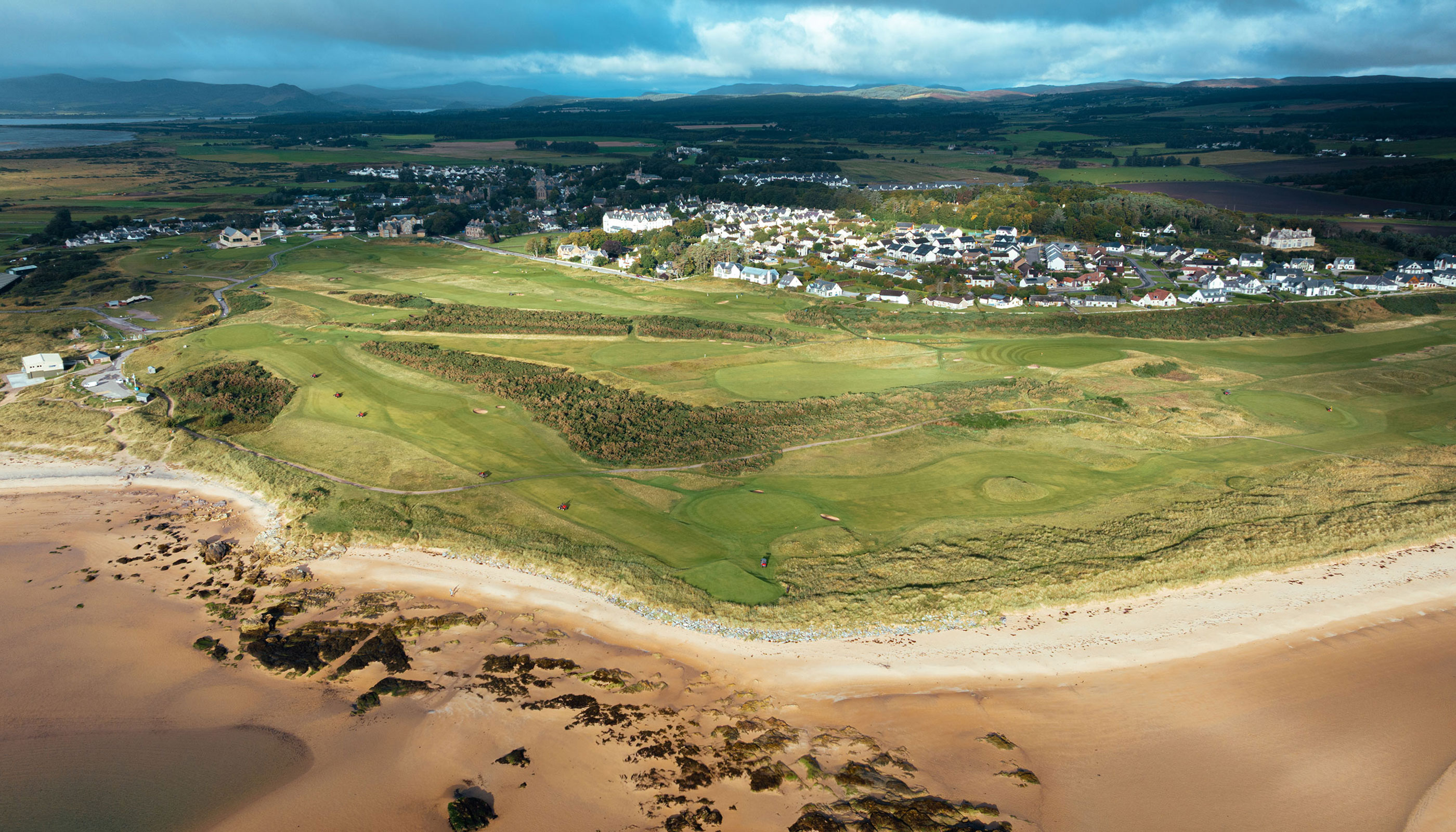
Royal Dornoch Golf Club
From its land to its architecture to its refined but simple presentation, Royal Dornoch has few discernible weaknesses.

Dornoch, Highland, Scotland
Old Tom Morris (original 18-hole design, 1886); J.H. Taylor (renovation, 1907); Donald Ross (redesign of first two holes, 1927); Robbie Grant and George Duncan (extension, 1948), Mackenzie & Ebert (renovation, 2020)
Semi-Private

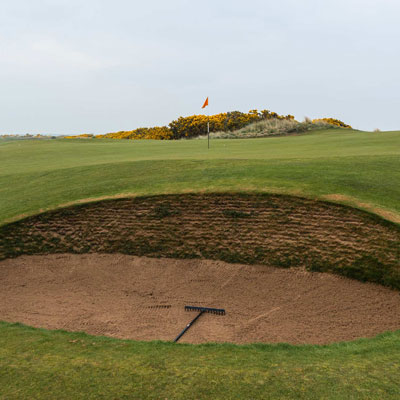
For much of the 20th century, Royal Dornoch Golf Club was largely unknown to golfers outside Scotland. This is hard to believe today. The course is obviously one of the best in the world, and it makes the kind of immediate impression that most traditional Scottish links don't. The North Sea is visible from almost everywhere on the property; the terrain features both big elevation changes and riotous, human-sized undulations; and the holes are challenging and strategically sound, with well-placed pot bunkers and large, rolling greens. From its land to its architecture to its refined but simple presentation, Royal Dornoch has few discernible weaknesses.
As complete and coherent as the course seems, however, it is the product of a hodgepodge of architectural influences. Golf has been played in the dunes along Dornoch Beach since the 17th century, but the club wasn't founded until 1877. Today's course began to take shape in 1886, when Old Tom Morris visited and drew up an 18-hole plan. Morris is responsible for several of Dornoch's best-known holes, including the incomparable stretch of Nos. 14 through 17 (originally Nos. 8 through 10 and 4).
Here are the major changes Royal Dornoch has made since:
- Between 1904 and 1907, J.H. Taylor spent his summers in Dornoch and advised the club on revising and lengthening the course.
- In 1921, Donald Ross, who grew up in Dornoch and served as keeper of the green in the 1890s, pitched a redesign of the first two holes. His plan was carried out in 1927.
- During World War II, the British Air Ministry requisitioned part of the club's land and flattened six holes — initially Nos. 13 through 18 — south of the clubhouse.
- In 1948, greenkeeper Robbie Grant and Open champion George Duncan replaced the lost holes by extending the course up, over, and back around a bluff at the north end of the property. Today's Nos. 6 through 11 are their work.
- In 2020, Tom Mackenzie of Mackenzie & Ebert shifted the seventh hole east, closer to the edge of the bluff, and in the process turned the eighth into a longer, dogleg-right par 4.
Take Note…
Accommodations. As Royal Dornoch’s profile has risen, the surrounding town’s tourist economy has steadily grown. While still small, Dornoch offers a handful of good hotels and restaurants. I can recommend the Royal Golf Hotel (the in-house restaurant, Crenshaw’s Brasserie, serves coffee in French presses — a huge plus in my book) and the Castle Whisky Bar and Bistro (good pizza, better selection of scotch).
Literature. Royal Dornoch has been the subject of an unusual amount of good writing. Herbert Warren Wind’s 1964 New Yorker essay “North to the Links of Dornoch” alerted many Americans to the course’s existence, and Lorne Rubinstein’s A Season in Dornoch is a modern classic.
New digs. Royal Dornoch’s new three-story clubhouse opened in December 2025. It’s spacious and comfy inside, but I can’t say I admire the distinctly modern look of the place.
{{royal-dornoch-about-gallery}}
Fore please! The Fried Egg Golf team is now driving... and as such has not yet written a full course profile.
If you're dying to read the course profile or would like to share your thoughts, drop a comment below.
Cheers!
Fore please! The Fried Egg Golf team is now driving... and as such has not yet written a full course profile.
If you're dying to read the course profile or would like to share your thoughts, drop a comment below.
Cheers!

Explore Related Content
Nairn Golf Club
Tain Golf Club
Lundin Golf Club
St. Andrews (New Course)
Augusta Country Club
Aronimink Golf Club
Get full access to exclusive benefits from Fried Egg Golf
- Member-only content
- Community discussions forums
- Member-only experiences and early access to events