JLM drive-by: what makes a bad course?


Courses and Architecture
I woke up one day earlier this month to yet another drive-by on my beloved TPC Toronto in the Fried Egg newsletter from Mr. LaMagna, who ranked it in the pleasantly titled tier ‘Unfortunately, It’s a Golf Course.’ In the interest of disclosure, I work at TPC Toronto, so if you want to dismiss everything that follows here as flak or propaganda, that’s fair game.
I will say I’ve chuckled at the many JLM zingers coming at my employer’s expense over the past year, including this one during last year’s Canadian Open.

With that said, this latest zinger got me thinking about what makes for a ‘bad’ golf course, and I can’t help myself from stepping into traffic here to talk about a course I know well and, I think, is poorly understood. For whatever it’s worth, I do believe I’m writing this not out of professional obligation, but because I’ve spent a huge amount of time thinking about this course and hope to engage in some discussion around it here.
According to what’s been written and said by folks from Fried Egg Golf, Golf Club Atlas, No Laying Up and others, we have committed some grievous sins with our North course. The prevailing narrative goes: the bunkers are repetitive, it’s a long and boring slog, the greens are flat pancakes, it rewards bomb-and-gouge specialists, and its overall look is generally out of line with the current architecture zeitgeist. Oh, and it’s a ’run of the mill TPC.’
While I disagree with those, and not just because they’re mostly been posited by people who have never set foot on the property, I won’t attempt to refute them here (though regarding the bunker shapes, you may be surprised to learn the course was designed to be played from the ground, not Google Maps). Our work is in the public sphere and criticism is fair game. If you don’t like it, you don’t like it, and that’s just an innate part of evaluating golf courses
Instead, I want to point to a few things that I enjoy about the course and have not seen discussed much in these spaces. There are some aspects to the course I’ve learned to appreciate having played, photographed and talked about it for years, and while truthfully I hope to change some people’s minds about the course, the reason I’m choosing to write it here (of all places!) is that I hope to inspire some discussion about what is worthy of criticism and derision, and what really makes for a ‘bad’ golf course.
What criteria should really banish a venue to the ‘Unfortunately, It’s a Golf Course’ tier? What is the threshold of redeeming qualities a course must possess to elevate out of that tier? And even when a course fails that litmus test, how hard should a fan or commentator have to look to find something interesting? I’ll make my case below, then return to the question.
--
1. Emphasis on Tee-to-Green play
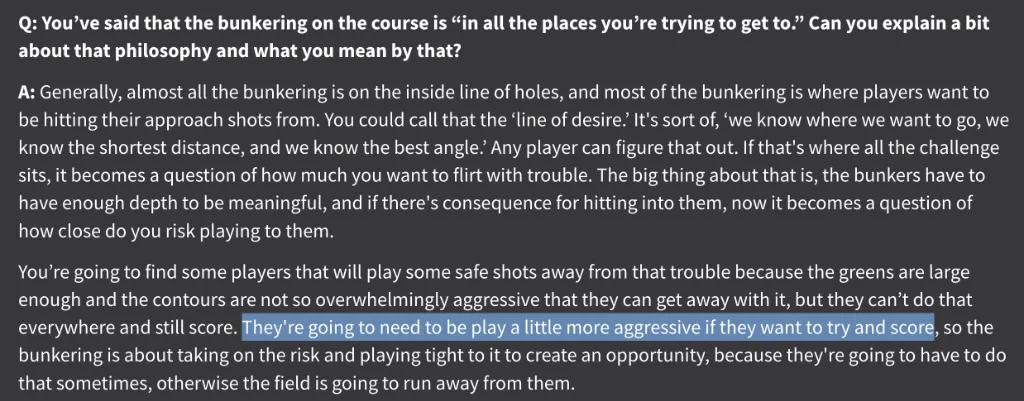
The premise of the North course’s 2023 renovation was to make tee-to-green play actually matter. The thinking for how we aimed to accomplish that: We know modern, technologically-optimized players are going to score well no matter what we do. Instead of trying to arbitrarily manipulate scoring with narrow targets, thick rough and more hazards, let’s create opportunities for the best players to earn their scoring opportunities with great long game play. If players continually decline risk off the tee and into the greens, their ability to keep pace with whoever is playing best that week will be compromised.
I went deeper into the topic with Ian Andrew in this Q&A.
When I looked up Data Golf’s course summary from last year’s Canadian Open, I wasn’t sure this would be reflected in the results. I was admittedly expecting to find evidence of a ‘Piece of Sh*t Putting Contest’, owing to the soft conditions from the heavy Wednesday rain and the fact that there was snow on the ground less than 50 freaking days before the tournament. However, at risk of being a numbers-blinded #DataBoy and misinterpreting the below chart, I was surprised to find that the Within-Event Correlations and Course Insights showed that players who gained strokes on the field did so overwhelmingly with the long game. In particular, distance having such a negligible impact on total strokes gained goes against the prevailing critique that the North course is a Ball Speed Impostor’s paradise, where speed is the only number that matters and all you need to do to win is hit it far and make a few putts:
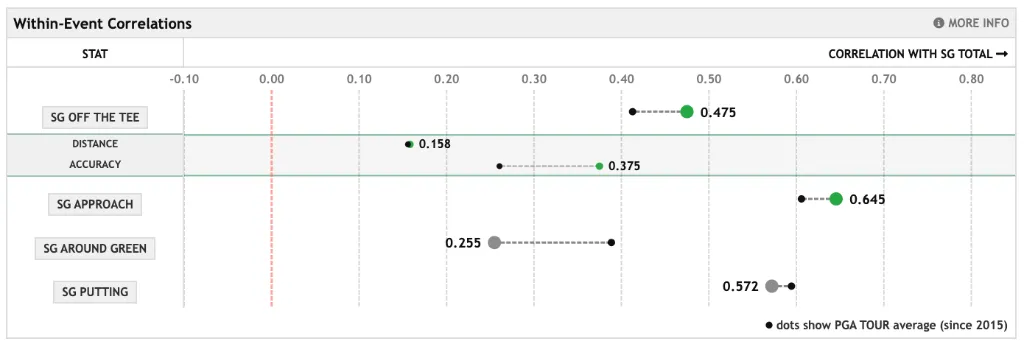
Players who gained strokes on the field in 2025 did so primarily with driving accuracy and approach play
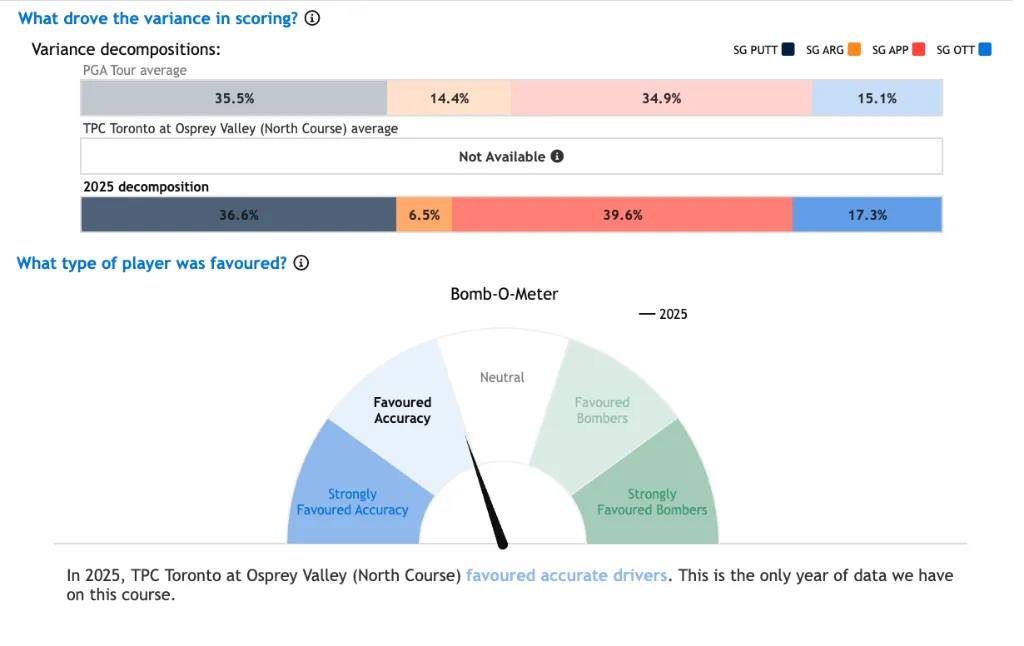
Course Insights point to approach play as the strongest influence on scoring variance, while the course slightly favoured accurate drivers
It’s just one year’s worth of data and these are raw correlations, but to see evidence that the course actually played in line with the design’s premise suggests that, despite the jokes about Cameron Champ leading well into the weekend, there’s something here beyond a mindless bomber’s paradise.
2. Approach shot length variety
Members of this forum are obviously familiar with modern equipment’s muting on shotmaking skill, and know that only the rarest venues and weather conditions really emphasize these skills in the men’s pro game. To be sure, the ways most often mentioned among a course’s tools to combat this - truly exceptional green contouring, or exposure to forceful natural elements, for example - are not a strength of the North course, and I’m not here to convince you otherwise.
However, to me one of the course’s strongest traits is undeniably the variety of approach clubs it can put in players’ hands, and the variety of approach distances, if not types of approach shots, players face during a round. I love how the course is essentially bifurcated into scoring opportunities (short approaches) and what Ian Andrew, the renovation architect, calls ‘perseverance’ holes (long approaches).
Below is the Approach Shot Distribution from last year’s event, via Data Golf. As you can see, there are a much higher number of very short and very long approaches compared to the average Tour course.
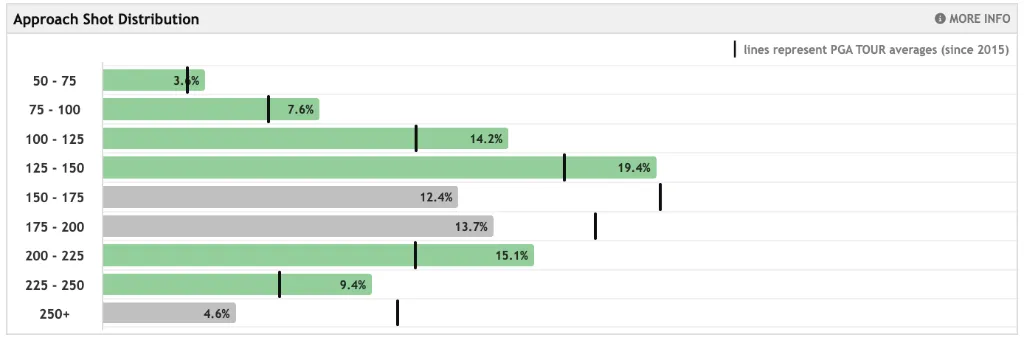
This is consistent with the intent of the 2023 renovation, which aimed to emphasize the back-and-forth nature of the scoring/perseverance holes, especially on the back nine:
• 10-11, perseverance holes (tricky par-4, brutally tough par-3)
• 12, scoring hole (drive-and-pitch par-4)
• 13, perseverance hole (very long par-4)
• 14-15, scoring holes (short par-3, short par-4 with sharp dogleg)
• 16-17, perseverance holes (very long par-4s)
• 18, scoring hole (reachable, risk-reward par-5)
The par-3s are also well positioned to give the players a variety of yardages and wind directions. 7 and 11 can both play between 190 to 230+ but play in opposite directions, so they give players opposite wind directions, and can both require a long approach club. 4 and 14 both give players a different look at a shorter club, with 14’s internal punchbowl and 4’s severe upside-down saucer runoff area on the right side. Ultimately this is meant to test a variety of approach shot skills, plus add a fun psychological element of the back-and-forth between easy and difficult holes.
For what it’s worth, I think the Tour could, should and will lean into this dynamic more when it comes to course setup in 2026.
—
3. Approach shot tests:
I can’t blame folks who saw the course for the first time on TV last June and saw a set of soft dartboard greens - between the heavy rain on Wednesday and humid, windless conditions the rest of the week, I’m not sure any course’s greens would have looked very interesting from TV Tower-level perspectives. However, beyond just a variety of yardages players have into greens, there are some approach shots I find very interesting to watch even in pillow-soft conditions, and which turn outright fascinating if things get firm and spicy (like they did when the course hosted the 2024 PGA Tour Americas Tour Championship and the winning score was only 5-under). I’d argue that the following approach shots:
• Reward aggressive risk-taking
• Penalize misses that cut it too close to the danger
• Make subsequent shots much harder after conservative play.
10th hole: With a water hazard short right and a false front/closely mown runoff area short right, balls that don’t carry far enough into the green or have too much spin will roll back, even if they’re 4-5 paces onto the green. But bailing long or left means playing back towards that same hazard, which makes for a very delicate two-putt or up and down. There’s a nice element of deferred risk and “take on the hazard now, or later” to this one, especially since the S-shaped, cambered fairway requires an actual golf shot to hit. To me it’s kind of crazy that on a course where there are two extremely long par-3s and six par-4s that can play 500 yards (including two that are just converted par-5s - shoutout to the TPC Summerlin Model, #ParIsASocialConstruct), a 415-yard par-4 could play as the sixth hardest hole, as it did for the week. My friend Jake Scott explained it better than I ever could here in this video.
16th hole: For my money, this is the best green on the course. Perhaps someone more learned in the GCA lexicon can tell me what this is called, but basically the right half the green is severely back-to-front, while the left side is severely front-to-back. You can get a better appreciation for it in this photo:
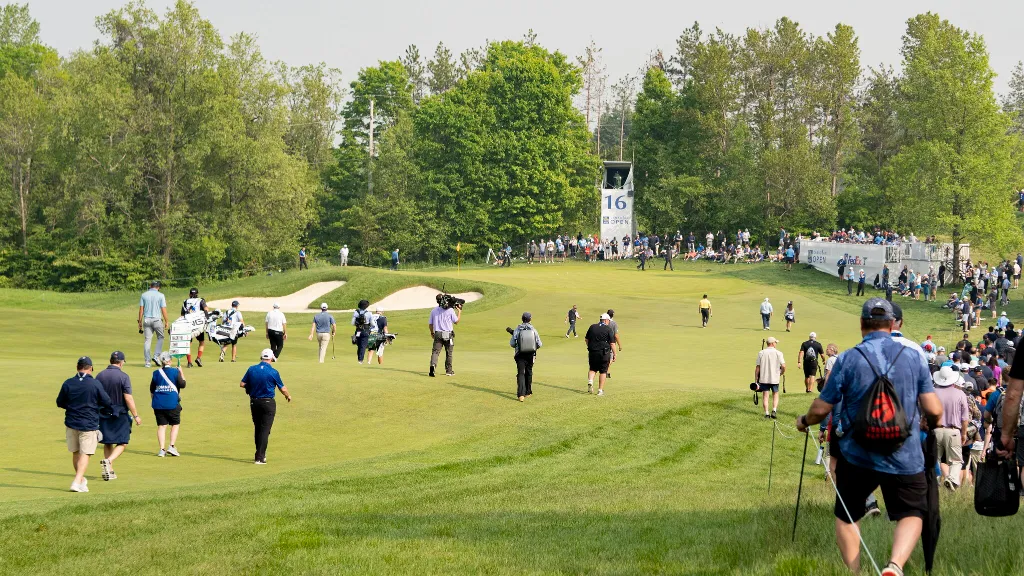
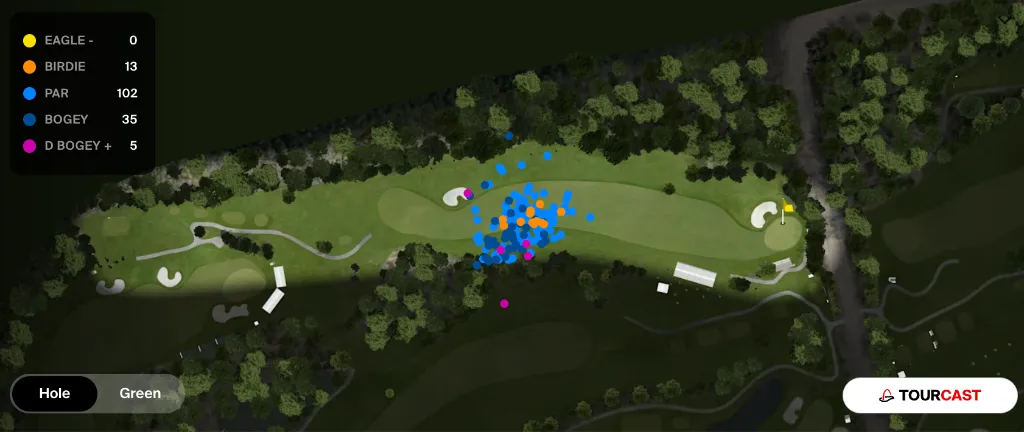
I think this hole did a fantastic job of rewarding excellent tee-to-green play in last year’s Canadian Open. Check out the ShotLink data from last year’s first round (which I’ll note came after heavy rain and, sigh, preferred lies the night before). Because the left hole location was so well protected by the deep bunker and front-to-back left side slope, the only birdies came from the very right side of the fairway. But look at all the bogeys that came from missing in the right rough! Find the preferred angle down the right side, and it’s a green light. But chase that angle and miss, and making par was a stiff challenge.
A closer look at the green reveals that players who bailed safely out right frequently three-putted or failed to get up and down. A two-shotter that puts a mid-iron in a player’s hand and makes them hit a shot of consequence? In this economy???
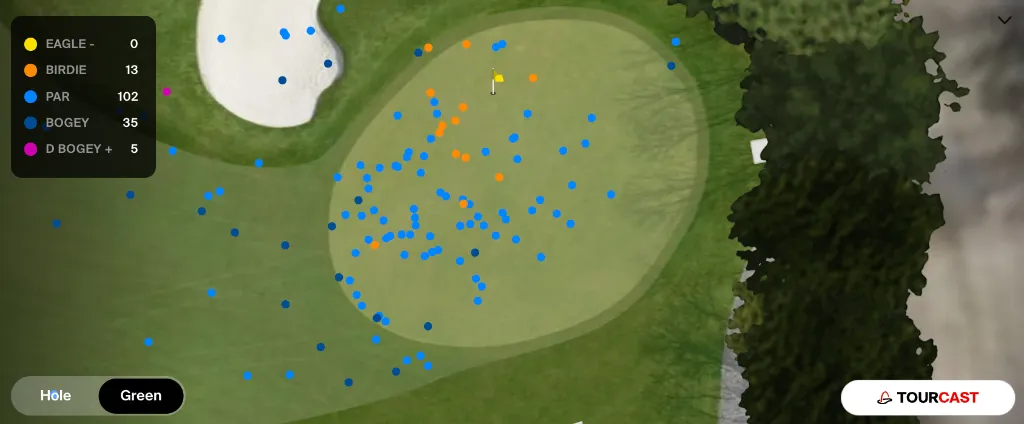
I’d also add that this green offers players multiple ways to get it close, including hitting a shot that releases to the back of the green and funnels down to the left side. I saw Taylor Pendrith do exactly that once in 2019 and probably think about that shot one a week.
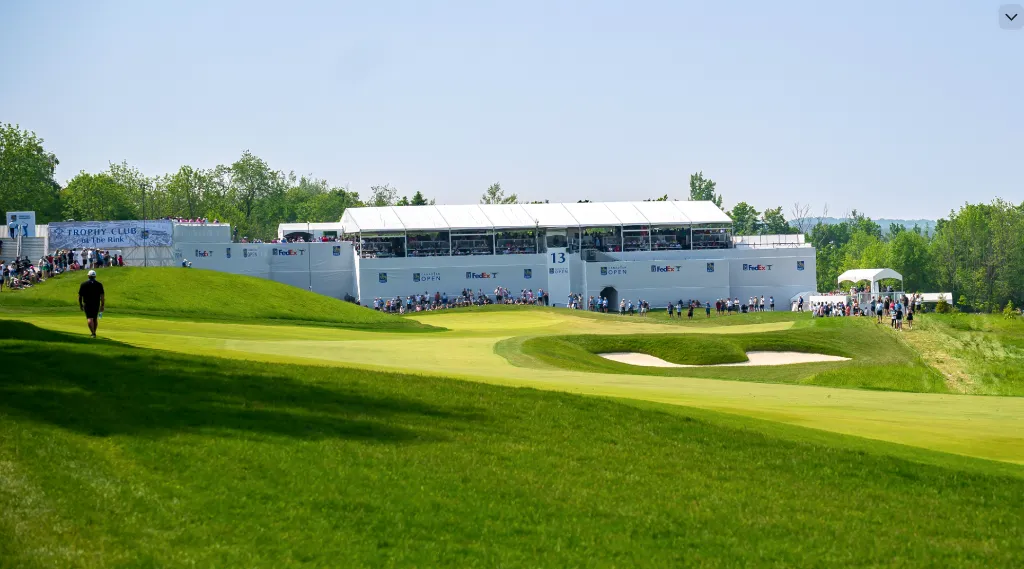
13th hole: Located on one of the best pieces of ground on property, the large mound left of the green is covered with very thick fescue and sets up a preferred angle off the tee down the right side, especially since the fairway cambers severely from left-to-right. From the left side of the fairway, the green is partially obscured and gives the player almost no room to run it up. There’s a bail out area short right, but it was lowered and the front right of the green was raised in the 2023 renovation to make that a very delicate recovery. What that all ads up to: a player who can curve it right-to-left off a left-to-right slope has a significant advantage on this approach shot, while cutting it too close to the mound nets out a stiff penalty and bailing safely right makes the next shot more difficult.
4th hole: In the 2023 renovation, the front right of this green was steeped into a false front, so any tee shots that play too aggressively along the right side or don’t effectively control spin are carried well away from the hole. Check out Max Homa’s tee shot in Round 2: right over the flag with a 9-iron or wedge, but since he cut it too close to the dangerous slope, the ball carried 70 feet away and led to a bogey. He could have played safely left and left himself a very slippery downhill putt, but instead chose to take on the risk and was penalized for cutting it too close.
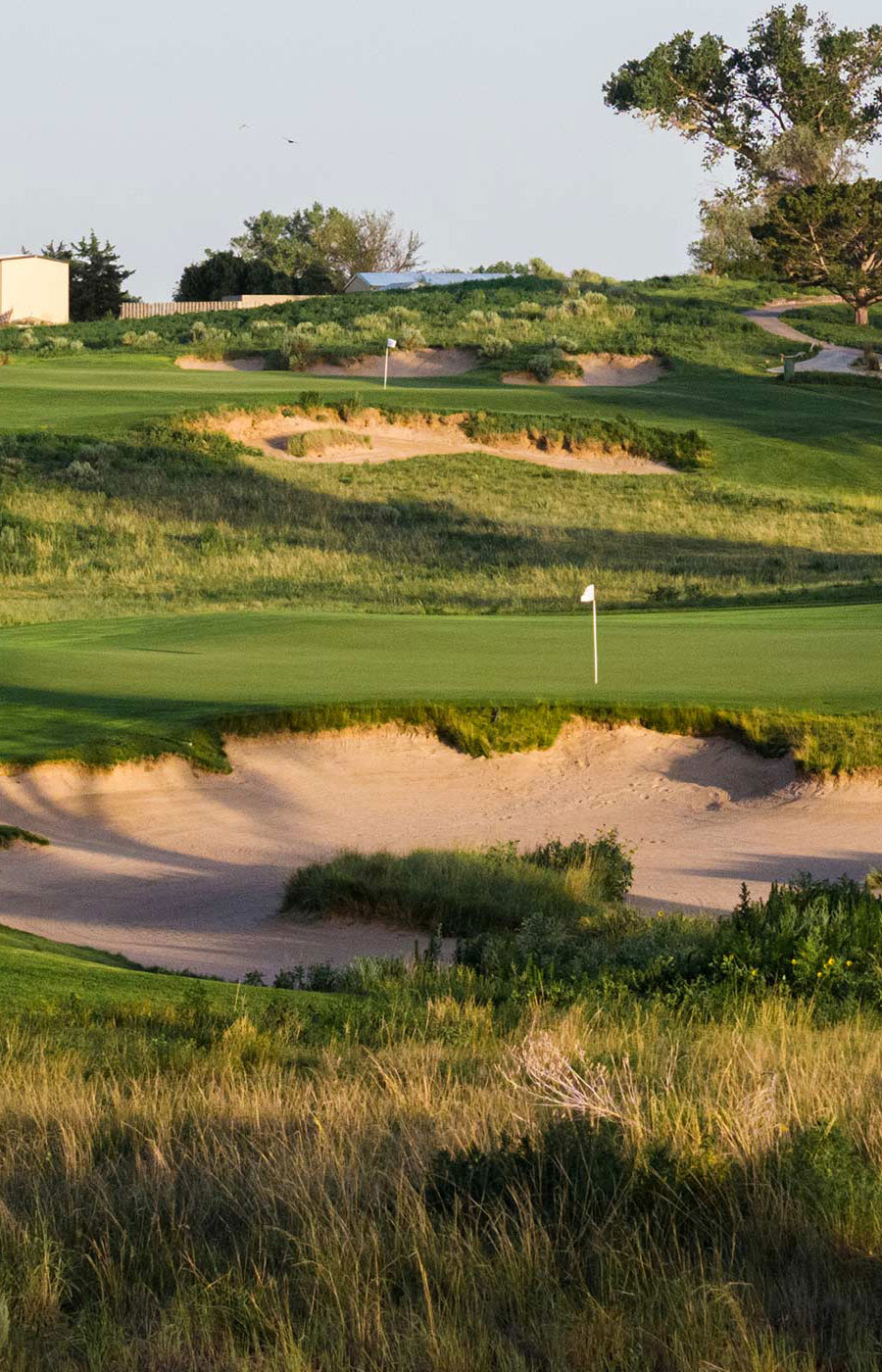
11th hole: 11 features a similar short-right vs. long-left dynamic to 10, except it can play 225 yards and the long/left misses are into a giant wall of extremely thick fescue. On most holes on the North course, there’s a spot available for a player to take their medicine after a miss, hit a smart recovery and get up-and-down. Not so on the 11th - just ask Ludvig. I think that change of pace is a good thing. Joseph’s own venue ranking criteria praise courses that severely penalize wide misses, and I’d humbly suggest that there aren’t many par-3s on Tour that do a better job of that than 11:
I could go on, in particular about the 2nd, 5th, 9th, and 18th greens, but my point is that there are very interesting approach shots to watch for if you know where to look.
—
None of the above information is meant to argue with your perception of the North course if you just don’t like it. Despite my obvious bias and stated fandom of the course, I’ll be the first to admit that it’s not in the same class of course as St. George’s, with its artistic bunkering and fantastic greens, or Hamilton and its routing genius. But that’s also not what the course is trying to do - it’s meant to provide a compelling, credible test for modern tour players while simultaneously giving the PGA Tour and Golf Canada an excellent venue to run a modern tour event and national championship. As the modern venue discourse will tell you, that's not an easy needle to thread.
So, I’ll return to the question that started this journey: what makes a bad course? Are the grevious sins TPC Toronto has apparently committed beyond the pale? If a course can provide a modicum of interest to the enlightened fan, is it truly bad?
I come in peace, and hope to see some responses and discussion here!
Engage in our content with thousands of other Fried Egg Golf Club Members
Engage in our content with thousands of other Fried Egg Golf Club Members

Yolk with Doak 47: New Projects & Listener Q&A






Leave a comment or start a discussion
Lorem ipsum dolor sit amet, consectetur adipiscing elit. Suspendisse varius enim in eros elementum tristique. Duis cursus, mi quis viverra ornare, eros dolor interdum nulla, ut commodo diam libero vitae erat. Aenean faucibus nibh et justo cursus id rutrum lorem imperdiet. Nunc ut sem vitae risus tristique posuere. uis cursus, mi quis viverra ornare, eros dolor interdum nulla, ut commodo diam libero vitae erat. Aenean faucibus nibh et justo cursus id rutrum lorem imperdiet. Nunc ut sem vitae risus tristique posuere.