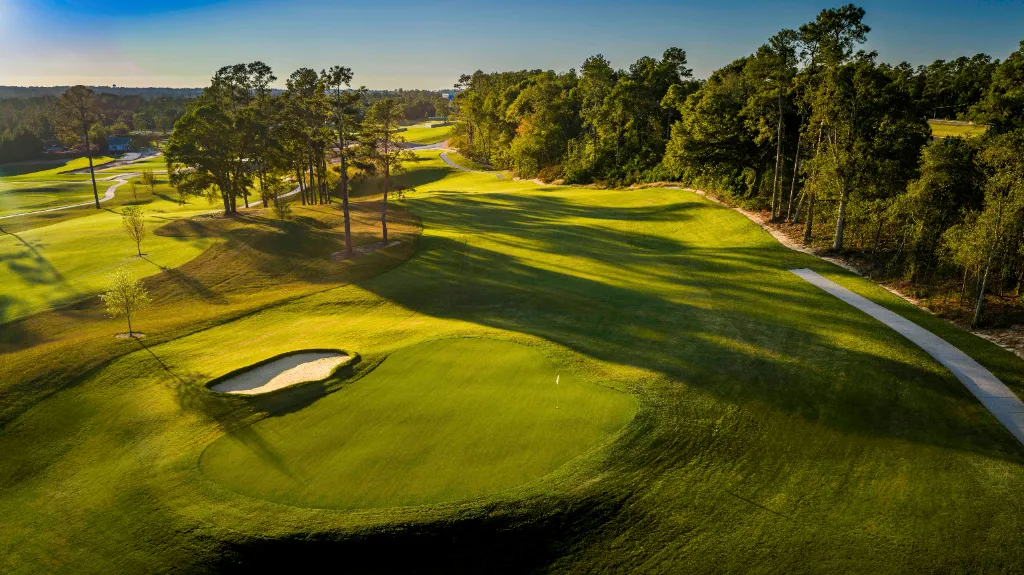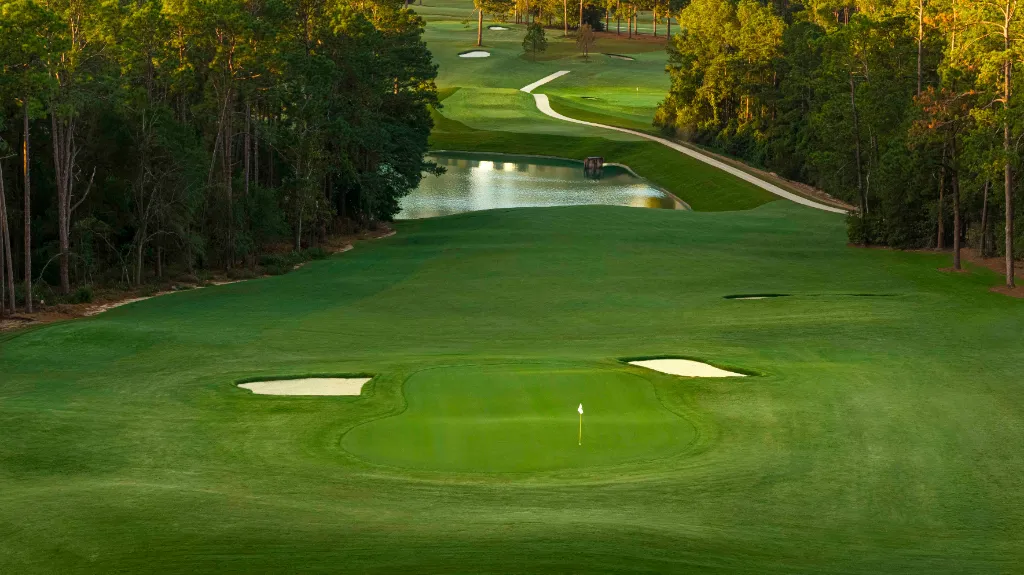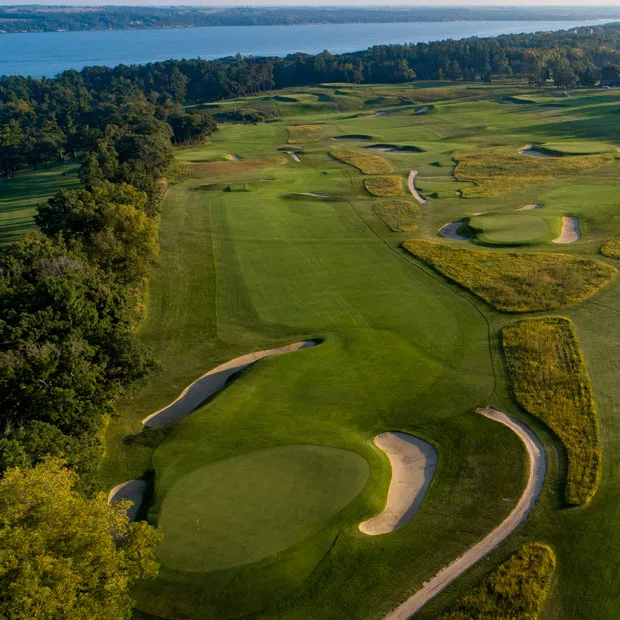
Earlier this week, River Ranch Golf Resort near Pasco, Washington, announced plans for a first golf course designed by David McLay Kidd. I first reported on this development last October.
The property, formerly the site of a winery, features dramatic cliffs above the Snake River.
Kidd's plan calls for an intimately routed front nine and a much more spread-out, looping back nine, with a clifftop 18th hole.
And yes, the fairways will be quite wide.
According to Golfweek, Kidd's team started shaping holes earlier this winter. They hope to begin grassing this April, finish the bunkering in summer 2027, and have the course ready for a fall 2027 or spring 2028 opening. (I'll put my money on 2028.)
River Ranch has not yet publicized plans for additional courses, but if the first 18 does well, you can expect more. The owners have plenty of land. Hell, they could easily fit an executive course on the unused ground inside of Kidd's back nine.
The resort is three hours south of Gamble Sands, where Kidd has designed two 18-hole courses and a short course over the past 12 years. The River Ranch project confirms his ongoing dominance over high-end new builds in the Pacific Northwest. Kidd lives in Bend, Oregon, so it's no surprise that he keeps getting the best jobs in the region.
The city of Pasco — part of central Washington's "Tri-Cities" area — is three and a half hours from both Seattle and Portland, and a little under an hour from Walla Walla, Washington, where Dan Hixson's excellent Wine Valley Golf Club is located. There's a lot of good wine terroir in this region, including the famed Red Mountain, Horse Heaven Hills, and Walla Walla AVAs. So it makes sense that River Ranch is betting on the Tri-Cities as an ascendent weekend destination for well-heeled Seattleites and Portlanders.
Earlier this week, River Ranch Golf Resort near Pasco, Washington, announced plans for a first golf course designed by David McLay Kidd. I first reported on this development last October.
The property, formerly the site of a winery, features dramatic cliffs above the Snake River.
Kidd's plan calls for an intimately routed front nine and a much more spread-out, looping back nine, with a clifftop 18th hole.
And yes, the fairways will be quite wide.
According to Golfweek, Kidd's team started shaping holes earlier this winter. They hope to begin grassing this April, finish the bunkering in summer 2027, and have the course ready for a fall 2027 or spring 2028 opening. (I'll put my money on 2028.)
River Ranch has not yet publicized plans for additional courses, but if the first 18 does well, you can expect more. The owners have plenty of land. Hell, they could easily fit an executive course on the unused ground inside of Kidd's back nine.
The resort is three hours south of Gamble Sands, where Kidd has designed two 18-hole courses and a short course over the past 12 years. The River Ranch project confirms his ongoing dominance over high-end new builds in the Pacific Northwest. Kidd lives in Bend, Oregon, so it's no surprise that he keeps getting the best jobs in the region.
The city of Pasco — part of central Washington's "Tri-Cities" area — is three and a half hours from both Seattle and Portland, and a little under an hour from Walla Walla, Washington, where Dan Hixson's excellent Wine Valley Golf Club is located. There's a lot of good wine terroir in this region, including the famed Red Mountain, Horse Heaven Hills, and Walla Walla AVAs. So it makes sense that River Ranch is betting on the Tri-Cities as an ascendent weekend destination for well-heeled Seattleites and Portlanders.
Just checking in on my boy Nick Dunlap after Andy and Brendan mentioned some big misses off the tee at Sony last week. These are all from the front nine today on the Stadium Course.......
Coming to our event at Philadelphia CC on June 1? Jump in here and show yourself! Feel free to hit the "+ Follow" button at the top right of this post to get email updates when someone else posts in here.
This is long overdue but I'm happy to say that, starting in 2026, our Virtual Hangouts will be available as podcasts! You will always be welcomed and encouraged to join in live, but we know that everyone can't always make our monthly meetings.
The podcast is available as a private RSS feed. You can find instructions on how to add the podcast to your preferred podcast app in the FEGC Podcast Page. Note - This podcast is not available on Spotify as that platform does not allow for private RSS feed podcasts. iPhone users won't have any trouble using the Apple Podcast app and Android users will be best served to use the Pocket Casts app.
Let me know if you have any questions! Welcome to the 21st Century
This is long overdue but I'm happy to say that, starting in 2026, our Virtual Hangouts will be available as podcasts! You will always be welcomed and encouraged to join in live, but we know that everyone can't always make our monthly meetings.
The podcast is available as a private RSS feed. You can find instructions on how to add the podcast to your preferred podcast app in the FEGC Podcast Page. Note - This podcast is not available on Spotify as that platform does not allow for private RSS feed podcasts. iPhone users won't have any trouble using the Apple Podcast app and Android users will be best served to use the Pocket Casts app.
Let me know if you have any questions! Welcome to the 21st Century
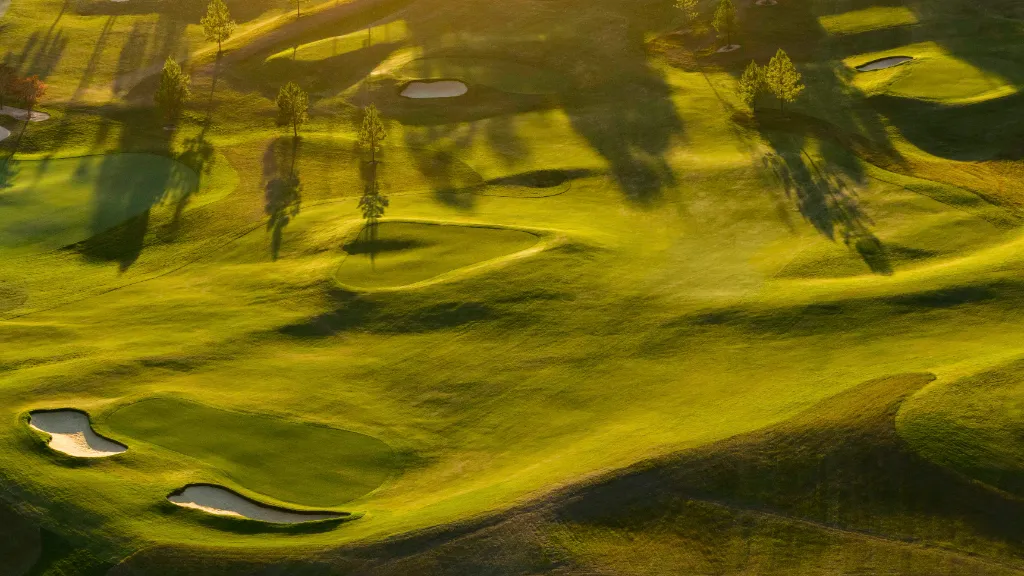
Wanted to get your input on how you could renovate / improve these two holes. The first hole (farthest to the left) is a straightforward par 5 with one bunker on the shared fairway portion. The second is a par 4 where most players can’t hit to the shared bunker and only obstacle is the bunker on the left side of the fairway. Both holes are very straightforward. Hit it straight and that’s it.
We are going to be doing an new irrigation system install and I wanted to put this out there to see if any of you guys had ideas for small ways we could renovate these holes and give more character and strategy to these two holes!
Wanted to get your input on how you could renovate / improve these two holes. The first hole (farthest to the left) is a straightforward par 5 with one bunker on the shared fairway portion. The second is a par 4 where most players can’t hit to the shared bunker and only obstacle is the bunker on the left side of the fairway. Both holes are very straightforward. Hit it straight and that’s it.
We are going to be doing an new irrigation system install and I wanted to put this out there to see if any of you guys had ideas for small ways we could renovate these holes and give more character and strategy to these two holes!
This might be the ultimate Filling Foursomes post.
We had a twosome back out of our trip to SW Ireland at the end of April so we're looking for a couple of FEGC members who are interested in jumping in. Tossing the basics here but please feel free to email me at will@thefriedegg.com with any questions!
The Basics
Dates: April 25-May 2, 2026 (Depart USA on April 25, Return to USA on May 2. Golf on the 26th-1st)
Lodging: Grand Southern Killarney Hotel (4 Nights) & Vaughn Lodge (2 Nights). Lodging is Single Occupancy (each person has their own room)
Included in the Trip: Six rounds of golf, six nights of premium lodging, daily transportation, and two group dinners. Participants are responsible for airfare.
You can find full information of the trip on our Event Page.
This might be the ultimate Filling Foursomes post.
We had a twosome back out of our trip to SW Ireland at the end of April so we're looking for a couple of FEGC members who are interested in jumping in. Tossing the basics here but please feel free to email me at will@thefriedegg.com with any questions!
The Basics
Dates: April 25-May 2, 2026 (Depart USA on April 25, Return to USA on May 2. Golf on the 26th-1st)
Lodging: Grand Southern Killarney Hotel (4 Nights) & Vaughn Lodge (2 Nights). Lodging is Single Occupancy (each person has their own room)
Included in the Trip: Six rounds of golf, six nights of premium lodging, daily transportation, and two group dinners. Participants are responsible for airfare.
You can find full information of the trip on our Event Page.
If an architect in 2026 decided to pull a CB McDonald and go in search of the best holes in the world, to then try and replicate (or mimic) on an ideal 18 hole course,
what holes would you put on the list?
what would a site have to look like to fit your holes on it? [assume all the lidar stuff from Lido is available to you]
what might you adjust about those holes?
These can be any 18 holes you want. You don't have to have a best 1st hole, best 2nd hole, etc., and you don't necessarily have to follow any standard Par 72 construct.
If an architect in 2026 decided to pull a CB McDonald and go in search of the best holes in the world, to then try and replicate (or mimic) on an ideal 18 hole course,
what holes would you put on the list?
what would a site have to look like to fit your holes on it? [assume all the lidar stuff from Lido is available to you]
what might you adjust about those holes?
These can be any 18 holes you want. You don't have to have a best 1st hole, best 2nd hole, etc., and you don't necessarily have to follow any standard Par 72 construct.
Has anyone gone through the Bandon Lottery process in the past? Was fortunate enough to be selected for the June-October window of 2027 (starting in a balmy 1,832th spot). Does anyone know what all I'll book on this venture? Is it just lodging, or will they want to do tee time bookings as well? Just want to know what to expect when they finally get to me.
Following the awesome news from the NLT about partnering with the Friends of Port Townsend Golf Park it got me thinking about what towns and cities across America would make for great partners with the NLT. Where are the best opportunities across America?
Last years NCAA singles champion. Foregoing his last year of college and Masters exemption to join LIV. I’m an Ole Miss fan through and through, and always had mixed feelings about him. Think he will fit right in with LIV.
Fellow eggheads! A discussion on SGS this morning after replaying Caleb Williams's miraculous game-tying touchdown centered around some of the best, most memorable plays that eroded a little bit due to a loss. For me, I cited Rajai Davis's equally miraculous game-tying home run off Aroldis Chapman in Game 7 of the World Series in 2016 that would end in an extra innings loss. A memory for a lifetime even if only a moment of bliss.
Where and when has this phenomenon taken place in golf? There had to be some stakes -- i.e. player in contention -- and the shot is somewhat lost to history because the player did not go on to win the trophy. We want to talk more about this on the next SGS and would love to cite some fellow FEGC members.
Fellow eggheads! A discussion on SGS this morning after replaying Caleb Williams's miraculous game-tying touchdown centered around some of the best, most memorable plays that eroded a little bit due to a loss. For me, I cited Rajai Davis's equally miraculous game-tying home run off Aroldis Chapman in Game 7 of the World Series in 2016 that would end in an extra innings loss. A memory for a lifetime even if only a moment of bliss.
Where and when has this phenomenon taken place in golf? There had to be some stakes -- i.e. player in contention -- and the shot is somewhat lost to history because the player did not go on to win the trophy. We want to talk more about this on the next SGS and would love to cite some fellow FEGC members.
I woke up one day earlier this month to yet another drive-by on my beloved TPC Toronto in the Fried Egg newsletter from Mr. LaMagna, who ranked it in the pleasantly titled tier ‘Unfortunately, It’s a Golf Course.’ In the interest of disclosure, I work at TPC Toronto, so if you want to dismiss everything that follows here as flak or propaganda, that’s fair game.
I will say I’ve chuckled at the many JLM zingers coming at my employer’s expense over the past year, including this one during last year’s Canadian Open.
With that said, this latest zinger got me thinking about what makes for a ‘bad’ golf course, and I can’t help myself from stepping into traffic here to talk about a course I know well and, I think, is poorly understood. For whatever it’s worth, I do believe I’m writing this not out of professional obligation, but because I’ve spent a huge amount of time thinking about this course and hope to engage in some discussion around it here.
According to what’s been written and said by folks from Fried Egg Golf, Golf Club Atlas, No Laying Up and others, we have committed some grievous sins with our North course. The prevailing narrative goes: the bunkers are repetitive, it’s a long and boring slog, the greens are flat pancakes, it rewards bomb-and-gouge specialists, and its overall look is generally out of line with the current architecture zeitgeist. Oh, and it’s a ’run of the mill TPC.’
While I disagree with those, and not just because they’re mostly been posited by people who have never set foot on the property, I won’t attempt to refute them here (though regarding the bunker shapes, you may be surprised to learn the course was designed to be played from the ground, not Google Maps). Our work is in the public sphere and criticism is fair game. If you don’t like it, you don’t like it, and that’s just an innate part of evaluating golf courses
Instead, I want to point to a few things that I enjoy about the course and have not seen discussed much in these spaces. There are some aspects to the course I’ve learned to appreciate having played, photographed and talked about it for years, and while truthfully I hope to change some people’s minds about the course, the reason I’m choosing to write it here (of all places!) is that I hope to inspire some discussion about what is worthy of criticism and derision, and what really makes for a ‘bad’ golf course.
What criteria should really banish a venue to the ‘Unfortunately, It’s a Golf Course’ tier? What is the threshold of redeeming qualities a course must possess to elevate out of that tier? And even when a course fails that litmus test, how hard should a fan or commentator have to look to find something interesting? I’ll make my case below, then return to the question.
--
1. Emphasis on Tee-to-Green play
The premise of the North course’s 2023 renovation was to make tee-to-green play actually matter. The thinking for how we aimed to accomplish that: We know modern, technologically-optimized players are going to score well no matter what we do. Instead of trying to arbitrarily manipulate scoring with narrow targets, thick rough and more hazards, let’s create opportunities for the best players to earn their scoring opportunities with great long game play. If players continually decline risk off the tee and into the greens, their ability to keep pace with whoever is playing best that week will be compromised.
When I looked up Data Golf’s course summary from last year’s Canadian Open, I wasn’t sure this would be reflected in the results. I was admittedly expecting to find evidence of a ‘Piece of Sh*t Putting Contest’, owing to the soft conditions from the heavy Wednesday rain and the fact that there was snow on the ground less than 50 freaking days before the tournament. However, at risk of being a numbers-blinded #DataBoy and misinterpreting the below chart, I was surprised to find that the Within-Event Correlations and Course Insights showed that players who gained strokes on the field did so overwhelmingly with the long game. In particular, distance having such a negligible impact on total strokes gained goes against the prevailing critique that the North course is a Ball Speed Impostor’s paradise, where speed is the only number that matters and all you need to do to win is hit it far and make a few putts:
Players who gained strokes on the field in 2025 did so primarily with driving accuracy and approach play
Course Insights point to approach play as the strongest influence on scoring variance, while the course slightly favoured accurate drivers
It’s just one year’s worth of data and these are raw correlations, but to see evidence that the course actually played in line with the design’s premise suggests that, despite the jokes about Cameron Champ leading well into the weekend, there’s something here beyond a mindless bomber’s paradise.
2. Approach shot length variety
Members of this forum are obviously familiar with modern equipment’s muting on shotmaking skill, and know that only the rarest venues and weather conditions really emphasize these skills in the men’s pro game. To be sure, the ways most often mentioned among a course’s tools to combat this - truly exceptional green contouring, or exposure to forceful natural elements, for example - are not a strength of the North course, and I’m not here to convince you otherwise.
However, to me one of the course’s strongest traits is undeniably the variety of approach clubs it can put in players’ hands, and the variety of approach distances, if not types of approach shots, players face during a round. I love how the course is essentially bifurcated into scoring opportunities (short approaches) and what Ian Andrew, the renovation architect, calls ‘perseverance’ holes (long approaches).
Below is the Approach Shot Distribution from last year’s event, via Data Golf. As you can see, there are a much higher number of very short and very long approaches compared to the average Tour course.
• 14-15, scoring holes (short par-3, short par-4 with sharp dogleg)
• 16-17, perseverance holes (very long par-4s)
• 18, scoring hole (reachable, risk-reward par-5)
The par-3s are also well positioned to give the players a variety of yardages and wind directions. 7 and 11 can both play between 190 to 230+ but play in opposite directions, so they give players opposite wind directions, and can both require a long approach club. 4 and 14 both give players a different look at a shorter club, with 14’s internal punchbowl and 4’s severe upside-down saucer runoff area on the right side. Ultimately this is meant to test a variety of approach shot skills, plus add a fun psychological element of the back-and-forth between easy and difficult holes.
For what it’s worth, I think the Tour could, should and will lean into this dynamic more when it comes to course setup in 2026.
—
3. Approach shot tests:
I can’t blame folks who saw the course for the first time on TV last June and saw a set of soft dartboard greens - between the heavy rain on Wednesday and humid, windless conditions the rest of the week, I’m not sure any course’s greens would have looked very interesting from TV Tower-level perspectives. However, beyond just a variety of yardages players have into greens, there are some approach shots I find very interesting to watch even in pillow-soft conditions, and which turn outright fascinating if things get firm and spicy (like they did when the course hosted the 2024 PGA Tour Americas Tour Championship and the winning score was only 5-under). I’d argue that the following approach shots:
• Reward aggressive risk-taking
• Penalize misses that cut it too close to the danger
• Make subsequent shots much harder after conservative play.
10th hole: With a water hazard short right and a false front/closely mown runoff area short right, balls that don’t carry far enough into the green or have too much spin will roll back, even if they’re 4-5 paces onto the green. But bailing long or left means playing back towards that same hazard, which makes for a very delicate two-putt or up and down. There’s a nice element of deferred risk and “take on the hazard now, or later” to this one, especially since the S-shaped, cambered fairway requires an actual golf shot to hit. To me it’s kind of crazy that on a course where there are two extremely long par-3s and six par-4s that can play 500 yards (including two that are just converted par-5s - shoutout to the TPC Summerlin Model, #ParIsASocialConstruct), a 415-yard par-4 could play as the sixth hardest hole, as it did for the week. My friend Jake Scott explained it better than I ever could here in this video.
16th hole: For my money, this is the best green on the course. Perhaps someone more learned in the GCA lexicon can tell me what this is called, but basically the right half the green is severely back-to-front, while the left side is severely front-to-back. You can get a better appreciation for it in this photo:
I think this hole did a fantastic job of rewarding excellent tee-to-green play in last year’s Canadian Open. Check out the ShotLink data from last year’s first round (which I’ll note came after heavy rain and, sigh, preferred lies the night before). Because the left hole location was so well protected by the deep bunker and front-to-back left side slope, the only birdies came from the very right side of the fairway. But look at all the bogeys that came from missing in the right rough! Find the preferred angle down the right side, and it’s a green light. But chase that angle and miss, and making par was a stiff challenge.
A closer look at the green reveals that players who bailed safely out right frequently three-putted or failed to get up and down. A two-shotter that puts a mid-iron in a player’s hand and makes them hit a shot of consequence? In this economy???
I’d also add that this green offers players multiple ways to get it close, including hitting a shot that releases to the back of the green and funnels down to the left side. I saw Taylor Pendrith do exactly that once in 2019 and probably think about that shot one a week.
13th hole: Located on one of the best pieces of ground on property, the large mound left of the green is covered with very thick fescue and sets up a preferred angle off the tee down the right side, especially since the fairway cambers severely from left-to-right. From the left side of the fairway, the green is partially obscured and gives the player almost no room to run it up. There’s a bail out area short right, but it was lowered and the front right of the green was raised in the 2023 renovation to make that a very delicate recovery. What that all ads up to: a player who can curve it right-to-left off a left-to-right slope has a significant advantage on this approach shot, while cutting it too close to the mound nets out a stiff penalty and bailing safely right makes the next shot more difficult.
4th hole: In the 2023 renovation, the front right of this green was steeped into a false front, so any tee shots that play too aggressively along the right side or don’t effectively control spin are carried well away from the hole. Check out Max Homa’s tee shot in Round 2: right over the flag with a 9-iron or wedge, but since he cut it too close to the dangerous slope, the ball carried 70 feet away and led to a bogey. He could have played safely left and left himself a very slippery downhill putt, but instead chose to take on the risk and was penalized for cutting it too close.
11th hole: 11 features asimilar short-right vs. long-left dynamic to 10, except it can play 225 yards and the long/left misses are into a giant wall of extremely thick fescue. On most holes on the North course, there’s a spot available for a player to take their medicine after a miss, hit a smart recovery and get up-and-down. Not so on the 11th - just ask Ludvig. I think that change of pace is a good thing. Joseph’s own venue ranking criteria praise courses that severely penalize wide misses, and I’d humbly suggest that there aren’t many par-3s on Tour that do a better job of that than 11:
I could go on, in particular about the 2nd, 5th, 9th, and 18th greens, but my point is that there are very interesting approach shots to watch for if you know where to look.
—
None of the above information is meant to argue with your perception of the North course if you just don’t like it. Despite my obvious bias and stated fandom of the course, I’ll be the first to admit that it’s not in the same class of course as St. George’s, with its artistic bunkering and fantastic greens, or Hamilton and its routing genius. But that’s also not what the course is trying to do - it’s meant to provide a compelling, credible test for modern tour players while simultaneously giving the PGA Tour and Golf Canada an excellent venue to run a modern tour event and national championship. As the modern venue discourse will tell you, that's not an easy needle to thread.
So, I’ll return to the question that started this journey: what makes a bad course? Are the grevious sins TPC Toronto has apparently committed beyond the pale? If a course can provide a modicum of interest to the enlightened fan, is it truly bad?
I come in peace, and hope to see some responses and discussion here!
I woke up one day earlier this month to yet another drive-by on my beloved TPC Toronto in the Fried Egg newsletter from Mr. LaMagna, who ranked it in the pleasantly titled tier ‘Unfortunately, It’s a Golf Course.’ In the interest of disclosure, I work at TPC Toronto, so if you want to dismiss everything that follows here as flak or propaganda, that’s fair game.
I will say I’ve chuckled at the many JLM zingers coming at my employer’s expense over the past year, including this one during last year’s Canadian Open.
With that said, this latest zinger got me thinking about what makes for a ‘bad’ golf course, and I can’t help myself from stepping into traffic here to talk about a course I know well and, I think, is poorly understood. For whatever it’s worth, I do believe I’m writing this not out of professional obligation, but because I’ve spent a huge amount of time thinking about this course and hope to engage in some discussion around it here.
According to what’s been written and said by folks from Fried Egg Golf, Golf Club Atlas, No Laying Up and others, we have committed some grievous sins with our North course. The prevailing narrative goes: the bunkers are repetitive, it’s a long and boring slog, the greens are flat pancakes, it rewards bomb-and-gouge specialists, and its overall look is generally out of line with the current architecture zeitgeist. Oh, and it’s a ’run of the mill TPC.’
While I disagree with those, and not just because they’re mostly been posited by people who have never set foot on the property, I won’t attempt to refute them here (though regarding the bunker shapes, you may be surprised to learn the course was designed to be played from the ground, not Google Maps). Our work is in the public sphere and criticism is fair game. If you don’t like it, you don’t like it, and that’s just an innate part of evaluating golf courses
Instead, I want to point to a few things that I enjoy about the course and have not seen discussed much in these spaces. There are some aspects to the course I’ve learned to appreciate having played, photographed and talked about it for years, and while truthfully I hope to change some people’s minds about the course, the reason I’m choosing to write it here (of all places!) is that I hope to inspire some discussion about what is worthy of criticism and derision, and what really makes for a ‘bad’ golf course.
What criteria should really banish a venue to the ‘Unfortunately, It’s a Golf Course’ tier? What is the threshold of redeeming qualities a course must possess to elevate out of that tier? And even when a course fails that litmus test, how hard should a fan or commentator have to look to find something interesting? I’ll make my case below, then return to the question.
--
1. Emphasis on Tee-to-Green play
The premise of the North course’s 2023 renovation was to make tee-to-green play actually matter. The thinking for how we aimed to accomplish that: We know modern, technologically-optimized players are going to score well no matter what we do. Instead of trying to arbitrarily manipulate scoring with narrow targets, thick rough and more hazards, let’s create opportunities for the best players to earn their scoring opportunities with great long game play. If players continually decline risk off the tee and into the greens, their ability to keep pace with whoever is playing best that week will be compromised.
When I looked up Data Golf’s course summary from last year’s Canadian Open, I wasn’t sure this would be reflected in the results. I was admittedly expecting to find evidence of a ‘Piece of Sh*t Putting Contest’, owing to the soft conditions from the heavy Wednesday rain and the fact that there was snow on the ground less than 50 freaking days before the tournament. However, at risk of being a numbers-blinded #DataBoy and misinterpreting the below chart, I was surprised to find that the Within-Event Correlations and Course Insights showed that players who gained strokes on the field did so overwhelmingly with the long game. In particular, distance having such a negligible impact on total strokes gained goes against the prevailing critique that the North course is a Ball Speed Impostor’s paradise, where speed is the only number that matters and all you need to do to win is hit it far and make a few putts:
Players who gained strokes on the field in 2025 did so primarily with driving accuracy and approach play
Course Insights point to approach play as the strongest influence on scoring variance, while the course slightly favoured accurate drivers
It’s just one year’s worth of data and these are raw correlations, but to see evidence that the course actually played in line with the design’s premise suggests that, despite the jokes about Cameron Champ leading well into the weekend, there’s something here beyond a mindless bomber’s paradise.
2. Approach shot length variety
Members of this forum are obviously familiar with modern equipment’s muting on shotmaking skill, and know that only the rarest venues and weather conditions really emphasize these skills in the men’s pro game. To be sure, the ways most often mentioned among a course’s tools to combat this - truly exceptional green contouring, or exposure to forceful natural elements, for example - are not a strength of the North course, and I’m not here to convince you otherwise.
However, to me one of the course’s strongest traits is undeniably the variety of approach clubs it can put in players’ hands, and the variety of approach distances, if not types of approach shots, players face during a round. I love how the course is essentially bifurcated into scoring opportunities (short approaches) and what Ian Andrew, the renovation architect, calls ‘perseverance’ holes (long approaches).
Below is the Approach Shot Distribution from last year’s event, via Data Golf. As you can see, there are a much higher number of very short and very long approaches compared to the average Tour course.
• 14-15, scoring holes (short par-3, short par-4 with sharp dogleg)
• 16-17, perseverance holes (very long par-4s)
• 18, scoring hole (reachable, risk-reward par-5)
The par-3s are also well positioned to give the players a variety of yardages and wind directions. 7 and 11 can both play between 190 to 230+ but play in opposite directions, so they give players opposite wind directions, and can both require a long approach club. 4 and 14 both give players a different look at a shorter club, with 14’s internal punchbowl and 4’s severe upside-down saucer runoff area on the right side. Ultimately this is meant to test a variety of approach shot skills, plus add a fun psychological element of the back-and-forth between easy and difficult holes.
For what it’s worth, I think the Tour could, should and will lean into this dynamic more when it comes to course setup in 2026.
—
3. Approach shot tests:
I can’t blame folks who saw the course for the first time on TV last June and saw a set of soft dartboard greens - between the heavy rain on Wednesday and humid, windless conditions the rest of the week, I’m not sure any course’s greens would have looked very interesting from TV Tower-level perspectives. However, beyond just a variety of yardages players have into greens, there are some approach shots I find very interesting to watch even in pillow-soft conditions, and which turn outright fascinating if things get firm and spicy (like they did when the course hosted the 2024 PGA Tour Americas Tour Championship and the winning score was only 5-under). I’d argue that the following approach shots:
• Reward aggressive risk-taking
• Penalize misses that cut it too close to the danger
• Make subsequent shots much harder after conservative play.
10th hole: With a water hazard short right and a false front/closely mown runoff area short right, balls that don’t carry far enough into the green or have too much spin will roll back, even if they’re 4-5 paces onto the green. But bailing long or left means playing back towards that same hazard, which makes for a very delicate two-putt or up and down. There’s a nice element of deferred risk and “take on the hazard now, or later” to this one, especially since the S-shaped, cambered fairway requires an actual golf shot to hit. To me it’s kind of crazy that on a course where there are two extremely long par-3s and six par-4s that can play 500 yards (including two that are just converted par-5s - shoutout to the TPC Summerlin Model, #ParIsASocialConstruct), a 415-yard par-4 could play as the sixth hardest hole, as it did for the week. My friend Jake Scott explained it better than I ever could here in this video.
16th hole: For my money, this is the best green on the course. Perhaps someone more learned in the GCA lexicon can tell me what this is called, but basically the right half the green is severely back-to-front, while the left side is severely front-to-back. You can get a better appreciation for it in this photo:
I think this hole did a fantastic job of rewarding excellent tee-to-green play in last year’s Canadian Open. Check out the ShotLink data from last year’s first round (which I’ll note came after heavy rain and, sigh, preferred lies the night before). Because the left hole location was so well protected by the deep bunker and front-to-back left side slope, the only birdies came from the very right side of the fairway. But look at all the bogeys that came from missing in the right rough! Find the preferred angle down the right side, and it’s a green light. But chase that angle and miss, and making par was a stiff challenge.
A closer look at the green reveals that players who bailed safely out right frequently three-putted or failed to get up and down. A two-shotter that puts a mid-iron in a player’s hand and makes them hit a shot of consequence? In this economy???
I’d also add that this green offers players multiple ways to get it close, including hitting a shot that releases to the back of the green and funnels down to the left side. I saw Taylor Pendrith do exactly that once in 2019 and probably think about that shot one a week.
13th hole: Located on one of the best pieces of ground on property, the large mound left of the green is covered with very thick fescue and sets up a preferred angle off the tee down the right side, especially since the fairway cambers severely from left-to-right. From the left side of the fairway, the green is partially obscured and gives the player almost no room to run it up. There’s a bail out area short right, but it was lowered and the front right of the green was raised in the 2023 renovation to make that a very delicate recovery. What that all ads up to: a player who can curve it right-to-left off a left-to-right slope has a significant advantage on this approach shot, while cutting it too close to the mound nets out a stiff penalty and bailing safely right makes the next shot more difficult.
4th hole: In the 2023 renovation, the front right of this green was steeped into a false front, so any tee shots that play too aggressively along the right side or don’t effectively control spin are carried well away from the hole. Check out Max Homa’s tee shot in Round 2: right over the flag with a 9-iron or wedge, but since he cut it too close to the dangerous slope, the ball carried 70 feet away and led to a bogey. He could have played safely left and left himself a very slippery downhill putt, but instead chose to take on the risk and was penalized for cutting it too close.
11th hole: 11 features asimilar short-right vs. long-left dynamic to 10, except it can play 225 yards and the long/left misses are into a giant wall of extremely thick fescue. On most holes on the North course, there’s a spot available for a player to take their medicine after a miss, hit a smart recovery and get up-and-down. Not so on the 11th - just ask Ludvig. I think that change of pace is a good thing. Joseph’s own venue ranking criteria praise courses that severely penalize wide misses, and I’d humbly suggest that there aren’t many par-3s on Tour that do a better job of that than 11:
I could go on, in particular about the 2nd, 5th, 9th, and 18th greens, but my point is that there are very interesting approach shots to watch for if you know where to look.
—
None of the above information is meant to argue with your perception of the North course if you just don’t like it. Despite my obvious bias and stated fandom of the course, I’ll be the first to admit that it’s not in the same class of course as St. George’s, with its artistic bunkering and fantastic greens, or Hamilton and its routing genius. But that’s also not what the course is trying to do - it’s meant to provide a compelling, credible test for modern tour players while simultaneously giving the PGA Tour and Golf Canada an excellent venue to run a modern tour event and national championship. As the modern venue discourse will tell you, that's not an easy needle to thread.
So, I’ll return to the question that started this journey: what makes a bad course? Are the grevious sins TPC Toronto has apparently committed beyond the pale? If a course can provide a modicum of interest to the enlightened fan, is it truly bad?
I come in peace, and hope to see some responses and discussion here!
I'm looking for some questions for this month's TFE Mailbag, both the sacred and the profane. I had a lot of fun with the last one, which you can read here:
Next Wednesday, we're gathering for this month's hangout with Brendan, KVV, and Garrett to discuss our 2026 Fried Egg plans across the content front. The recording will be at Noon ET on January 21. Link to join in live is below as well as the article in the Clubhouse.
What questions do you have for the group? It can be about our content plans, travel plans, personal plans, Jordan Spieth's season outlook, etc.
Next Wednesday, we're gathering for this month's hangout with Brendan, KVV, and Garrett to discuss our 2026 Fried Egg plans across the content front. The recording will be at Noon ET on January 21. Link to join in live is below as well as the article in the Clubhouse.
What questions do you have for the group? It can be about our content plans, travel plans, personal plans, Jordan Spieth's season outlook, etc.
Bryson DeChambeau just became the first professional golfer to endorse a prediction market. Of course he did.
The self-proclaimed scientist, golf's most insufferable mix of pseudo-intellectualism and shameless opportunism, has signed with Kalshi to become their billboard. Complete with TV commercials and, most disturbingly, "the launch of markets on events he plays in."
If you're wondering how we got to a place where athletes can openly partner with platforms that let people bet on their own performances, with zero insider trading protections, while everyone in charge just shrugs, welcome to 2026. Where regulatory capture meets algorithmic manipulation meets artificial intelligence, and a guy who once tried to convince us he could science his way to golf dominance is now trying to convince us that turning sport into a betting market is innovation.
The Grand Bargain Nobody Made
Kalshi is a prediction market. That's the sanitized term for what is, functionally, a betting platform where you can wager on virtually anything. Press conference lengths. Whether Israel will start a nuclear war with Iran. Whether Bryson DeChambeau finishes in the top 20 at the Masters.
Brian Phillips at The Ringer recently explained the regulatory sleight of hand that made this possible. Kalshi convinced the government it wasn't a gambling platform but a derivatives market. This one classification unlocked everything: they can operate in states where sports betting is illegal, they face none of the scrutiny applied to actual sportsbooks, and, crucially, unlike stock markets that prohibit insider trading, derivatives markets have no such restrictions.
Let me repeat that: There is nothing stopping someone with direct knowledge of an outcome from betting on that outcome and taking your money.
Kalshi's CEO has said the promise of prediction markets "is to financialize everything and create a tradable asset out of any difference in opinion."
The explicit goal is to turn every aspect of human existence into something people can bet on, and more importantly, something insiders can manipulate for profit. And the people who could stop this, who should stop this, are instead partnering with them. CNN and CNBC both signed deals with Kalshi. The Golden Globes integrated Polymarket into their broadcast.
Why Bryson Is Perfect For This
Of course it's Bryson. The guy who rebranded himself as golf's great thinker, who talks about physics and science while demonstrating neither, who left the PGA Tour for LIV's blood money while claiming it was about "growing the game."
And now he's partnering with a platform that will create betting markets on his own performances. Not adjacent to them. Not theoretically related. Directly on them.
The implications are obvious to anyone who's thought about sports integrity for five minutes. Can you trust a guy with financial ties to a betting platform is trying his hardest on a random Sunday at a LIV event? When finishing T-27 instead of T-18 means nothing to his bank account but might mean hundreds of thousands to someone who knew it was coming? When every decision (lay up or go for it, aggressive line or conservative, one more practice putt or call it) has twenty plausible explanations?
But here's the thing: you don't even need actual corruption for this to be corrosive. The mere appearance of a conflict of interest destroys trust. And golf, more than most sports, runs on trust. There are no referees watching every shot. Players call penalties on themselves. The entire structure assumes everyone is competing on merit.
If the USGA and Augusta National and the R&A have any sense of institutional responsibility, they'd take a hard look at whether someone with direct financial ties to a betting platform (I mean predictions market) that creates markets on his performance should be welcome in their fields.
The Perfect Storm: Three Trends Converging at the Worst Possible Time
What makes this particularly dangerous isn't just prediction markets in isolation. It's that they're emerging at the exact moment when three massive tech trends are colliding, and nobody in a position of authority seems interested in pumping the brakes.
First: The gutting of content moderation. Social media platforms have systematically dismantled their safeguards against misinformation. Twitter is a disinformation playground. Meta fired most of its content moderation staff. There's no one watching the gates anymore.
Second: AI-powered manipulation at scale. Want to move a betting line? Generate a deepfake video showing Bryson limping after a practice round. Create fake text screenshots suggesting he's injured. Deploy bot networks to amplify the rumors across social platforms. The technology exists now, costs almost nothing, and gets more sophisticated every week.
Third: The prediction markets themselves. Which, as we've established, have no insider trading protections, accept anonymous cryptocurrency bets, and are being actively integrated into news coverage.
Here's how it could work: Someone places a massive bet against Bryson winning the U.S. Open. They generate and spread AI-created "evidence" of an injury or scandal. The rumors proliferate on unmoderated social platforms. Other traders see the odds shifting and pile on. The conspirators cash out. And maybe Bryson never even knows it happened until reporters start asking questions based on the fake news.
Or worse, the odds become the news. CNN and CNBC are using Kalshi data in their coverage. News shapes public perception, which shapes betting behavior, which appears as "data," which shapes more news. It's a closed loop where reality and perception blur, and somewhere in the middle, insiders extract money from the confused masses.
This already happens. The Times reports that someone using a brand-new crypto account bet $34,000 against very long odds on Venezuela's Maduro losing power, wagering most of it just hours before news of his capture broke. They walked away with $410,000. Similar suspicious trading patterns appeared around Trump's pardon of Binance founder Changpeng Zhao.
Kalshi claims to prohibit insider trading and checks trades against a database of "politically exposed people." But as Timothy Massad, who led the CFTC under Obama, told the Times: "It's very difficult for the platforms themselves to prevent this or the C.F.T.C. to prohibit it." The law is so vague it's virtually impossible to enforce.
And the people who should be regulating this, preventing this, stopping this? They're partnering with them instead. Major news networks. Awards shows. The president's son. And now, most pertinent to the audience reading this about sport, athletes themselves.
The Regulatory Vacuum
Traditional sportsbooks don't let athletes become spokespeople for betting on their own performances. There's a firewall, however imperfect, between competition and gambling. Athletes can't bet on their own sports. Regulations exist to maintain competitive integrity.
Prediction markets ignore all of that. They're not regulated as gambling. They're derivatives markets. Different rules. Fewer protections. And now they're paying athletes directly to promote betting on those same athletes' performances.
The counter-argument is that sports betting already exists, so what's the difference? The difference is oversight. The difference is separation. The difference is that we had, however imperfectly, some guardrails. Prediction markets are dismantling those guardrails while the people in charge either don't understand what's happening or don't care.
DraftKings and FanDuel (who we should also note have some pretty deplorable business practices) both launched prediction markets in December. More will follow. The money is too big. The technology is too powerful. The regulations are too weak. And nobody's stepping in to stop it.
Or Rather, The People Who Should Be Stopping It Are Getting Paid
Actually, it's worse than nobody stepping in. The people positioned to regulate these platforms are actively invested in them.
A New York Times report published today, January 15, 2026, reveals that Donald Trump Jr. is simultaneously an investor in and adviser to Polymarket, a paid adviser to Kalshi, and a director of Trump Media, which just announced its own prediction market platform called Truth Predict. He's literally advising the two biggest competitors in the space while his father's administration oversees their regulation.
The Commodity Futures Trading Commission, which is supposed to police these markets, spent the Biden years trying to constrain them. Then Caroline Pham took over temporarily under Trump and said the agency had "unfairly constrained" prediction markets and needed to "back off." Both Kalshi and Polymarket's CEOs now sit on the CFTC's innovation council, helping shape policy on the very industry they profit from.
The timeline is damning: A week before Trump's inauguration, Kalshi hired Don Jr. as a strategic adviser. Four months later, the CFTC dropped its appeal of a ruling that had banned Kalshi from election betting. Polymarket was under investigation by both the FBI and CFTC. In July, both investigations closed. In August, Don Jr. invested in Polymarket and joined its advisory board. A week later, the CFTC issued a ruling that cleared obstacles for Polymarket to serve U.S. traders.
This isn't regulatory capture. This is regulatory demolition. The agencies meant to protect the public from predatory gambling are instead partnering with the gamblers, taking their advice, and clearing their legal obstacles. All while the president's son collects checks from multiple platforms and helps launch a competing one.
And now athletes like Bryson are free to sign deals that would have been unthinkable three years ago, because the people who could stop them are literally on the payroll.
The Exit Nobody's Looking For
Bryson DeChambeau is a cancer to the fabric of golf. Not because he hits it far or changed his body or plays on LIV. Because at every opportunity, he chooses the path that enriches himself while degrading the sport. The pseudo-intellectual act, the Saudi money, and now this, partnering with a platform designed to turn competition into content for betting markets.
He's the perfect avatar for this moment. The guy who talks about science while understanding nothing about institutional trust. Who claims to love golf while actively participating in its corruption. Who sees the future of sports as something to be financialized and extracted, and signs up to be the face of that extraction.
But Bryson's just a symptom. The disease is that the people who could stop this, who should stop this, are instead enabling it. The CFTC dropped its enforcement. Don Jr. is collecting checks from both major platforms while his father's administration clears their legal obstacles. News networks are integrating betting odds into their coverage. And nobody with actual power seems to think there's a problem.
This is happening in real-time. The momentum is all in the wrong direction. The money is too big. The technology is too powerful. The regulators have been captured. And the platforms have explicitly said their goal is to financialize everything.
When we look back in five years at how sports became indistinguishable from professional wrestling, how we stopped being able to trust what we were watching, we'll remember this moment. January 2026. When a guy who hits golf balls for a living became the first athlete to openly endorse betting on his own performances, while the president's son advised the platforms and the regulators looked the other way.
Complete with TV commercials.
I'd bet on it, but that feels like giving them what they want.
Disclaimer: I work for Fried Egg Golf but I am not a big J journalist. I am not a little J journalist. This post was not edited or revised by the editorial team at Fried Egg Golf. I’m merely a human who is upset by the current trends that I see and am using this modest medium to get my thoughts out there. These thoughts are my own and are not meant to be representative of the broader Fried Egg team.
Bryson DeChambeau just became the first professional golfer to endorse a prediction market. Of course he did.
The self-proclaimed scientist, golf's most insufferable mix of pseudo-intellectualism and shameless opportunism, has signed with Kalshi to become their billboard. Complete with TV commercials and, most disturbingly, "the launch of markets on events he plays in."
If you're wondering how we got to a place where athletes can openly partner with platforms that let people bet on their own performances, with zero insider trading protections, while everyone in charge just shrugs, welcome to 2026. Where regulatory capture meets algorithmic manipulation meets artificial intelligence, and a guy who once tried to convince us he could science his way to golf dominance is now trying to convince us that turning sport into a betting market is innovation.
The Grand Bargain Nobody Made
Kalshi is a prediction market. That's the sanitized term for what is, functionally, a betting platform where you can wager on virtually anything. Press conference lengths. Whether Israel will start a nuclear war with Iran. Whether Bryson DeChambeau finishes in the top 20 at the Masters.
Brian Phillips at The Ringer recently explained the regulatory sleight of hand that made this possible. Kalshi convinced the government it wasn't a gambling platform but a derivatives market. This one classification unlocked everything: they can operate in states where sports betting is illegal, they face none of the scrutiny applied to actual sportsbooks, and, crucially, unlike stock markets that prohibit insider trading, derivatives markets have no such restrictions.
Let me repeat that: There is nothing stopping someone with direct knowledge of an outcome from betting on that outcome and taking your money.
Kalshi's CEO has said the promise of prediction markets "is to financialize everything and create a tradable asset out of any difference in opinion."
The explicit goal is to turn every aspect of human existence into something people can bet on, and more importantly, something insiders can manipulate for profit. And the people who could stop this, who should stop this, are instead partnering with them. CNN and CNBC both signed deals with Kalshi. The Golden Globes integrated Polymarket into their broadcast.
Why Bryson Is Perfect For This
Of course it's Bryson. The guy who rebranded himself as golf's great thinker, who talks about physics and science while demonstrating neither, who left the PGA Tour for LIV's blood money while claiming it was about "growing the game."
And now he's partnering with a platform that will create betting markets on his own performances. Not adjacent to them. Not theoretically related. Directly on them.
The implications are obvious to anyone who's thought about sports integrity for five minutes. Can you trust a guy with financial ties to a betting platform is trying his hardest on a random Sunday at a LIV event? When finishing T-27 instead of T-18 means nothing to his bank account but might mean hundreds of thousands to someone who knew it was coming? When every decision (lay up or go for it, aggressive line or conservative, one more practice putt or call it) has twenty plausible explanations?
But here's the thing: you don't even need actual corruption for this to be corrosive. The mere appearance of a conflict of interest destroys trust. And golf, more than most sports, runs on trust. There are no referees watching every shot. Players call penalties on themselves. The entire structure assumes everyone is competing on merit.
If the USGA and Augusta National and the R&A have any sense of institutional responsibility, they'd take a hard look at whether someone with direct financial ties to a betting platform (I mean predictions market) that creates markets on his performance should be welcome in their fields.
The Perfect Storm: Three Trends Converging at the Worst Possible Time
What makes this particularly dangerous isn't just prediction markets in isolation. It's that they're emerging at the exact moment when three massive tech trends are colliding, and nobody in a position of authority seems interested in pumping the brakes.
First: The gutting of content moderation. Social media platforms have systematically dismantled their safeguards against misinformation. Twitter is a disinformation playground. Meta fired most of its content moderation staff. There's no one watching the gates anymore.
Second: AI-powered manipulation at scale. Want to move a betting line? Generate a deepfake video showing Bryson limping after a practice round. Create fake text screenshots suggesting he's injured. Deploy bot networks to amplify the rumors across social platforms. The technology exists now, costs almost nothing, and gets more sophisticated every week.
Third: The prediction markets themselves. Which, as we've established, have no insider trading protections, accept anonymous cryptocurrency bets, and are being actively integrated into news coverage.
Here's how it could work: Someone places a massive bet against Bryson winning the U.S. Open. They generate and spread AI-created "evidence" of an injury or scandal. The rumors proliferate on unmoderated social platforms. Other traders see the odds shifting and pile on. The conspirators cash out. And maybe Bryson never even knows it happened until reporters start asking questions based on the fake news.
Or worse, the odds become the news. CNN and CNBC are using Kalshi data in their coverage. News shapes public perception, which shapes betting behavior, which appears as "data," which shapes more news. It's a closed loop where reality and perception blur, and somewhere in the middle, insiders extract money from the confused masses.
This already happens. The Times reports that someone using a brand-new crypto account bet $34,000 against very long odds on Venezuela's Maduro losing power, wagering most of it just hours before news of his capture broke. They walked away with $410,000. Similar suspicious trading patterns appeared around Trump's pardon of Binance founder Changpeng Zhao.
Kalshi claims to prohibit insider trading and checks trades against a database of "politically exposed people." But as Timothy Massad, who led the CFTC under Obama, told the Times: "It's very difficult for the platforms themselves to prevent this or the C.F.T.C. to prohibit it." The law is so vague it's virtually impossible to enforce.
And the people who should be regulating this, preventing this, stopping this? They're partnering with them instead. Major news networks. Awards shows. The president's son. And now, most pertinent to the audience reading this about sport, athletes themselves.
The Regulatory Vacuum
Traditional sportsbooks don't let athletes become spokespeople for betting on their own performances. There's a firewall, however imperfect, between competition and gambling. Athletes can't bet on their own sports. Regulations exist to maintain competitive integrity.
Prediction markets ignore all of that. They're not regulated as gambling. They're derivatives markets. Different rules. Fewer protections. And now they're paying athletes directly to promote betting on those same athletes' performances.
The counter-argument is that sports betting already exists, so what's the difference? The difference is oversight. The difference is separation. The difference is that we had, however imperfectly, some guardrails. Prediction markets are dismantling those guardrails while the people in charge either don't understand what's happening or don't care.
DraftKings and FanDuel (who we should also note have some pretty deplorable business practices) both launched prediction markets in December. More will follow. The money is too big. The technology is too powerful. The regulations are too weak. And nobody's stepping in to stop it.
Or Rather, The People Who Should Be Stopping It Are Getting Paid
Actually, it's worse than nobody stepping in. The people positioned to regulate these platforms are actively invested in them.
A New York Times report published today, January 15, 2026, reveals that Donald Trump Jr. is simultaneously an investor in and adviser to Polymarket, a paid adviser to Kalshi, and a director of Trump Media, which just announced its own prediction market platform called Truth Predict. He's literally advising the two biggest competitors in the space while his father's administration oversees their regulation.
The Commodity Futures Trading Commission, which is supposed to police these markets, spent the Biden years trying to constrain them. Then Caroline Pham took over temporarily under Trump and said the agency had "unfairly constrained" prediction markets and needed to "back off." Both Kalshi and Polymarket's CEOs now sit on the CFTC's innovation council, helping shape policy on the very industry they profit from.
The timeline is damning: A week before Trump's inauguration, Kalshi hired Don Jr. as a strategic adviser. Four months later, the CFTC dropped its appeal of a ruling that had banned Kalshi from election betting. Polymarket was under investigation by both the FBI and CFTC. In July, both investigations closed. In August, Don Jr. invested in Polymarket and joined its advisory board. A week later, the CFTC issued a ruling that cleared obstacles for Polymarket to serve U.S. traders.
This isn't regulatory capture. This is regulatory demolition. The agencies meant to protect the public from predatory gambling are instead partnering with the gamblers, taking their advice, and clearing their legal obstacles. All while the president's son collects checks from multiple platforms and helps launch a competing one.
And now athletes like Bryson are free to sign deals that would have been unthinkable three years ago, because the people who could stop them are literally on the payroll.
The Exit Nobody's Looking For
Bryson DeChambeau is a cancer to the fabric of golf. Not because he hits it far or changed his body or plays on LIV. Because at every opportunity, he chooses the path that enriches himself while degrading the sport. The pseudo-intellectual act, the Saudi money, and now this, partnering with a platform designed to turn competition into content for betting markets.
He's the perfect avatar for this moment. The guy who talks about science while understanding nothing about institutional trust. Who claims to love golf while actively participating in its corruption. Who sees the future of sports as something to be financialized and extracted, and signs up to be the face of that extraction.
But Bryson's just a symptom. The disease is that the people who could stop this, who should stop this, are instead enabling it. The CFTC dropped its enforcement. Don Jr. is collecting checks from both major platforms while his father's administration clears their legal obstacles. News networks are integrating betting odds into their coverage. And nobody with actual power seems to think there's a problem.
This is happening in real-time. The momentum is all in the wrong direction. The money is too big. The technology is too powerful. The regulators have been captured. And the platforms have explicitly said their goal is to financialize everything.
When we look back in five years at how sports became indistinguishable from professional wrestling, how we stopped being able to trust what we were watching, we'll remember this moment. January 2026. When a guy who hits golf balls for a living became the first athlete to openly endorse betting on his own performances, while the president's son advised the platforms and the regulators looked the other way.
Complete with TV commercials.
I'd bet on it, but that feels like giving them what they want.
Disclaimer: I work for Fried Egg Golf but I am not a big J journalist. I am not a little J journalist. This post was not edited or revised by the editorial team at Fried Egg Golf. I’m merely a human who is upset by the current trends that I see and am using this modest medium to get my thoughts out there. These thoughts are my own and are not meant to be representative of the broader Fried Egg team.
And a little more background: the course was built in the 60s in MN. It's not top anything. I grew up playing here and it's home to me. I have no idea if it's a good course or not but I never tire of playing it. The owner's continue to play keeping up with the joneses rather than be trendsetters and let the course stand on its own merit.
Very biased because we’re friends with the owner but I’m a huge fan. I’ve had two over the last six years. They’re so well made. And if anything breaks in transit they’ll send you a replacement part.
Discussion Of Affordability On The Last Episode Of Designing Golf
Apr 21
There are plenty of great designers who can and will build to a budget. A big part of the issue with these renovations, though, is that they're being done at clubs that either a) weren't originally built with modern amenities like the irrigation example in the episode or b) weren't originally built with ANY long-term, lower-cost sustainability in mind.
I live in Jacksonville where there are tons of these middle ground neighborhood golf courses. They all have miles of concrete cart paths--both on the holes themselves and most notably for miles and miles in between--plus ailing water features and too many bunkers and bad drainage and all the rest of it. The cost to maintain all of that to minimum standards demands a higher price for membership or public play than they can get away with charging with "aging infrastructure." So they pop for a reno, but then no one wants a reno that takes out most of the cart paths and reduces the size of the clubhouse, and around and around she goes...
I'm pushing 50, and what's most unfortunate I think is that the less expensive aging golf courses I grew up on were all neighborhood courses that were bunched in on maybe 150 acres maximum and all the holes ran parallel and all of that but they were MUCH more sustainable and much cheaper to maintain. The modern version of those aging courses that COULD be accessible entry points for golf are all the subdivision clubs we got in the 90s with miles and miles of non-golfing ground to maintain. They're just the opposite from an expense and sustainability perspective, and we're stuck with them because even 150 acres in a similar area would be too much money in land cost (particularly when you can sell houses instead) to justify building a golf course.
Winston-Salem, NC: Reynolds Park Golf Course (Maxwell about $25 to walk)
Winston-Salem, NC: Tanglewood Park Championship Course (a solid RTJ)
Asheboro, NC: Asheboro Muni (Ross 9 holer, $10 to walk all day)
Wilmington, NC: Wilmington Muni (18 hole Ross, $46 to walk)
I mention Reynolds Park almost as much as Ben mentions Warren. It's a wonderful Maxwell on some great land. Tanglewood is a fun one with a good short 4's that are unique to my eye (5th and 15th). Two loops around Asheboro for $10 felt like petty theft. It was a delightful surprise. Wilmington Muni is in a coastal town and the city has done a good job maintaining it and restoring it. Gets a lot of play and it's not hard to see why. There's a volcano hole! And a bell!
I was lucky to win one of the bags at the event, so not entirely sure what model it is, but I really enjoy it. I mostly use a push-cast at home, but when I travel every caddie I've had said they love to carry it compared to standard stand bags so a-plus review there.
Denver, Colorado: Common Ground
East Georgia: Arrowhead Pointe
Houston, Texas: Cypresswood
Lexington, Kentucky: Gibson Bay
Louisville, Kentucky: Nevel Meade
Upstate South Carolina: Furman
All of these have some architecual interest and are walkable. I'm not breaking news on Common Ground, but I adore each of the other courses listed. Arrowhead Pointe is the best hidden gem I've played anywhere in the country. Both courses at Cypresswood are solid, but the Traditions course really makes me feel things. Gibson Bay gets lost in the limelight of Kearney Hill and with it being in Richmond, but is a stout test with some greay holes. Nevel Meade is a beacon of light in the otherwise sad scene that is public golf in Louisville. Furman has some of the best greens complexes I've ever seen and makes me understand why Brad Faxon is such a putting guru.
I have the stand model. It’s a very well designed bag. Pockets are perfectly sized and positioned. The fit and finish of the bag is great. However my stand stopped deploying after 5 rounds and the straps broke within a month and I had to replace the clasp and closure system. Other than these issues. I really enjoy the bag and am only swapping to a more minimal bag due to my want to walk more than 36 holes a day regularly.
I really want to check this place out next time I go to Kauai, God willing. The Makai course at Princeville was great but the charm at Wailua was evident just from driving by it on the main road. Forget Poipu Bay, give me Wailua!
I've got one of the older models of the Rye, and I love it. One of the shoulder straps on it broke after two seasons of pretty heavy use playing and carrying my bag, but they offer free replacements. I'd consider it a "no frills" bag, but they look great, are well made, and you're supporting a small business. If something happened to mine, I wouldn't hesitate to buy another.
SE Mich: Living in Detroit seems like most of what I view as great value courses are clustered around Ann Arbor but I'd say Calderone, Leslie Park (at the walking rate), and Washtenaw are all good value courses (not factoring pace of play since I've had wildly varying results depending on time of year). U of M at the affiliate rate is also great bang for buck, another win for university courses.
32, married, no kids (yet)
New to the FEGC. Grew up in northwest Indiana where I've put many balls into the waters of the infamous Lost Marsh golf course during that time. Lived downtown for about 10 years but I just moved back to northwest Indiana. I'm a member at Briar Ridge in Dyer, happy to host anyone who wants to get a game in! Would love to meet some guys in the FE community.
Discussion Of Affordability On The Last Episode Of Designing Golf
Apr 21
My club is in this weird middle ground you mention. Very basic, member-owned course built in the 1960's. The course and membership were dying in the late 2010's but were totally revitalized by the COVID golf boom, which enabled them to hire a new super who saved the greens with a larger budget. We had bentgrass that are 30+ years old and were on their last leg. With the COVID boom, the board began entertaining a renovation that is now underway. Through some lucky connections, Beau Welling took on the project. We're redesigning 6 holes, moving the driving range, and then renovating the other 12 holes that'll follow mostly the original corridors. All that to say, the leadership is actively trying to upgrade the amenities into a more luxurious country club. Before we were mostly golf course with a dining room.
We're building a fancy entrance, comfort stations, and a manned bag drop hut in the parking lot. Our initiation fee has gone up 6x and dues increased as well with the debt service for the renovation. I'm very concerned we're out over our skis if the golf craze recedes at all, but we'll see over the next few years.