
A Q&A with Keith Cutten
On his firm's recently finished design at Cabot Revelstoke in the Columbia Mountains and modern golf course architecture


Canadian golf architecture has long been defined by great mountain courses, above all Stanley Thompson's pair of masterpieces in the Rockies, Banff Springs and Jasper Park Lodge. For the past several years, Whitman, Axland & Cutten has been building its own addition to that canon in Revelstoke, a ski town roughly three hours from Banff. Their 18-hole design — the first course at Cabot Revelstoke — will open partially for preview play this fall, with a full debut set for 2027.
Last week I sat down with WAC's youngest partner, Keith Cutten, to discuss the new course, Stanley Thompson's influence, his book The Evolution of Golf Course Design, and his thoughts on the current state of golf architecture.
Garrett Morrison: Your firm recently finished work at a new course at Cabot Revelstoke. For those unfamiliar with the region, what's the land like?
Keith Cutten: It's a Canadian mountain course. And what I mean by that is the views are just epic. You're in the Columbia River Valley with mountains all around you.
I think what makes it distinctive is that Canada's known for Stanley Thompson's work in the mountains — Banff [Springs], Jasper [Park]. Those courses sit on the valley floors more or less, looking up at the mountains. Then we have some more modern works in Canada that sit on the sides of the mountains — one of those being Sagebrush, where I actually started my career, with Rod [Whitman]. And those are a lot harder to get right. The grades are generally not so conducive to golf.
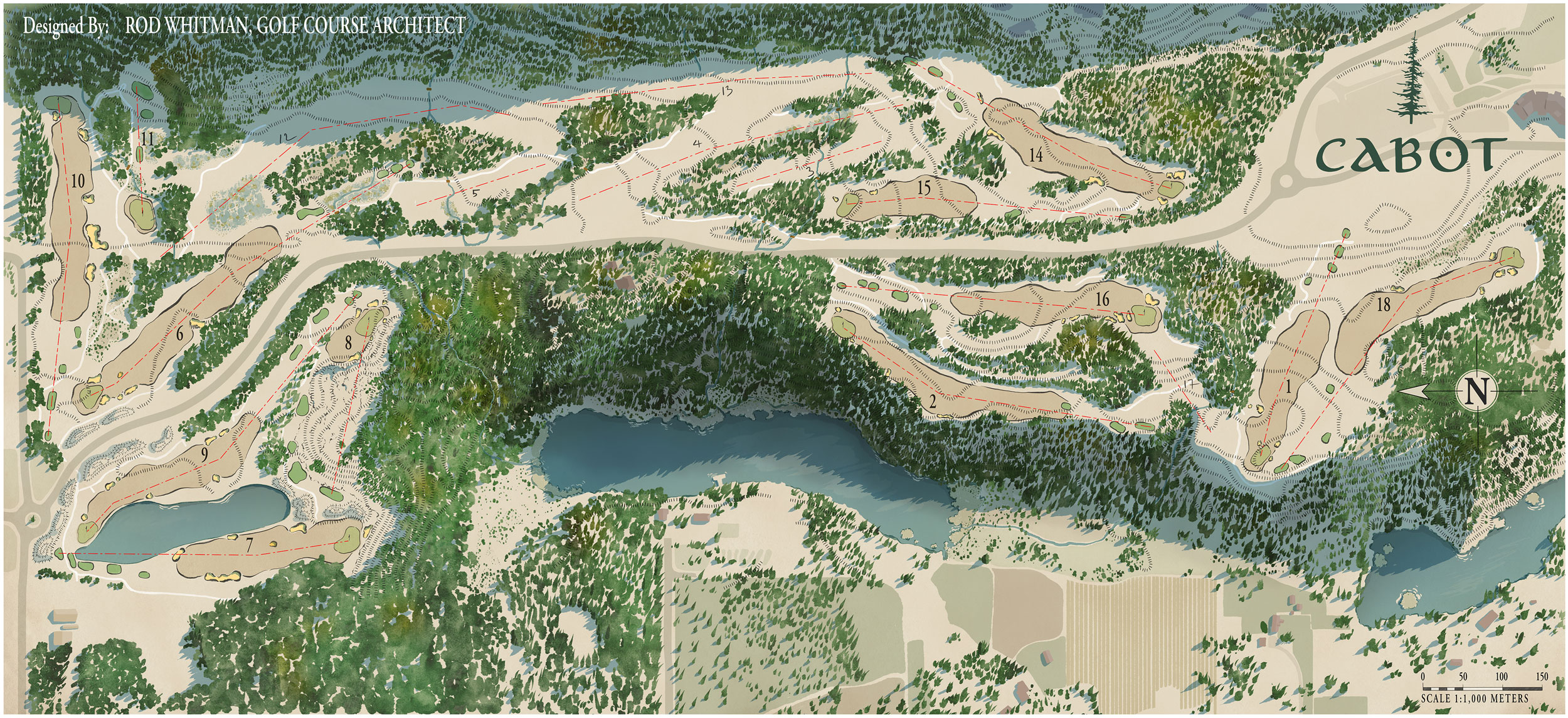
Revelstoke is kind of the perfect mix. It's on a bench at the base of the mountain, which allows for golf. It's literally just wide enough to fit 18 golf holes on. You play off it to start, almost like the original start of Banff, hitting away from the clubhouse down into the valley. And then you go along the bench and work your way out and then come back. It's really walkable, although I think most people will be taking carts. It is a resort course. But it's beautiful. Because of the bench, the views are just so long down the river valley, which you wouldn't normally get if you're sort of sitting flat on the floor. So it's the best of both worlds.
Garrett: What’s the topography like within the course?
Keith: There's a lot of movement within the site. There are rock outcroppings, there are natural wetlands. The routing took Rod quite a long time to get right. We've been working with this site for a good six, seven years now. And he put a lot of effort, as we do with all our projects, into getting the routing correct. I remember how many iterations he did on that site.
The first sequence of holes is quite dramatic, until you get to where the irrigation lake is — holes 7, 8, 9. That was more of a graded-flat field, but we added some spice to it. The irrigation lake served as a main source for our fills elsewhere on the site. But then when you get to 7 green and 8, you’re at the edge of the bench, and it's a dramatic drop-off. Eight is the hole that you've probably seen photos of, where it's a big drop shot off the tee and you have this chasm in front of you. So even on the flat area of the site, there's always drama close by.
In the more compelling areas of the site — the first sequence of holes and the finish — there's a lot of movement. You're playing alongside the mountain with holes 12, 13, 14. You turn the corner around a rock outcropping for the short 15th. The 16th plays over a ridge, 17 is another shorter par 3 over a giant ravine, and then 18 plays into the base of the clubhouse where you started the round.
{{design-notebook-cabot-revelstoke-gallery}}
So there's a lot of movement out there, but within the golf holes, it’s golf scale. It's human scale.
Garrett: This project was a long time in the making. I remember first hearing about it back in 2020, and the expected opening date was 2023. What was the holdup?
Keith: Permitting. So, for our American readers, British Columbia is basically the California of Canada. When Cabot did the big promotional launch, we had a routing, we had some renderings that were quite good, but we were just submitting for permitting. Those in the know — including myself, having a planning background — knew this was going to be a minimum of three years. And it took every bit of those three years. So we didn't actually break ground there until two-and-a-half years ago, and it wasn't until last year that we had a full construction year on the golf course.
Garrett: I'm fascinated by how different architects approach mountain terrain. Canada's greatest golf architect, Stanley Thompson, was famous for how well he handled mountain sites. As you were putting together this course, were Thompson's designs a source of inspiration?
Keith: Maybe a little bit. Rod is an Alberta boy, born and raised. He's well familiar with Thompson's work at Banff and Jasper. It definitely had an impact on his growth as an architect.
But each site to us is different. You go there with sort of a blank slate. You're really trying to pay attention to what the ground gives you. You're trying to go out there and find great natural features, natural green locations. How does the site drain? You're on the side of a mountain. You don't want to be moving heaven and earth and risk changing something that Mother Nature is just going to put back. Mother Nature is undefeated.
Garrett: Is there a hole out there, or two, that you're most proud of?
Keith: The par 3s. One thing that stands out about Stanley Thompson's work, if anybody plays Banff or Jasper, they know how good Thompson was with his par 3s. I would consider Jasper as having one of the best par-3 collections in golf.
Garrett: I need to get out there.
Keith: It's just so walkable and so fun. But that really put the pressure on us as far as what to deliver at Revelstoke. We knew the comparisons would happen, and I think we delivered. I think the collection of par 3s at Revelstoke is world-class. They came out even better than some of the renderings showed, and they looked epic there.
Garrett: Let’s touch on a few other topics. You put out another run of your book, The Evolution of Golf Course Design, earlier this year. That book has been circulating for about eight years at this point. What parts of it seem to have resonated with people the most? What do readers come up to you and talk about?
Keith: It's twofold. I get people that read the early periods [of the book’s historical survey of golf architecture] and really appreciate the connection I found between Horace Hutchinson and the Arts and Crafts movement.
It’s funny, though, how a lot of people kind of get that wrong. They think I rehashed some of Tom MacWood's work on that subject, which really wasn't the case. The major feature I sort of unlocked was Horace Hutchinson — his connection to [George Frederic] Watts, and how he was the linchpin for all of those people [in the golf architecture world], taking golf course design away from professionals like Old Tom Morris and turning it more into a profession of the elite.
The other big thing I hear about is the end of the book, where I put a spotlight on where things might be going. You have to remember, it was 2018 when I published this, but most of the writing happened earlier. It was more 2015, 2016 when I was pulling the research together, and there were courses like Mammoth Dunes, but a lot of the big, broad, massive-scale courses that we see now hadn’t happened yet. I put a spotlight on that, and I get a lot of feedback, with people coming up and basically being like, "Well, you were right." There's a lot of width out there and maybe a lack of the compression and release that we learned about in earlier generations of golf architecture.
I don't know if I'll do an update, but we’ve got a few more years until the end of this decade, and I think there's a lot to be talked about for where golf can go next. Understanding the past is a big part of that.
{{inline-article}}
Garrett: Well, that’s where my next question is going. I always like hearing how historians think about the present moment. What do you see as the big themes of 2020s golf architecture so far? What will future historians focus on when they talk about this decade?
Keith: Current courses are full of strategy, full of quirk, full of fun, but they generally get big, they get sandy. There's a lot of eye-catching things on every hole that try to grab your attention or try to grab the cover of a magazine or an Instagram post or whatever. If you're not eye-catching, you're getting left behind.
But great golf doesn't necessarily have to be eye-catching on every hole. You can have a bunkerless hole, and it might be one of the best holes on the property. It just won’t photograph as well as everything else.
I think the better practices are a little bit more cognizant of how designs are going to survive long term. Anybody that understands the history of golf knows there's just constant ebbs and flows in this business. What's trending now won't be later. So you really have to lean on the principles that make great architecture, which are routing, greens, and great contour. Those things are going to stand the test of time. And if you know how to do that well, the aesthetics are secondary. The aesthetics are hopefully site-based, but they change with time, they change with maintenance. So as long as you've got the aforementioned correct, everything else will be fairly easy to either put back or evolve.
Garrett: This relates to a discussion I've seen pop up among — not necessarily golf architects themselves, but more golf architecture nerds and journalists. A lot of people are wondering whether golf architecture is sort of stuck in the neoclassical style and approach that Bill Coore, Tom Doak, and the early restoration architects introduced in the 1980s and 90s. Do you share that concern? Do you feel like golf architecture necessarily has to go somewhere new?
Keith: I don't think so. I think it's the media that puts a lot of emphasis on the certain courses that look similar. Whether it be Bandon, Streamsong, Cabot, there are a lot of sites that are linksy, great for golf, sand dunes exposed. That stuff is eye-catching, and it seems to make people think that a lot of golf being built right now is the same. But that couldn’t be further from the truth. I mean, Coore & Crenshaw’s Brambles is completely different from anything they've built elsewhere. Bill Coore actively moves around and tries to change his landscapes.
I think there's a lot of artistry still going on in this business, maybe more than ever.
Garrett: What's next on Whitman, Axland & Cutten’s docket?
Keith: Revelstoke is wrapping up. We've got the 12-hole preview loop this fall, and the real opening's going to be next year.
We're also wrapping up a private club in the Montreal-Mirabel area, formerly the Hillsdale Golf and Country Club, now 18 Black. It's an unbelievable property. It was a 27-hole, really tight Howard Watson course that has been completely reimagined. Brand-new clubhouse, brand-new maintenance facilities, new 18-hole course on the 27-hole land that makes really good use of that landscape. I'm really excited to let everybody see that next year.
We're obviously still full bore at The Ranch in Florida for Ken [Bakst], the owner of Friar's Head, and he's been pretty hush-hush on things. But we've done really well this year to get a good portion of the site done for the members this fall. There's a par-3 course and a 10-hole practice course that are going to come online. Then we've got most of the other dirt work done for our East and West courses, and we're going to roll into that this winter.
We're working with the Glencoe Golf and Country Club in Calgary. They’ve got 45 holes of golf, and we've got the Meadows Course, which is 18, and we're completely reimagining that. This is our first year of construction, so we're almost done with nine holes, and we'll finish the other nine next year.
We're about to start a nine-hole addition at Blackhawk, which is Rod's golf course up in Edmonton that opened in 2003. We're just starting tree clearing and some initial earthmoving now.
We're in a few master plans. I've been consulting at Riverside, a Donald Ross course in New Brunswick for a few years. We're going to be back at Prairie Dunes in Kansas in November, doing a little bit of bunker work. We're working with the Credit Valley Golf and Country Club near Toronto on a master plan. We've got a par-3 course in Austin that is going to start work late next year. And we've got a client in Vietnam that we're doing a couple golf courses for. So it's very busy.






Design Notebook: The Athletic Lights Up Yale, LinksDAO Sells Spey Bay
A Q&A with David Normoyle about Cypress Point
Design Notebook: Pebble Beach Changes and Medinah No. 3 Insights
A Q&A with Ashley Mead
Design Notebook: Lahinch Debrief and Saudi Arabia's Golf Struggles
A Q&A with Geoff Shackelford
Get full access to exclusive benefits from Fried Egg Golf
- Member-only content
- Community discussions forums
- Member-only experiences and early access to events