
A Q&A with David Normoyle about Cypress Point
On his new book that sheds light on the deep history of Cypress Point
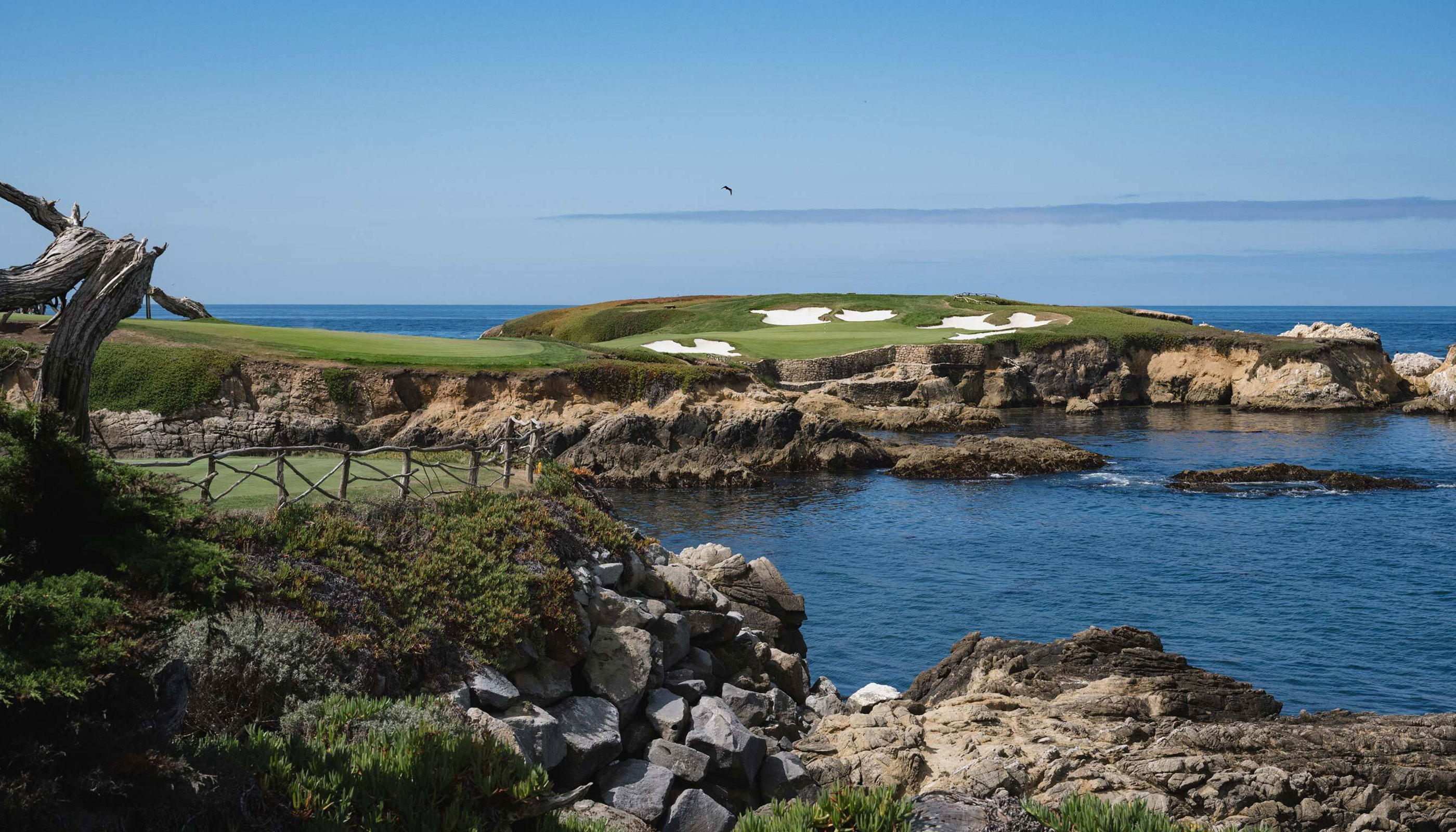

Golf club history books can rarely be described as “hotly anticipated.” David Normoyle’s centennial history of Cypress Point Club is an exception.
Published earlier this year and sold exclusively through the club’s pro shop, the book sheds new light on many interesting subjects: the specific roles played by Samuel Morse and Marion Hollins in founding and developing the club, the widely misunderstood contributions of Seth Raynor to the early design process, and the sensory and emotional experience of playing Alister MacKenzie and Robert Hunter’s masterpiece in the California dunes.
Last week, I got a chance to talk with David about all of these topics. Below is a lightly edited transcript of our conversation.
Garrett Morrison: There was already a fairly substantial literature on Cypress Point. What did you want your book to contribute?
David Normoyle: The first thing that we did in working with the club's Centennial History Committee was figure out what we wanted the purpose of the book to be, before we looked at the existing literature or anything else. And for us, the purpose of the book was quite simply to produce a story that was worthy of the name of Cypress Point. That was the objective. And what that meant was that not only in the words that we chose, but in the content of the book, the form of the book, the design of the book, we wanted to create a centennial history which was inspired by the place itself: beautiful, intimate, understated, and refined. So if you felt, while you were holding this book, that you were holding the experience of being at Cypress Point in your hands, then we achieved our objective.
{{inline-course}}
Garrett: Tell me about the choices you made with the structure of the book. How did you break the book up into different sections, and why did you make those choices?
David: When you're writing a centennial history book, you have to make a very early decision: do you want the book to be chronological in the story that you tell, or do you want it to be thematic? If it's chronological, the 20s get followed by the 30s get followed by the 40s, and you get locked into that kind of structure. For some books and some clubs, that's absolutely the right structure. For us, when we thought about the story we wanted to tell about Cypress Point, we felt that a thematic approach was more appropriate, because it's not so much a story of “in the 50s this happened and in the 80s that happened.” It's really: what is the essence of the club itself? What makes Cypress Point Cypress Point, a hundred years in?
So we were guided in the thematic approach essentially by the name of the club. If you break it down into its components — Cypress, then Point, then Club — to me, Cypress means the tree. The fact that this particular tree exists only native in two places on the planet, Cypress Point and Point Lobos, south of Pebble Beach. So we wanted to explain what makes Cypress Point, independent of golf, Cypress Point: the land, the history of the land, the people who've gathered there, the story of the tree itself. So that was the first chunk of information: what's the story of the land before golf gets there?
{{design-notebook-cypress-point-pre-course-gallery}}
Then when you talk about the Club, it's about: what's the social organization that was organized by Marion Hollins and Samuel Morse and others? And the clubhouse is such an important part that it deserves its own story. And then, really the point of the whole thing is the golf, and how you play golf on and navigate the point. Not just the point, but the dunes and the forest.
At the very end of that, after we talked about the Cypress and the Point and the Club, we wanted to have an appropriate place for all the other stuff: the club history, the stories of the members, the leaders, the caretakers, the various traditions, the Crosby, Walker Cup, things like that.
So thematically it allowed us to tell a story that was more about the overall impression formed a hundred years in.
Garrett: One of my takeaways from your book’s discussion of the land is that Cypress Point, the place, was always considered special. It didn't just become special after the golf course was built on it.
David: That’s why, in the author's note to the book, I include a little excerpt from a book about the Monterey cypress trees from 1922. So this precedes the creation of the golf course. I found this quote and I loved it, and I think it's worth repeating. The author said, “Even without some knowledge of their history, anyone would be touched with wonder coming for the first time upon the old cypress trees clinging to the rocky coast of the Monterey Peninsula. When one learns that they are the only native growth of their kind left on the earth, the wonder grows, and one would learn more.”
I think that's the thing about Cypress Point, about the place, before you even bring golf into the equation, is that when one learns about it, the wonder grows and you want to learn more. And that's what we hope to do with this book: to feed that passion for the place.
Garrett: You get into some detail about the Monterey cypress trees themselves. You've already mentioned that they're found in only two places, Cypress Point and Point Lobos. It's a unique and beautiful tree; it has this almost human personality to it. Your description of it is one of the best I've encountered.
How did you do your research for that? Arboreal science is not usually an area of specialty for golf writers.
David: The Monterey Public Library has a California History Room, which is outstanding. And I went physically to the Monterey Public Library and got to know the librarian. He took me into the space, and they had a wonderful collection of books and research articles about the trees. So everything from technical things from the U.S. Department of Agriculture all the way to more artistic, touristy impressions of the cypress trees. They had a big pile of research ready for me to access.
Not everything exists online. Sometimes all you have to do is go to your local library.
Garrett: I think these days people are inclined to see Cypress Point, Pebble Beach Golf Links, and Monterey Peninsula Country Club — and you could throw Del Monte Golf Course into this mix as well — as quite separate entities. But something your book illuminates is that they were actually part of one coherent development vision by Samuel Morse's Del Monte Properties. How did Morse view the relationship between these properties?
David: There's a really nice map in the book that shows the way that the peninsula works and the location of the golf courses relative to one another.

Everything starts with Hotel Del Monte in Monterey, not the peninsula. Hotel Del Monte is an existing structure dating from the 1880s; it burned in the fire in the 1920s — that's a whole other story — but it had the Del Monte Golf Course. And what Morse understood, starting with the Western Amateur [at Del Monte] in 1916, is that if you want to sell real estate to wealthy people, you need people to come from another place to there, and that this particular golf tournament attracted wealthy patrons who might be interested in real estate.
So starting with the public-access Del Monte Golf Course, that's the sort of thing that will get people in beds at Hotel Del Monte. Then next to that he had, in 1919, the Pebble Beach Golf Links, which puts bodies in beds at a newly renovated lodge. Then, if you are trying to sell small parcels, you need 36 holes of a local country club with all of its amenities to provide things for people year-round. That was the original idea for the Monterey Peninsula Country Club.
And at the very tip of [the pyramid] you have a very small, elite private club that attracts people from around the world to come and visit and buy the most ostentatious and most beautiful and most luxurious lots lining 17-Mile Drive overlooking the ocean.
So it was a really intentional structure from from the base of the pyramid with Old Del Monte, up to Pebble Beach, up to Monterey Peninsula, and at the the tip of the pyramid, the Cypress Point Club on the most beautiful, exclusive piece of land. And it wasn't just Morse; it was some of his business partners who talked about this. But without golf being the anchor to make the entire development possible, you don't have what you have today. As Bing Crosby said, you would have had Coney Island or something like that. You wouldn't have had Cypress Point.
Garrett: I love that quote.
So Marion Hollins has become a famous figure in recent years, rightfully so — and was, during her lifetime, even more famous. But her role in the development of Cypress Point and within Del Monte Properties has always been a bit mysterious to me. Your book provides some needed clarity there. Could you give me the basics of Hollins’s story?
David: It’s been mushy and fuzzy for a long time.
Sam Morse, as we discussed, had this structured, tiered vision for golf on the Monterey Peninsula. Because Cypress Point was meant to be a private club independent of the Del Monte Properties Company, as a concept, he couldn't be the one advancing it, even though he was intimately involved. He needed an agent to act on his behalf, to drum up support, sign up members, and provide the vision for the experience. That's where Marion Hollins came in.
Now, she had come out West not because of golf, but because of polo. Her family was very wealthy, from New York City, and so she was pals with all these famous polo players. And polo was a big part of the equestrian scene at Del Monte and Pebble Beach. She also happened to be the U.S. Women’s Amateur champion in 1921, and she was developing the Women's National Golf Club on Long Island.
So she’s wealthy, she’s a socialite, she has the golf course development experience behind her. What better and more perfect person for Sam Morse to identify as his developer of Cypress Point?

[Hollins] was involved with signing people up and selling real estate. She was a real estate salesperson to wealthy people from the East. That's what she did. And Cypress Point was just a continuation of that. She was meant to receive, in compensation for her work at Cypress Point, a large parcel of land not far from the 18th fairway.
What we've learned is that she suffered an injury, supposedly a back injury related to polo, though the records on that are very limited and unclear. But the point is the project stalled in 1926, after Seth Raynor died and before MacKenzie got fully engaged. And it was another real estate salesperson from Del Monte Properties, Harrison Godwin, who pushed the project over the line and signed up the necessary 100 total members to fund the golf course.
So Marion Hollins was a founder of the club. She was the visionary behind the 16th hole. She helped begin and launch Cypress Point, but she wasn't exclusively responsible for it. It was this group of people related to Del Monte Properties who made it all happen.
She remained a member for the rest of her life. She used the club and participated in the club. But when she struck it rich in oil in 1928, just as Cypress Point was opening, she used the profits from that to develop Pasatiempo. So that became her personal and deep passion, because she was no longer an agent for Sam Morse. She was the owner and controller of her own destiny.
Garrett: Another topic there has been a lot of confusion about is Seth Raynor's early work at Cypress Point. Some have gone as far as to imply that Raynor must have been primarily responsible for today’s routing of the course. You’ve countered this narrative and sorted out the details more clearly than anyone has before.
When I had you on the Designing Golf podcast last year, before the release of the book, you generously offered some hints as to what you had found in your research. But now that the book is out, maybe we can be a little more specific. What is the relationship between Raynor's initial 1925 routing of Cypress Point and MacKenzie’s ultimate design?
David: We had the opportunity, with Cypress Point hosting the Alister MacKenzie Society in 2024, to address the Raynor-MacKenzie question. I delivered a presentation to the MacKenzie Society, sharing — in a way publicly, but [mostly] privately, for the first time — the Raynor routing, which the club has.
What we wanted to get into was not just the question of, okay, what holes are MacKenzie holes and what holes are Raynor holes, because it's not quite that simple. What we wanted to do is explain what happened.
Sam Morse and Marion Hollins, in 1924-25, started thinking about a golf course at Cypress Point, hand-in-hand with the golf courses at Monterey Peninsula. Seth Raynor and Charles Blair Macdonald were engaged to do the Monterey Peninsula courses. Macdonald never came out; Raynor did. And while Raynor was working on the Monterey Peninsula courses, he stepped just down the road and took a look at the land of Cypress Point. So in February of 1925, a stick routing of the golf course was produced.
[Ed. note: David’s book contains a reproduction of this routing, as well as a two-page spread that superimposes it on an aerial photo of today’s course, showing the differences precisely. I will not share these images here because I feel they are best saved as a perk for book owners. But I will offer the following detail from William Howard Bull’s 1926 map of the Monterey Peninsula, which contains an approximation of Raynor’s 1925 layout.]

One of the things we wanted to make clear, both in the presentation to the MacKenzie Society and in the book, is that a golf course consists of multiple components. The most important components are routing, number one — the sequence of the holes; design, number two — the character of the holes, meaning their individual features and qualities, fairway contours, bunkers, greens, all that kind of stuff; and then ultimately the most important thing is the actual construction and execution of these ideas.
What's absolutely clear in the historical record is that Seth Raynor created a routing of 18 holes at Cypress Point in February 1925. Because Marion Hollins had her injuries and didn't sign up enough members to begin construction by January 1926, when Seth Raynor died, there was no money to build anything. So, to our knowledge and the historical record, nothing was progressed beyond the point of a routing. There's a routing — sticks. There's no design, no construction.
When Seth Raynor dies on January 23, 1926, coincidentally Alister MacKenzie is already on a train, going across the country to San Francisco to meet Robert Hunter, his future business and design partner, for the purpose of building golf courses in California. When MacKenzie gets on the train in New York City after having taken a ship across the Atlantic from the UK, Seth Raynor is still alive, and there is no reason to think MacKenzie has anything to do with Cypress Point. While he’s on the train, Raynor dies. Coincidentally, MacKenzie arrives several days later in San Francisco, and Marion Hollins needs an architect. So talk about providential good timing. This was not a master strategy.
MacKenzie visited the site for the first time, we believe, according to newspaper reports, on February 2, 1926.
Garrett: Remarkably quickly after Raynor’s death.
David: Astoundingly quickly. Like, you-couldn’t-make-it-up quickly. I mean, it'd almost be hard to get on a plane and get there in the same amount of time.
So, very quickly, MacKenzie drafts, in his own distinctive hand, in February of 1926, the routing and design features of the golf course, which is included in the book. And this is where I think it takes on a different life from the Raynor plan. They also had to sign up enough members, and MacKenzie and Hunter not only had to finish the design aspects of the golf course, but also construct it. So all the details and features and connectivity of the land are exclusively the work of MacKenzie and Hunter and the American Golf Course Construction Company.

So what does that mean about Raynor and MacKenzie? The way I think about it is, from the beginning they knew the clubhouse was going to be in one place and one place only. The clubhouse is going to be on a flat piece of land overlooking Cypress Point, the namesake of the club, and overlooking Fan Shell Beach, where the first green and the second tee are. That means the golf course has to start and finish there.
If the name of the club is Cypress Point, you're going to play holes around Cypress Point. And you really only have two choices. Do you start from the clubhouse and go down the hill on what’s now the 18th hole and play Cypress Point clockwise to begin? Or do you finish the golf course playing it counterclockwise? And they knew from the beginning that they were going to start in the forest and dunes, and finish on Cypress Point. I mean, any great project would finish on its best holes, not start on its best holes.
Garrett: And besides that, on the point itself, there was probably just one way to position the holes. There were a few obvious places for greens, and that was it. So you can go clockwise or counterclockwise, but you're not going to put the greens in different spots.
David: That's really the only way to get around. And I would also note that when you look at the historical record, in the many, many photographs of Cypress Point when it was just 17-Mile Drive and the loop, there's one consistent thing. People took pictures from the land out to the point. People did not take pictures from the point looking back to the land, because it just looked like a big mass of land. So you were always going to play a golf shot from the land out to the point. In a way it was preordained. So whether it was Raynor who did that, or MacKenzie who did that, or Hollins who did that, or my mother-in-law who did that, it was probably going to be the same.
The big question is what to do with the 14 holes on the other side of 17-Mile Drive. And that's where MacKenzie and Raynor are markedly different.
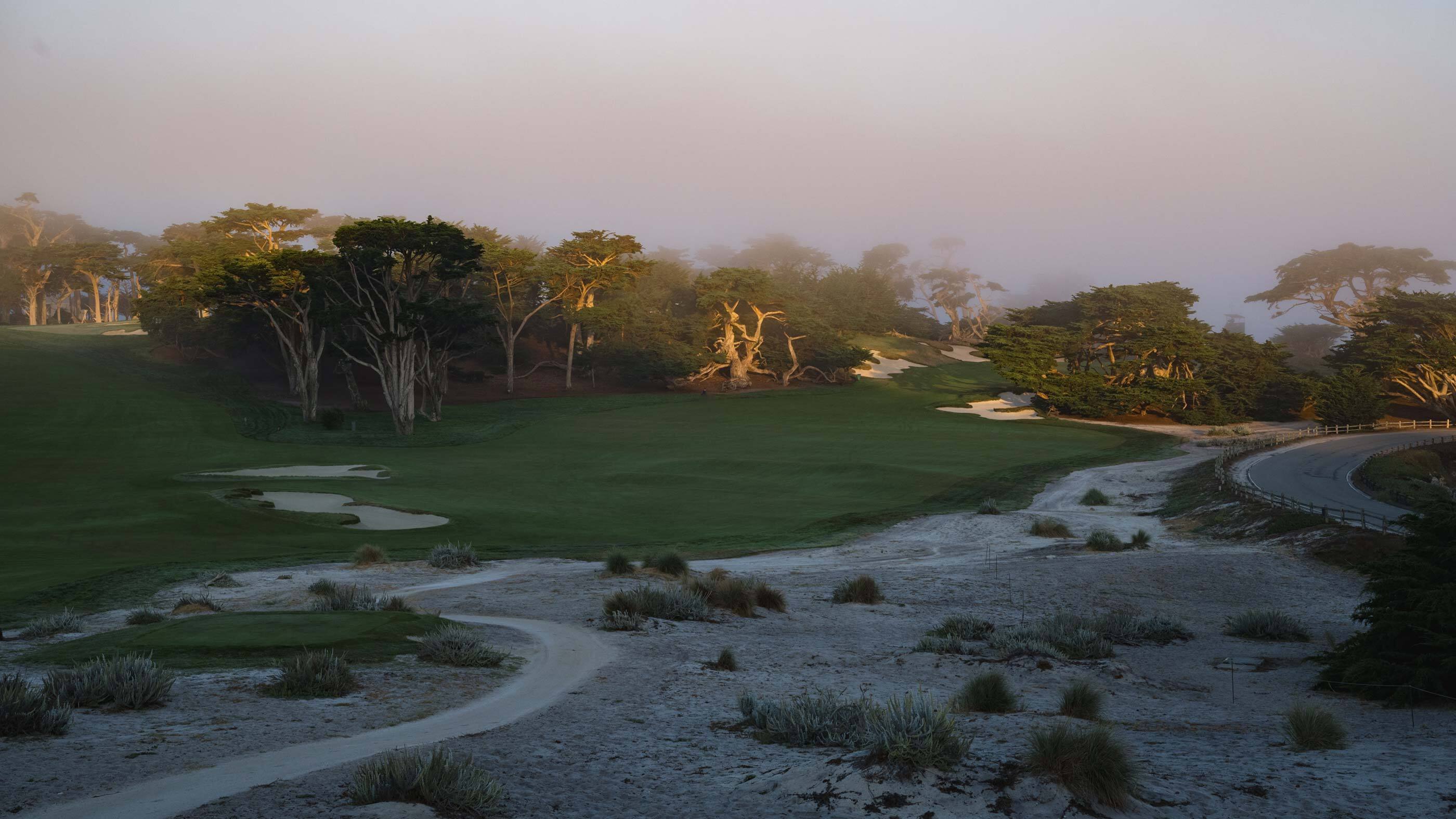
If you look at Raynor's routing as compared to the routing MacKenzie produced, you see that Raynor went more into the woods and shied more away from the dunes than MacKenzie did. Every hole [in the MacKenzie routing] on the inland side of 17-Mile Drive either plays to a dune or from a dune — except for the fifth, because it's all the way in the forest. But on every other hole: to a dune or from a dune. That was not present at all in the Raynor's routing. That is only present in the MacKenzie routing.
One plays to a dune and 2 plays from it. Thirteen plays back to that same dune and 14 plays from it. That's the Fan Shell dune, dune number one. And then all the other holes rotate around the second dune, the big central dune, in some way — playing to it, playing from it, or playing over it. That is exclusively a MacKenzie feature and was not present in any way on the Raynor plan. The only thing you might be able to say is that Raynor had one green up in the big dune and one tee coming off of it.
Garrett: Right, that was 9 green and 10 tee in Raynor’s routing.
Also, some of the most famous holes at Cypress Point today are 7 through 9, which very dramatically climb up the central dune and actually play on top of it and up to the peak of it. Those holes were not present in Raynor's routing. So that's obviously a big difference.

But there do appear to be some similarities between Raynor's concept for the inland sequence of Cypress Point and MacKenzie's concept. In Raynor's routing, the first hole is approximately the same length — it's a par 4. The third hole is a par 3. The holes in the meadow behind the big central dune [today, Nos. 6, 10, and 11; in Raynor’s plan, Nos. 9 through 11] work back and forth in roughly similar ways. Then 12th comes back around the central dune, the 13th green is in a similar spot, and 14 goes up the hill to connect with the coast. So there are some basic structural echoes here.
But if you look at the specifics of where each hole is located, in every case MacKenzie was looking to push into the most interesting features of the property. He pushed the first hole onto Fan Shell dune, which Raynor apparently didn't do. Instead of having the third hole play along the perimeter of the property, MacKenzie rerouted it into the interior and toward the central dune, so the green now sits at the base of it. He did this over and over throughout his routing. Maybe there was a Raynor hole somewhere in the vicinity that had a similar length, but in every case MacKenzie shifted it to make it interact with a dune or some other interesting feature.
I think that gives such great insight into who MacKenzie was as a router of golf courses. He was constantly, constantly trying to put his holes on the best natural features of a property.
David: That is everything. And look, the reality of the property is that it's a big “L”-shaped hockey stick. So there's only so much you can do. You have the four holes around Cypress Point. The first and the 14th are essentially connector holes away from the clubhouse and back to Cypress Point. There are limits to what you can do.
So the question is, how do you manage the inland ravine?
By the way, we found this wonderful old map from the 1860s, which shows that essentially the golf course is routed through a drainage ravine, because otherwise it would have been developed for housing.
Garrett: That was a new insight for me. When you’re playing Cypress Point you’re so focused on the dunes that you don't realize, between the base of the dunes and that little cliff that the second hole plays up on top of, there’s a ravine. It’s a place where water naturally flows.
David: Yes, the Del Monte Forest drains through there to Fan Shell Beach. And there's only so many ways you can route a golf course through that. So yes, Raynor started out on the right side, crossed over, and came back. And yes, MacKenzie finished that. But everywhere he could, MacKenzie pushed away from the forest and into the dunes.
That's why I think, if this is a Raynor golf course, it would be beautiful along Cypress Point, but it would be a much more forested experience and less of the dunescape. And the dunescape is what no other American golf course can offer.
I would add that most of what we've been talking about is routing. We haven't talked at all about bunker shapes, green shapes, contours. MacKenzie said that what people don't understand about Cypress Point is that essentially all of the fairways and all of the greens had to be artificially constructed. The trick was in making it look natural.
You go to other golf courses that were manufactured out of nothing, and you're very conscious of the fact that they were manufactured out of nothing. It's almost like you can see the magician's trick. But the fact that you can't see the magician's trick at Cypress Point — you don't know what's natural and what's artificial — is, in ways people can't articulate, why the golf course connects with them so profoundly.
Garrett: Part of the reason Cypress Point is so well shaped is that Robert Hunter oversaw the construction process. Over the next few weeks, in Fried Egg Golf Club, we're reading Robert Hunter's book The Links, which he actually wrote before working with MacKenzie at all. I had never really put that together before reading your book.
David: It was his version of Tom Doak's Confidential Guide. It was the things that he wanted golf to be about rather than the things he had created.
Garrett: That's a good way to put it. So our members are gonna be very interested in Robert Hunter over the next month or so. What should they know about Hunter and his contributions to Cypress Point?
David: Robert Hunter and his son and the company that they formed with Alister MacKenzie were the boots on the ground. Hunter lived in Pebble Beach. He was a dedicated golfer. He and his son played a lot of father-son competitions. He was thoughtful about golf. He was well traveled and well practiced. And he was the guy on the ground making all the decisions and handling the communication while MacKenzie had not yet settled in the United States. It was really after Cypress Point, and with the beginning of Pasatiempo, that MacKenzie began to be there more purposefully and more frequently.
So at Cypress Point, it was MacKenzie's words and MacKenzie's ideas and MacKenzie's design drawings, but it was Hunter making all of the decisions. He was in every way MacKenzie's design partner.
Garrett: I want to save most of your description of the golf course itself for readers to discover. It’s a great experience, just following along with your walking tour of Cypress Point. It’s almost like playing the golf course again. But I’d like to zero in on one theme you touch on in this chapter and unpack it a bit.
A lot of your insights center on how the course reveals the landscape to the player — how it discovers and encounters different features of the property, and in what order that happens. One aspect of this drama is how the course alternates between what you call “protection and exposure,” or what others might call “refuge and prospect,” or “compression and release.” What is the significance of that theme to Cypress Point?
David: Rhythm. It’s the way in which any composition or meal or film builds and introduces motifs, introduces ideas, and then builds upon them, and then they grow. I mean, these are just things that are baked into our human experience of how we experience great art. The sequence of going through the holes in this particular order, if you're aware, can reveal a kind of insight and stimulate your senses, all senses. Sight, smell, taste, all of that — and even to the way the sound of the ocean builds as you get to the 15th hole.
If you're attuned to it and you're not just focused on whether your 6-iron is going right or left today, you have a walk that can be as enjoyable or pleasurable without golf clubs as one that is with it. And that to me is the insight why people connect with and love Cypress Point so much. It’s that the sequence of the experience is baked into the same sequence of experience of other wonderful pleasures in life.
Garrett: There's the overall sequence of the golf course culminating at the point itself. But then, within the course — and you point this out in the book — there are these mini-sequences, where you see a certain feature, approach that feature, and then play up on top of or around or in some way engage with that feature. The course is full of these little sub-rhythms. This had to be intentional on MacKenzie's part, right?
David: It either had to be intentional on MacKenzie's part by creating it, because there are too many coincidences to suggest that it wasn't intentional, or he had to have the discipline to know that it was an existing natural feature and to step aside and let it just be and stand on its own.
The fun part of how that chapter came about was — Jim Langley, the longtime professional of the club, was really seen as the conscience of the club for decades. And Martin Miller, who's the photographer behind all the modern photography in the book, spent a lot of time with Jim out on the golf course. They would just go for walks, and Jim would share stories with Martin. So one day, before I wrote the chapter, Martin and I were out there photographing the golf course and talking about it, and I said, "Let's just go for a walk." So I put on the tape recorder on my phone, and we spent five hours just walking the golf course without golf clubs. And I asked Martin, "Tell me everything Jim Langley ever told you about the golf course."
So that walk, channeling Jim Langley, was the inspiration for the spirit of how that chapter was written. It's not a hole-by-hole description of how you play the golf course. It's intended as, to use an evolving cliché, a kind of love letter to the experience. Whether you're a serious golfer or not, I think walking the golf course and having those rhythms revealed to you, with insights from Jim Langley, through Martin Miller, through me — that's why it does things to people they can't explain. And we tried in some small way to capture what an explanation for those things might be.




Redefining Modern Amateurism in Golf's Reinstated Amateur Era
Q&A: Neil Hutchinson, Superintendent at the Evans at Canal Shores
Chicago Golf Eclectic 18
New-Look Medinah in the Spotlight at 2026 Presidents Cup
A Q&A with Ashley Mead
Cabot Announces New Resort in Nova Scotia
Get full access to exclusive benefits from Fried Egg Golf
- Member-only content
- Community discussions forums
- Member-only experiences and early access to events