

A Q&A with Ashley Mead
On his firm's recent work at Presidents Cup host Medinah Country Club and future projects
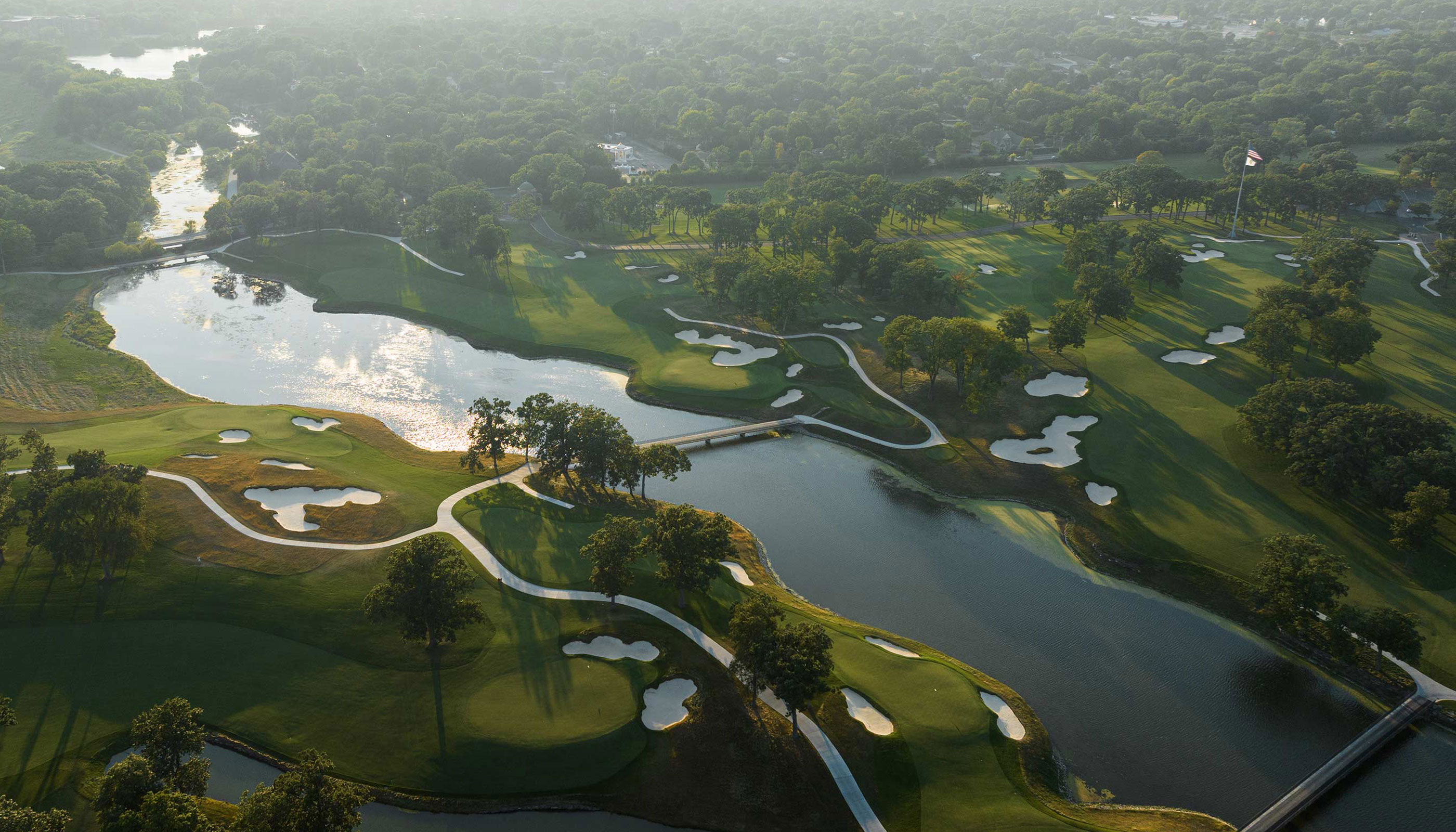

Over the past decade, Fried Egg Golf has regularly interviewed Geoff Ogilvy and Mike Cocking, two of three founding partners of Australian golf architecture firm OCM Golf. Until now, though, we hadn’t given a feature to the third partner, Ashley Mead. There’s no particular reason for this; we’ve just crossed paths with Ogilvy and Cocking more often over the years and developed a rapport with them. But Mead has been central to every OCM project, including the firm’s recent reimagining of Course No. 3 at Medinah Country Club.
With the Presidents Cup at Medinah coming up this week, now seemed like the right time to sit down with Ashley — or Ash, as he prefers to be called — to talk about OCM’s work at the Chicago club and learn more about his background.
Garrett Morrison: One story I heard about the Medinah renovation was that OCM visited the Morton Arboretum outside of Chicago before starting work on the course. What did you see there, and what influence did it have?
Ash Mead: We quite often do that when we get a new project. We generally go to something in the local area to get inspiration from, whether that be a botanical garden, a national park, anything like that. You can look online and you can see pictures of those sorts of areas, but ideally you want to find and study something in the field.
So the reason for that visit was to get an understanding particularly of how the holes outside of Lake Kadijah looked and felt originally. It's sort of that open savannah, where you've got the oaks on top of the hills and then the grass coming down.
At Medinah, you play away from the clubhouse, down to the lake, and then out and into the fields. What do those fields look like? The idea of having that as oak savannah, with the trees on top and the fescue below, was a way that we could create a different feel in that area.
Garrett: On a related subject, I'm curious about your approach to the bunkers at Medinah. OCM's ability to create authentic-feeling [Melbourne] Sandbelt bunkers is something the firm has hung its hat on. But Medinah sits in a very different kind of landscape. How did you settle on a bunker style for the No. 3 course?
Ash: It's funny, a lot of people think that wherever we go, we're just going to build Sandbelt bunkers. But if you look at our work, it varies so much. For example, if you look at Fall Line [in Georgia], we've just built a heathland course as well as a Sandbelt-style course. We've done a course [near] Austin [at Luling Sport] where we built links-style bunkers, which were completely different. We're doing a job in Taboo at the moment in Canada, which is different again. So we really like to build a different style wherever we work.
With Medinah, it's such a big site, so we wanted to have something with a bit of size. And then, within that oak savannah [aesthetic], it was important to have fescue flowing off the back sides of the bunkers and down into the bunkers, on some of those tongues. On the fairway side, it's more manicured, and we want to get the short grass as close as we can to the edge of the bunker.
Probably one of our favorite things to do when we're creating a landscape is having whatever is natural, whether it be fescue or whether it be plants, and having it as a part of the bunker. At Medinah, that was the fescue. This probably stems from growing up in the Sandbelt and seeing how the indigenous heathland plants flow over into the hazards instead of being separate.
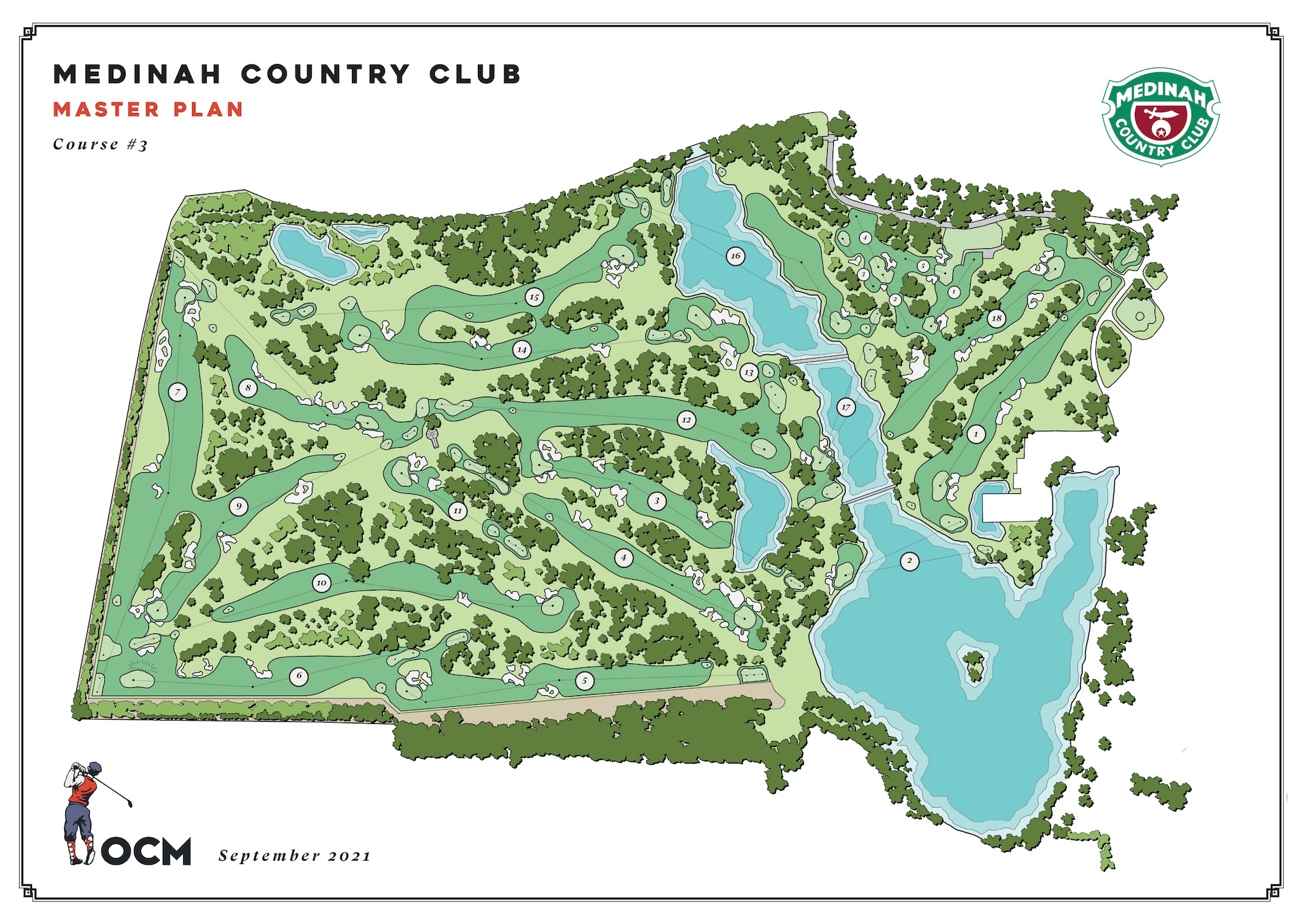
Garrett: One of the most dramatic changes you made to Medinah was rerouting the holes around Lake Kadijah. What was the main goal of reconfiguring those holes?
Ash: It was really trying to break up that run of 2, 13, and 17 — just those par 3s across the water, same sort of distance, and not set on angles, really.
For us, it was important to get those greens on angles as much as we could. I mean, good players know their numbers perfectly. They can get across the water and put it in the middle of the green. But if you can get the green on an angle, now they’ve really got to take it on if they want to attack the flag.
And we could always imagine what the 16th hole was going to look like. “How about we build a Cape Hole there?” The idea of putting something on the diagonal across Lake Kadijah was really important. And then it was about creating the finish for the course: 16 across the water, 17 back across the water, and then 18 up the old hole alignment, back to the clubhouse. Building that momentum up towards the finish of the course was also important.
Garrett: As you mentioned, the old holes around Lake Kadijah were pretty linear, most of them just crossing the lake perpendicularly. Now you have them playing on diagonals and more varied, unpredictable angles. The 16th hole in particular is going to get a lot of TV time. I guess it will be the 12th hole in the Presidents Cup. What kinds of strategic decisions are you hoping to see players make on the tee there?
Ash: Hopefully they move the tee forward a bit and play it really drivable instead of just playing it off the back. I think when playing it off the back tee, everyone will just get it over the water and then pitch it onto the green. But if they're encouraged to drive the green, it will bring those bunkers on the left, short of the green, into play. So if you pull that tee shot and hit it to the left instead of cutting it and letting it run onto the green, it gives you that really awkward long bunker shot to a green with no backstop and short grass heading down into the water.
There’s also a big bump just short of the green-side bunker on the left that helps the ball feed in. It flares up really high. So if they bring the tee forward, the players can use that slope and let it kick onto the green.
I’m looking forward to seeing how that hole plays. It should be exciting.
{{design-notebook-medinah-course-3-lake-holes-gallery}}
Garrett: A couple of other catnippy holes will be Nos. 5, 6, and 7, because they're going to play as the opening three holes, and you’ll have out-of-bounds hard against the left side on all of them.
Ash: It's going to be super interesting. That tee shot off one, in the Presidents Cup routing, what do you do? You can stand there and thread one down between the bunker and the out-of-bounds fence, and it's a pretty nice statement on the first tee if you can do that. But if you hit it out of bounds, you've lost the hole. So it's going to be a massive decision.
Then, if you are out there on that right-hand side, coming across those green-side bunkers, it’ll be very hard, especially with a back-right pin. So there is a big incentive to hit it as close to either the fairway bunker on the left or over it.
Garrett: We’ve just talked about the holes everyone is going to talk about — 5 through 7, 16. What's a hole that you think deserves more attention than it's gotten so far?
Ash: Probably 8 in the normal routing (4 for the Presidents Cup). It’s a dogleg-left par 4 playing out of a corner of the property, with a diagonal line of bunkers off the tee, a little pot bunker right of the green, and heaps of short grass on the left. If they move the tees forward, guys will try to drive the green, or maybe hit it into the left surrounds and pitch up the slope. Or will they will lay up to the right? That is a really difficult spot to a back-right pin, over the little pot bunker, which is quite deep.
We spent a bit of time at Medinah with the International team a while back. We played and walked around with them, talking about some of the strategies and what we were trying to achieve on the course. [The eighth] was probably a hole that confused them most in terms of what they wanted to do off the tee. They were struggling to figure out whether to hit an iron or a 3-wood, or try to drive the green. So that’s a hole I really want to watch as well.
{{inline-course}}
Garrett: All right, let’s move away from Medinah. I’ve heard Geoff Ogilvy’s and Mike Cocking’s origin stories before, but not yours. How did you get started in golf architecture?
Ash: I grew up around golf. My dad was the captain of a golf club, which we just renovated. We've actually all had the opportunity to renovate our home courses — Geoff at Victoria, Michael at Peninsula Kingswood, and me at Long Island [outside of Melbourne, now owned by The National Golf Club].
My dad would play early on Sunday morning, and I would caddie for him. And it really got me interested in the game.
When I was in high school, we lived next to a nine-hole golf course. It was called the Millionaires Club [also known as Frankston Golf Club], designed in 1912, 1913. It was just over our back fence. And me and my mate, who I'm still friends with now, we used to go over there and work during school holidays on the grounds staff to get a bit of extra money. Then they said, "Well, if you want to rake the bunkers once a week, you can do that on a Friday night and you can play as much golf as you want." That was a sweet deal.
When I finished school, I didn't really know what I was going to do. And my dad said to me, "Look, while you're trying to work out what you want to do, why don't you go down and work at the golf course?" And I did that. After a week, they said, "Do you want to do an apprenticeship? We've got a job at another golf course.”
And I loved it. I was an apprentice there, and then I became the assistant superintendent. But the one thing I really struggled with was the day-to-day activities being the same, whether it's cutting fairways, changing holes, cutting rough. I had always enjoyed landscaping and doing things with my hands and being outside, so I knew that’s what I wanted to do. Then an opportunity came up to work as a supervisor [for Michael Clayton’s design and construction company]. Michael [Cocking], just by chance, started around that time. And that's when our relationship really started. We've been working with each other for 26 years now, so that was 2000.
I was out in the field supervising construction, while Michael was in the office doing computer stuff and writing plans. But it was funny — I wanted to do more what he did and he wanted to do more what I did. So our roles sort of crossed over.
Today, we do the same sorts of things. Most site visits, it’s me and Michael going. And then, when we start a job, generally one person has more of a relationship with the client, and the other one takes the rest. It’s always important that the three of us, including Geoff, work together to edit our work. With us, you get three people as opposed to one. And I think the results are better because of that. If you get stuck on something, you speak to one of the other guys and they’ll see it straight away sometimes. It also gives us an opportunity to round off some of the rough edges. If you build a green that’s a little bold, one of the other guys might say, “Not sure about that.” So I think it works really well.
Garrett: What are some upcoming OCM projects that we should keep an eye on?
Ash: We're doing an interesting project at Taboo in Canada. We've never worked in that type of landscape before — the big boulders, big rocks, dramatic landscape, big trees. It’s a couple of hours north of Toronto. There was an existing 18-hole golf course there and we're building 36 holes, only using a handful of the old corridors. It's different to work on because we’re dealing with a lot of rock, and trying to work with the rock instead of blowing it up with dynamite has been really interesting. It'll be sort of a three-, four-year project for us up there.
It's a strange year for us. Usually we're building one or two courses in America, but at the moment, we're really busy, but just with design work on several different things.
Garrett: When I talk to architects who are in the design stage of the process, they tend to be so focused on the land and how to get the most out of the land that they aren’t really considering big-picture questions. They're not thinking, “How am I moving the art form forward with this?” But for you, are there any potential innovations in golf architecture that you’re excited about right now?
Ash: There is one, and it probably was a result of the Long Island project. As I said, it was the club I grew up on. My father was a member for a long time. We got the call to make a pitch, but we thought we were probably not going to get the job because it’s right next door to Peninsula Kingswood [where OCM had recently completed a renovation].
So we pitched a different idea. It was: when you’re a kid, you play that cross-country golf — you play from the ninth tee to the 10th green. And you shouldn't be doing it, but we've all done it before. Well, at Long Island, the fifth hole used to be a par 4, but sometimes they'd stretch it back to a par 5. So we said, why don't we put this back? Let's have the option of whether you want to play the par 4 or the par 5. They loved the idea. And they said, “As a part of your next presentation, give us a bit more of that.”
We ended up coming up with a plan where there are three completely different golf courses, ranging from the original golf course, which is 6,300 meters, to “The Farm,” which is 6,100, and then “The Track,” which is 5,800. There are 21 greens and roughly 33 or 34 different holes by playing different angles. It's quite complicated to get your head around, and it's really hard to explain to people, but if you look at the plans, it's like, oh, this is kind of interesting. The second hole [on the original course], for example, is a par 4, and then there’s a par 3 straight ahead, but in one of the routings, you play those as a par 5 all the way through.
{{design-notebook-long-island-plans-abc}}
So the idea of developing a course that does that on a bigger scale would be really interesting. It would probably suit a site that didn’t have any trees or anything on it, and where you were prepared to do a fair bit of earthworks and build it up from scratch. Have three different routings, or two different routings. Obviously people have done the reversible concept, but this is different in that it stemmed a little bit from George Thomas’s work at L.A. Country Club.
Garrett: That’s exactly what it is. Courses within a course. Thomas wasn’t saying, “Let’s play this in one direction and then in the other.” It was more, “Let’s have a couple of flex parts of this course where we can create different holes.”
Ash: And different pins on the greens that are only for certain holes.
You could create something interesting. Unfortunately, you probably couldn’t get three times your design fee for the three different routings.





Cabot Announces New Resort in Nova Scotia
A Special Round With an Old Friend

Q&A: Cory Griess, Superintendent at Prairie Dunes Country Club
Q&A with Golf Course Architect Sam Cooper
Merion East's Clever Inland Design on Display at 2026 U.S. Amateur
Is Royal Birkdale’s ‘Easiest’ Hole One of Its Best?
Get full access to exclusive benefits from Fried Egg Golf
- Member-only content
- Community discussions forums
- Member-only experiences and early access to events