

Design Notebook: Pebble Beach Changes and Medinah No. 3 Insights
Plus, a Q&A with golf course architect Ashley Mead

Hello, Fried Egg Golf Club members, and welcome back to Design Notebook, your periodic update on what’s happening in the golf architecture industry.
In today’s edition, I talk with Ashley Mead, a partner with Geoff Ogilvy and Mike Cocking at OCM Golf, about this week’s Presidents Cup venue, Course No. 3 at Medinah Country Club. First, though, let’s tackle the latest from next year’s U.S. Open venue…
Chocolate Drops
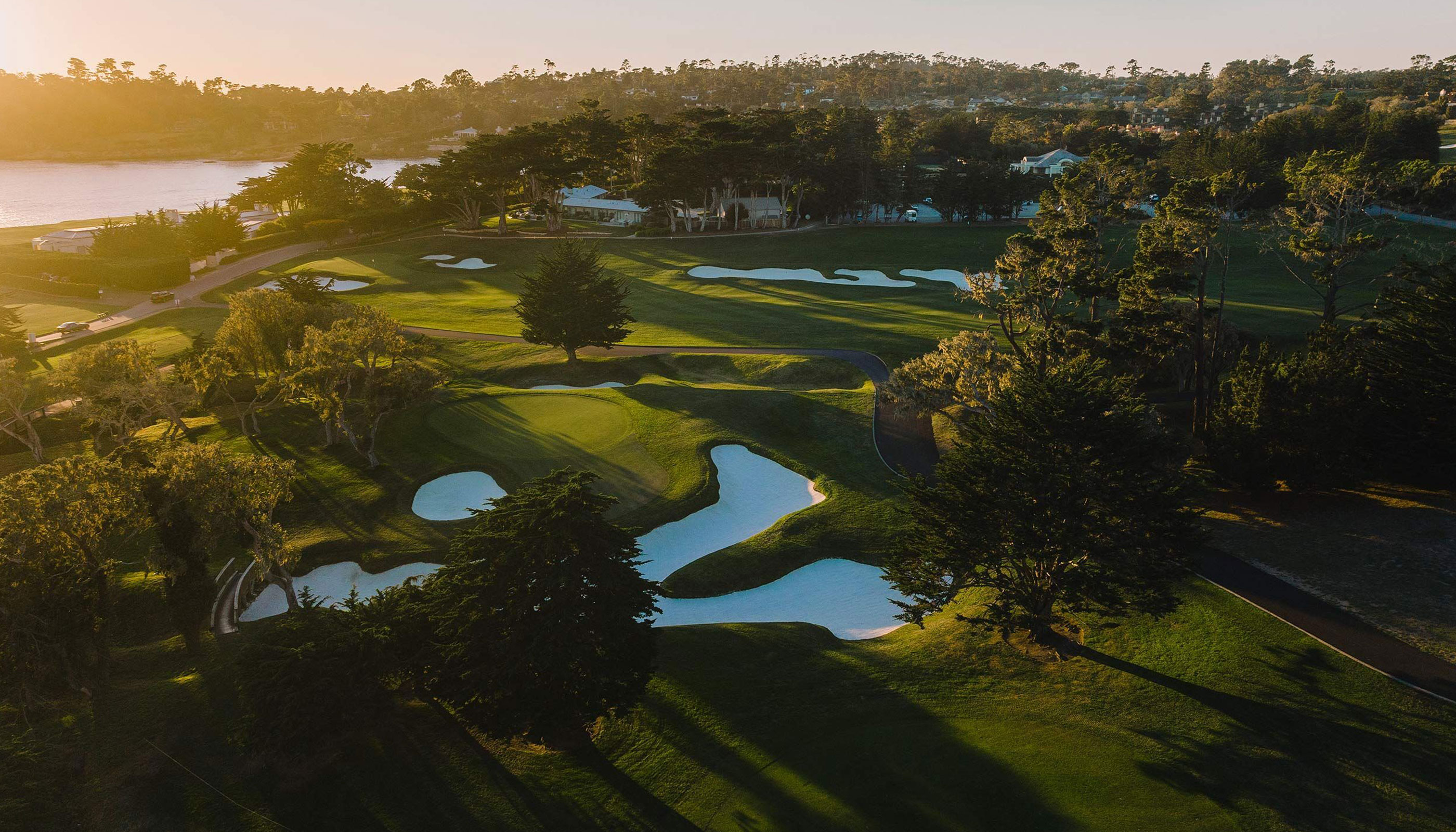
This past weekend, Golf Channel detailed several changes that Gil Hanse recently made to Pebble Beach Golf Links. If you’re thinking, “I didn’t know Gil was consulting at Pebble Beach,” don’t worry; your memory isn’t failing you. While the Pebble Beach Company has issued numerous press releases about Hanse’s ongoing redesign of the Links at Spanish Bay, it hadn’t previously disclosed that he’s also overseeing work at the mothership. A little odd!
But whatever — this is good news. In the decades since Chandler Egan and Robert Hunter’s 1929 renovation, Pebble Beach has handled architectural adjustments in-house, occasionally bringing in outside advice from the likes of Jack Nicklaus (who designed today’s fifth hole in 1998) and Arnold Palmer (who made tweaks ahead of the 2010 U.S. Open). The course has long needed a detailed, coherent plan that balances championship demands with historical considerations. Hanse can provide that.
Let’s not get ahead of ourselves, though. The projects described in the Golf Channel post are pretty minor:
No. 4: Back tee has been moved left, opening up a better view of the hole and creating a different, slightly trickier angle on the tee shot. Four fairway bunkers on the left have been merged into one large bunker tighter to the fairway.
No. 6: Back tee has been moved back, and five fairway bunkers on the left have been merged into one large bunker guarding the current landing zone for elite players’ drives.
No. 13: Back tee has been moved 30 yards back, and three fairway bunkers on the right have been merged into one bunker pinching the fairway.
No. 15: Back tee has been moved right, opening up a better view of the hole and creating room for gallery flow.
No. 18: The further-downrange cypress tree in the middle of the fairway, lost to a storm in 2014, has been reinstated.
The most encouraging trend here, to me, is the refinement of the course’s fairway bunkering. Egan and Hunter favored large, waste-area-like hazards, but over the years these were broken up into smaller bunkers that didn’t match the property’s scale. So it’s good to see the return of the big sandy expanses on the fourth and sixth holes. It’s a sign that Hanse has been making the case for Egan and Hunter’s vision for the course.
{{inline-course}}
I’m also a fan of two changes that Golf Channel didn’t cover: the widening of the sixth fairway, reversing an ill-advised narrowing for the 2023 U.S. Women’s Open; and the historically inspired expansion and reshaping of the 10th green and its surrounds.
Do I want more? Of course. I want all of the greens to be expanded to their former dimensions. I want the cliff-side alternate fairway on the ninth hole to be restored. I want the property’s wonderful network of barrancas to be renaturalized. I want the acres of green rough to be converted to native grasses.
But hiring Hanse and recapturing a few historical elements are big steps in the right direction. Color me optimistic.
The most talked-about recent change to Pebble Beach, however, was the removal of a tree on No. 16. A week ago, golf architecture enthusiast Joel Stewart noted that a cypress short and right of the 16th green had disappeared — a tree had formed one of the famous “goalposts” framing the approach shot. Stewart speculated, with apparently no basis, that the USGA had pushed Pebble Beach to get rid of it.
A predictable uproar ensued. PGA Tour pro Justin Thomas — ever eager to decry tree removal and champion his tournament-centric, Titleist-approved view of course design — commented on Stewart’s post: “Makes no sense to me why they’d do this. When are places going to realize getting rid of trees is not the answer to making courses better haha.”
Dan Rapaport of Skratch Golf tossed a few more logs on the fire, claiming in a furious Instagram reel that the “iconic” tree had been replaced by a bunker, that its removal was “the USGA’s decision,” and that it was “a huge part” of Pebble Beach’s “100 years of history.”
None of this was accurate. There’s no new bunker on the hole, and the tree was removed weeks ago without any USGA involvement. Pebble Beach gave the following statement to several media outlets: “The cypress tree 90 yards short and right of the green on No. 16 had become diseased and infested beyond recovery, despite our best efforts to treat it over the past two years. The tree was removed upon recommendation from a local, certified arborist to prevent the risk of spreading to neighboring trees.” Golf.com added that Pebble Beach will consult the arborist about possibly planting something new in its place.
Also, despite what Rapaport and others in the media have asserted, the goalpost trees on No. 16 are not a century-old feature. This 1929 sketch of the hole shows an open approach:
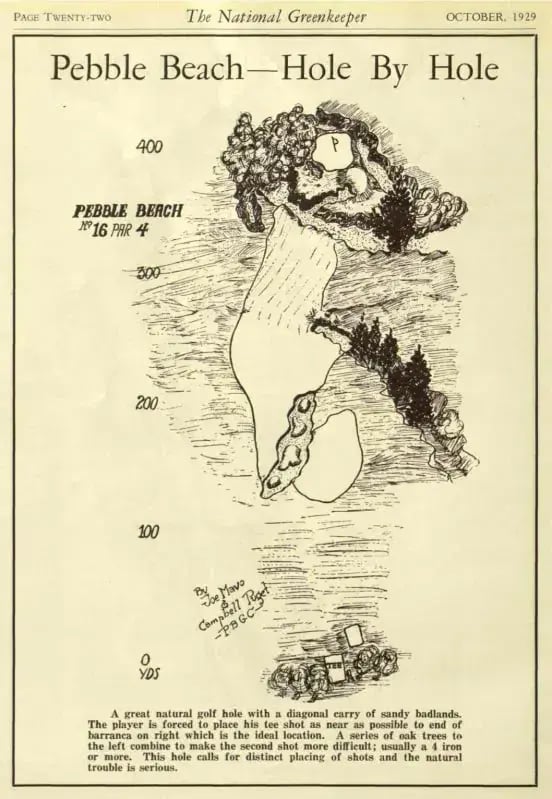
Best I can tell from the historical aerials, the tree on the right wasn’t planted until the 1960s.
Now, did the twin cypresses make the hole better? And should the right-hand one be restored? I’ll save those questions for another day. For now, let’s just appreciate how quick people are to accept a story that confirms their priors. (I’m certainly not exempt from this tendency.)
Thomas, at least, had the sense to post a mea culpa a few days later: “Hearing that the tree did in fact have a disease. Was a bit premature of me to assume without knowing all the info. I guess it’s obvious to tell I’ve seen it enough it triggers me easily [laughing emoji].”
Design Notebook is Presented By
This edition of Design Notebook is presented by the Golf Course Superintendents Association of America.
GCSAA supports more than 21 thousand members worldwide – from superintendents and equipment managers to students and educators. Celebrating its 100th anniversary this year, GCSAA continues to ensure that its members are at the forefront of research, education, innovation, and advocacy through a range of programs and services.
A few quick hits to wrap up:
→ Cabot Wilds, a new Cabot resort in Nova Scotia, is set to debut in late 2027 with an 18-hole golf course designed by Jeff Mingay. This is a major opportunity for Mingay, who has completed many restorations and renovations but never a solo new-build design. Read more here.
→ First Tee - Greater Charleston announced the creation of The Kids Course, a nine-hole par-3 course with a membership consisting exclusively of children ages 5-18. Adults will be permitted to play, but only in the company of a member. Brian Schneider and Troy Miller are the designers, and an opening date is tentatively scheduled for January 2028.
→ The University of Florida plans to build a new “championship-level golf course,” funded by Consumer Cellular CEO Ed Evans and designed by Beau Welling and Steve Smyers.
{{inline-article}}
Underlined and Starred
“In golf construction art and utility meet; both are absolutely vital; one is utterly ruined without the other.” -George Thomas
Have a topic or question you'd like discussed in Design Notebook? Contact Garrett at garrett@thefriedegg.com.




Design Notebook: Lahinch Debrief and Saudi Arabia's Golf Struggles
A Q&A with Keith Cutten
A Q&A with Geoff Shackelford
Design Notebook: Merion Reflections, Yale Conditions, and Muirfield Tensions
Design Notebook: An Open-Rota Renovation Vibe Shift

Design Notebook: Ron Prichard Discusses an Imperiled Muni and the State of the Restoration Game
Get full access to exclusive benefits from Fried Egg Golf
- Member-only content
- Community discussions forums
- Member-only experiences and early access to events