

Design Notebook: A Royal County Down Proposal and a Coul Links Denial
Plus, a Q&A with Blake Conant on his recent design work


Greetings, Fried Egg Golf Club members, and welcome back to Design Notebook, your exclusive debrief on what’s happening in the world of golf architecture.
Today, I have a meaty Q&A with Blake Conant, whose work with Tom Doak and Brian Schneider (as well as for his own firm Dundee Golf) has generated a lot of excitement lately. Blake and I talk about a few of his recent and ongoing projects, including the Gilroy at Old Barnwell.
But first, some news…
Chocolate Drops
On October 20, Royal County Down Golf Club announced plans to “significantly upgrade” its course. The club is working with UK-based firm Mackenzie & Ebert, best known for consulting at every current Open Championship rota venue and many of Great Britain and Ireland’s most prominent clubs. M&E’s recommendations include new and relocated tees, renovations of select bunkers and greens, and, in a few cases, substantial regrading of fairways and dunes.
RCD, which earned a three-Egg rating from Fried Egg Golf’s own Andy Johnson, is almost universally considered one of the 10 greatest courses on the planet. Yet the club apparently feels changes are needed to maintain its status as “one of the very best golf courses in the world and one of the most significant tourism assets in Northern Ireland.”
When the story broke, some speculated RCD was chasing an Open Championship, but members have since told us those rumors are unfounded.
Peruse the planning documents here, if you’re so inclined.
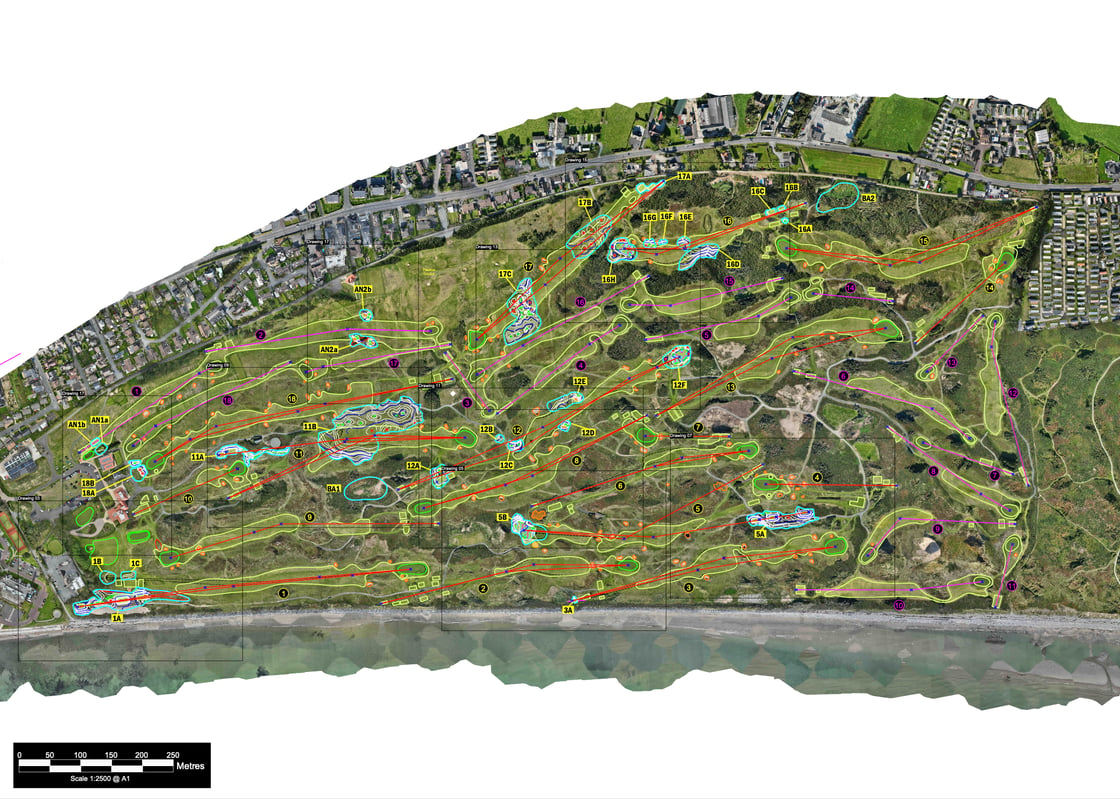
Now, before you reach for a pitchfork (an impulse I understand), remember that this proposal is just that: a proposal. We don’t know how many of M&E’s recommendations the club will actually adopt.
Plus, the plan isn’t especially ambitious. It targets specific areas of seven holes — two on the front nine, five on the back. For the most part, RCD seems intent on keeping its revered links intact, which is reassuring.
Still, a few of the suggested changes may prove controversial:
- No. 5: M&E is proposing to build a new tee complex, which would straighten out this par 4’s tricky diagonal tee shot, and reconstruct the green.
- No. 11: M&E wants to build another new tee complex and regrade the large natural landforms in the fairway, evidently to dispense with this par 4’s famously intimidating blind tee shot.
- No. 12: M&E is recommending an overhaul of this par 5’s beautifully sited green, along with most of its fairway bunkers.

If you’re familiar with my previous work on Mackenzie & Ebert, you know I have my guard up about all of this. This firm has a long track record of repetitive, ham-handed renovations of classic links courses. Regardless of a site’s character or history, M&E tends to lean on a house style: frilly-edged bunkers, pushed-up greens bordered by runoffs, and a predilection for vistas and open sightlines. Some of their recommendations for RCD appear to fall back on these habits.
But beyond the specifics of this project, I just have a fundamental issue with Tom Mackenzie and Martin Ebert’s approach to construction. They are not builders. Yes, they produce highly detailed plans on CAD software, but they delegate the bulk of on-site work to contractors. This sets them apart from today’s best architects — Coore, Doak, Hanse, OCM, Schneider — who spend more time in the field and work with skilled, trusted artisans to ensure quality.
In other words, M&E is essentially a design-contract outfit. That model has its place, but in my opinion, a great links course like Royal County Down deserves the attention of a proper design-build architect.
The Coul Links saga has come to a sad end. On October 23, the Scottish government rejected plans to build a Coore & Crenshaw-designed course on a stretch of protected dunes near the Highlands village of Embo.
The developers, who included Bandon Dunes founder Mike Keiser, promised to treat the land gently and garnered significant local support. But they could never quite escape the shadow of President Donald Trump, whose luxury resort in Aberdeen destroyed a sensitive dune system and left Scottish environmental groups understandably wary of U.S.-backed golf development. Those groups fought Coul Links from the beginning, and now they have decisively prevailed.
The lesson: golf’s reputation among the non-golfing public matters.
Speaking of which, the Trump administration has finally submitted an official plan for its Tom Fazio-led transformation of East Potomac Golf Links. Sent last week to the National Capital Planning Commission, the 55-page proposal is vague on many counts: it doesn’t specify the total cost of the project or the impact on green fees, for instance. It does, however, cite a price for the reconstruction of the park’s century-old sea wall: $304.5 million, which strikes me as conservative.
The plan acknowledges what I’ve been reporting for months: in order to build a big, fancy championship course at East Potomac, the administration intends to eliminate the vibrant recreational areas around the golf facility. This “displaced recreation,” the plan suggests, will be compensated for by “biking, walking, fishing, and picnicking… nearby, such as at West Potomac Park and the Tidal Basin.”
Is the administration saying it will create new infrastructure for bikers, walkers, fishermen, and picnickers at West Potomac Park and the Tidal Basin? Or is it just sort of… telling them to go there? Your guess is as good as mine. (And my guess is the latter.)
In the meantime, Judge Ana Reyes, who is handling a lawsuit over the project in district court, has ordered an ethics inquiry into how the Department of Justice’s lawyers have conducted themselves in the case.
Whether any of this will be affected by Tuesday’s midterm elections, in which the Trump-opposed Democratic Party made historic gains in the U.S. House of Representatives and Senate, is a question for someone smarter than I am.
Okay, how about some unambiguously good news? After a decades-long battle for survival, Lions Municipal Golf Course in Austin, Texas, can now feel confident in its future. On October 14, the City of Austin announced that it was in discussions with the University of Texas to take over full ownership of the course. The city, unlike the university, is committed to preserving Lions Muny, which became the first public golf course in the South to integrate in 1950.
Massive kudos to the Muny Conservancy, whose Save Muny initiative sets the gold standard for municipal golf advocacy. Good folks doing a good thing.
Let’s wrap up with some quick hits:
→ Coore & Crenshaw’s Pinehurst No. 11, next door to Doak’s No. 10 course, is open for preview play. Its official debut is set for March 2027.
→ Merion Golf Club has been anointed the fourth U.S. Open anchor site, joining Pinehurst, Oakmont, and Pebble Beach.
→ Tiger Woods and TGR Design are turning Tam O’Shanter Country Club, a Long Island enclave that closed in 2021, into a “private destination” with a redesigned course, a large practice facility, a golf performance center, a new clubhouse, and cottages for members.
→ Last week, journeyman architect Bill Bergin was elected president of the American Society of Golf Course Architects. Shoutout to outgoing president Mark Mungeam, one of the few members of the profession to speak out against the East Potomac takeover. “I think it’s a crazy idea,” Mungeam told the New York Times in May. “The park now is a public park. The golf is very much affordable, public-access golf.” That’s how you use a position of power in the golf world the right way.
{{inline-article}}
Underlined and Starred
“The essential difference between the best seaside golf and that of the inland variety is that, in the first case, one is battling with nature — as one does in climbing a mountain or in sailing a boat — while in the other one is faced with problems of human origin. No matter with what heights he is faced or with what winds assailed, the sportsman in battling with nature makes no complaint. But immediately he is faced with problems of human origin, he feels justified, if he finds them too difficult, in turning upon their creator with murder in his heart.” -Robert Hunter
Have a topic or question you'd like discussed in Design Notebook? Contact Garrett at garrett@thefriedegg.com.





A Q&A with Blake Conant
Design Notebook: The Athletic Lights Up Yale, LinksDAO Sells Spey Bay
A Q&A with David Normoyle about Cypress Point

Design Notebook: Pebble Beach Changes and Medinah No. 3 Insights
A Q&A with Ashley Mead

Design Notebook: Lahinch Debrief and Saudi Arabia's Golf Struggles
Get full access to exclusive benefits from Fried Egg Golf
- Member-only content
- Community discussions forums
- Member-only experiences and early access to events