

Rory McIlroy: A Man in Full
On his sixth major title and a satisfying struggle
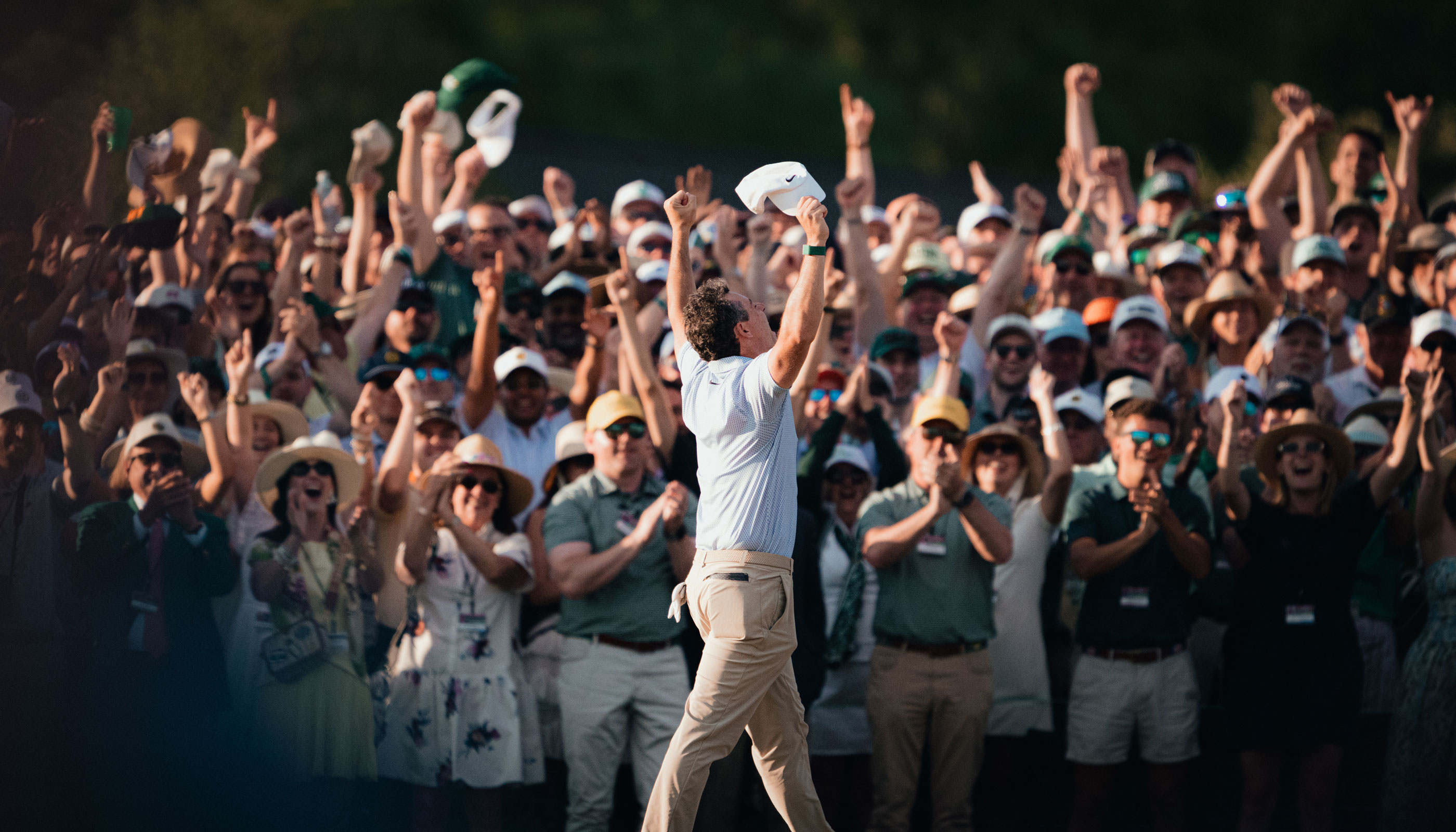
When he was young, Rory McIlroy made so many things in life look easy.
He didn’t walk across the fairways of golf courses around the world, he bounced and traipsed from one end to the other. The lines he took from the tee with his driver seemed to defy logic, then gravity. He ripped apart the record book at the U.S. Open, the PGA Championship, then the Open Championship, playing with a combination of artistry and aggression that was hard for mortals to reconcile. He thrived in the cauldron of the Ryder Cup. There had never been a player quite like him. How was it possible for this bushy-haired, undersized kid from a little town in Northern Ireland to play with so much freedom and fearlessness?
The answer was, McIlroy didn’t think about any of it. He was at his best when he was reacting instead of thinking. It was part of his gift, that guilelessness. There was only one caveat to living such a charmed life.
MASTERS HUB: Course insights, tournament coverage, and more from Augusta
He couldn’t figure out Augusta National. It made him think. More accurately, it made him overthink. It twisted his divine golf brain into little knots and pretzels. Over time, it began to haunt him. It started to seep into other areas of his life. His innocence dimmed. He told himself he didn’t need the Masters to feel complete, but deep down, that felt like a lie. Why did this one tournament matter so much?
As time went on, the answer became obvious. Because nothing at Augusta came easily.
It was a testament — he knew — to what a great golf course it was. McIlroy could not overpower it. He could not bludgeon it. He had to evolve. As anyone who has tried to evolve can attest, change is hard. You have to be vulnerable enough to admit you may not have the right answers. For a prodigy, there is nothing harder.
You have to abandon your instincts, the very thing that originally made you special.
When we look back one day on McIlroy’s Masters career, specifically his second consecutive green jacket, what will stand out the most is his gradual evolution into a thinker. There will be plenty of time to debate the merits of his greatness — six-time major winner, fourth person in history to defend his Masters title, greatest European golfer of all time. But the real story, and the one that may continue to blossom for years to come, is that he entered the next mature stage of his golfing life.
He no longer has to play great to win majors.
That was never going to be true in his first Masters victory. In 2025, he seesawed back and forth on a knife’s edge because of his obscene talent. He hit hero shots when he felt free of pressure or when he had no other choice, and he threw up on himself when he began to overthink and daydream of how it would feel to slip his arms into that green coat.
But in 2026, something different unfolded. McIlroy could not rely on his prodigious gifts. His driver was a mess. His irons were loose, particularly on Saturday. He had to plot his way under and around trees, he had to miss in proper places. He had to manufacture birdies and wrestle back par putts from the edge of disaster. Augusta National was primed for a fight, and its most effective weapon was making him second-guess himself.
{{rory-mcilroy-2026-masters-gallery}}
“You have a lot of time to think,” McIlroy said. “You're out there a long time. There's a long time between shots. There's a long time between rounds. It's just there's little things that happen that just start to make you second-guess things. It's just very hard to stay in the same spot mentally for a long period of time.”
A younger version of McIlroy would not have contended with the game he brought to Augusta this week. We know this because we have plenty of evidence to support it. McIlroy felt like he had to play perfectly at the Masters for all those years he spent chasing the Grand Slam, and he could never sustain that perfection. But this year, when so many things were sloppy from tee to green, his short game and his putting rose to the occasion. He thought about how to use the slopes to bail him out of trouble. He drew pictures in his mind and then chipped with the deft touch of a sketch artist.
There has always been something ethereal about McIlroy’s game, but now there is something gritty, and something strategic as well. When he came to the 12th tee on Sunday, he did not need a birdie. He was not even trying for one. But he knew he could not afford another second nine disaster. The wind was swirling. His nerves were vibrating. His mind drifted back to something Tom Watson told him during his first-ever practice round at Augusta when he was just 19 years old.
“He said he always waited until he felt where the wind should be and then just hit it,” said McIlroy. “Just hit it as soon as you can. That's what I did on 12. It was all over the place. When I stood up on the tee, it felt like it was off the right, and I looked at the 11th flag. It was blowing right to left. But I was patient, and I waited to feel where the wind should have been coming from, and I knew it was just a perfect three-quarter 9-iron.”
McIlroy knew it was good when the ball was in the air, that he’d executed exactly how he wanted, aiming at the bunker in the middle of the green. But when the ball landed, it spun to the right and nestled seven feet from the cup. It was the closest approach of the day. When he rolled in the birdie putt, it felt like stealing one from the field. But it was a well-earned theft. Nick Faldo found him later, on his way to the green jacket ceremony, and put his arm around McIlroy’s shoulder. “F-ing amazing,” Faldo said. “That was the key one.”
On 16, McIlroy's adrenaline got the best of him. He sent an 8-iron long and left. There was no panic. Having seen the famous Tiger Woods chip from 2005 roughly 10,000 times, he knew exactly what he needed to do. He putted it to the edge of the slope, then let gravity take over, the ball coming to rest a few inches from the cup. Another crucial par.
At times on Sunday, his focus wavered. It would be too tidy a narrative if it didn’t. His thoughts drifted to his parents, who he’d convinced this year to make the trip.
“I caught myself on the golf course a couple of times thinking about them, and I was like ‘No, not yet, not yet,’” McIlroy said. “I had to sort of convince them to come this year because they thought the reason I won last year was because they weren't here.”
After a shaky par on 17, he had one final test he had to complete. He fanned his tee shot way right, nearly onto the 10th fairway, and his heart began racing. “I think that was the moment of greatest stress,” he said. “I didn’t know where my ball was. It could go anywhere.”
When he found it, he had a gap. All week Augusta had given him breaks, and here was the final one. As he stood over the ball, shuffling his feet in the pine straw, ready to launch an 8-iron high over the trees, a patron blew a cloud of cigar smoke that practically engulfed him. McIlroy didn’t back away. He was too focused on the task. He launched his approach up into the sky, high enough to find the front bunker. He could breathe again. When he lagged his par putt to an inch, he let himself lean into the moment for the first time. He could see his parents, his wife, and his daughter behind the green.
There was a time when he believed the Masters was the destination, that if he finally got one, he’d feel complete. McIlroy realized once he did that there was still more he wanted to accomplish. A second Grand Slam? Double-digit majors? Anything felt possible in this new world.
It didn’t have to come easy from now on. The struggle is part of what made it so satisfying.
“It took me 10 years to win my fifth major, and then my sixth one's come pretty soon after it,” McIlroy said. “I'm not putting a number on it, but I certainly don't want to stop here.”
.png)
Interactive Augusta National Map
Click on a pin below to preview the hole or visit the full profile.
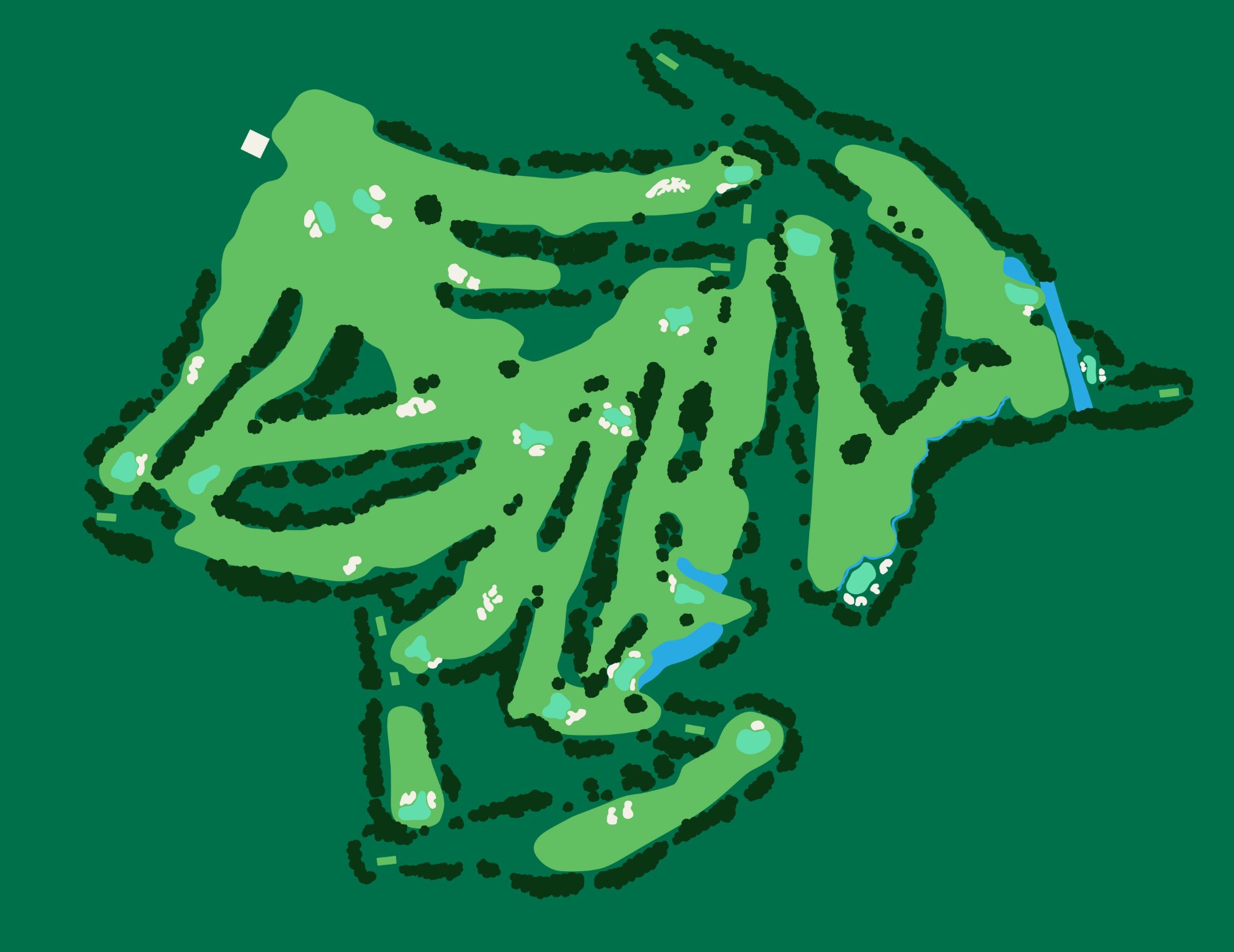
Augusta National
Ever since it opened, Augusta National has been in a constant state of evolution (for better or for worse), but it remains one of the greatest championship venues in the world
Hole 1 - Tea Olive
Augusta National's property is defined by a single broad downslope that ends at Rae’s Creek, and this par-4 opener is the only hole on the course that sits completely on top of it. Strategically, No. 1 at Augusta National is one of the most compelling opening holes in professional golf.
Hole 2 - Pink Dogwood
The second hole at Augusta National produces more off-the-tee variety than most par 5s in professional golf.
Hole 3 - Flowering Peach
Players face three basic options off the tee: hit a long iron or hybrid near the bunkers at the top of the first ridge, leaving a full wedge in; bash it left, past the bunkers and into the valley short left of the green; or go straight for the green in hopes of at least holding the narrow shelf short right. The most strategically complex hole on the golf course, “Flowering Peach” has stood the test of time, less affected by distance gains than most holes at Augusta National.
Hole 4 - Flowering Crab Apple
The first — and longest — par 3 at Augusta National has historically required a strong strike with at least a long iron, though club selections in the Masters have shifted as distance gains have spiraled out of control. Can you execute a towering shot with a long iron, hybrid, or fairway wood?
Hole 5 - Magnolia
“Magnolia” is like Paul Thomas Anderson’s film of the same name: brilliant, probably underrated, but a tad bloated. Nonetheless, the hole presents an honest challenge, and the green is one of the most artfully shaped at Augusta National (or anywhere else).
Hole 6 - Juniper
“Juniper” is, in our opinion, Augusta National’s second-best par 3. Each pin position presents a different range of challenges and exciting possible outcomes.
Hole 7 - Pampas
Yes, the green contours are fun, but “Pampas” has morphed into something that Alister MacKenzie likely would not endorse: a hole that merely defends itself through length and narrowness rather than asking complex strategic questions.
Hole 8 - Yellow Jasmine
This uphill three-shotter consistently produces the highest scoring average of Augusta National’s four par 5s, but it still presents a welcome birdie opportunity after the tough stretch of Nos. 4-7. “Yellow Jasmine” is the most underrated hole at Augusta National.
Hole 9 - Carolina Cherry
The ninth hole plays from a high point near the first and eighth greens, down through a valley frequently used by galleries, and up the hill where the clubhouse sits. From a risk-reward perspective, “Carolina Cherry” is a bit of a muddle.
Hole 10 - Camellia
The 10th hole kicks off the back half of the round in hair-raising fashion, plunging 100 feet into a valley shrouded by tall pines. Perry Maxwell’s 1938 transformation of “Camellia” is one of the rare cases in which a change to MacKenzie and Jones’s design represented a substantial improvement.
Hole 11 - White Dogwood
No. 11 is simply a brute, often playing as the most difficult hole to par at Augusta National. It’s also been one of the most frequently tinkered-with holes at Augusta National.
Hole 12 - Golden Bell
The focal point of Amen Corner and the center of gravity in any final round of the Masters, the 12th hole at Augusta National is as terrifying as it is beautiful.
Hole 13 - Azalea
This iconic risk-reward par 5 offers the first of a series of birdie opportunities on Augusta National’s home stretch.
Hole 14 - Chinese Fir
Although some nuances of MacKenzie and Jones’s original strategic concept for the hole have been lost, “Chinese Fir” is still a compelling par 4, rewarding precise and well-shaped shots both off the tee and into the green.
Hole 15 - Firethorn
No. 15 consistently presents one of the toughest decisions players have to make during their rounds: go for the green in two or lay up to one of the most demanding wedge shots in golf.
Hole 16 - Redbud
Set at the base of the ridge that the fifth green and sixth tee occupy, the par-3 16th hole provides a ready stage for championship-defining shots. Over the past several decades, the 16th has shown an undeniable knack for spectacle.
Hole 17 - Nandina
From tee to green, No. 17 is one of the simplest holes at Augusta National and is likely the least-loved hole on the second nine.
Hole 18 - Holly
“Holly” is a little funky, but its design is smart and elegant: bend it around the trees on the right and bypass some of the natural difficulty of the next shot.






Winners and Losers from LIV Golf 1.0

It's Too Soon for Jon Rahm's LIV Golf Retrospective
Lauren Coughlin's Brush With Perfection
Weekend Update: Tom Kim Earns Military Exemption, Michael Block Stumbles
How Can Team USA Solve a Problem Like Foursomes?

If Not Now, Then When for the Internationals?
Get full access to exclusive benefits from Fried Egg Golf
- Member-only content
- Community discussions forums
- Member-only experiences and early access to events