
Every Hole at Augusta National - No. 12, Golden Bell
History, Masters strategy, and expert commentary on the par-3 12th

The Basics
Par 3 | 155 yards
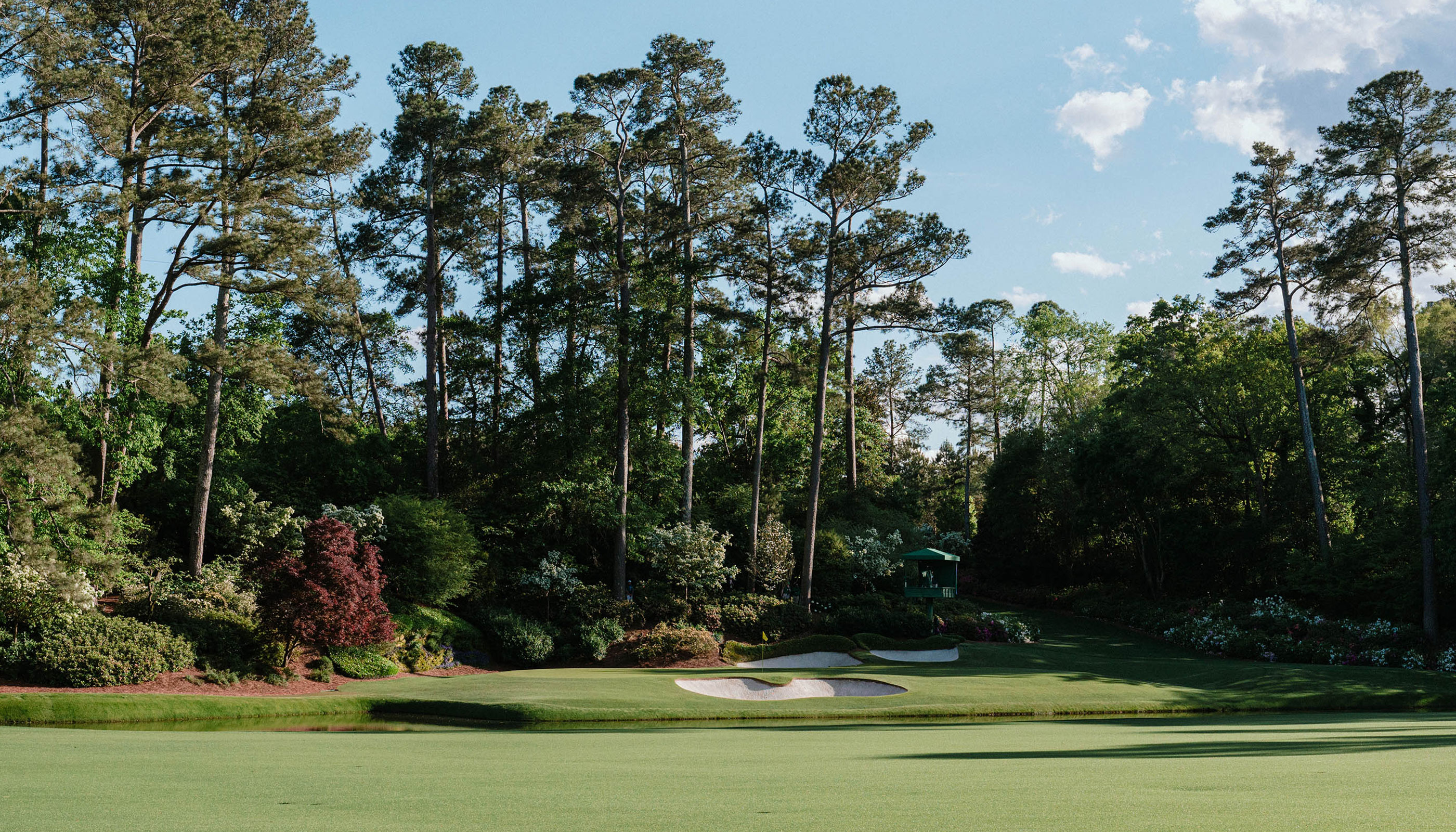
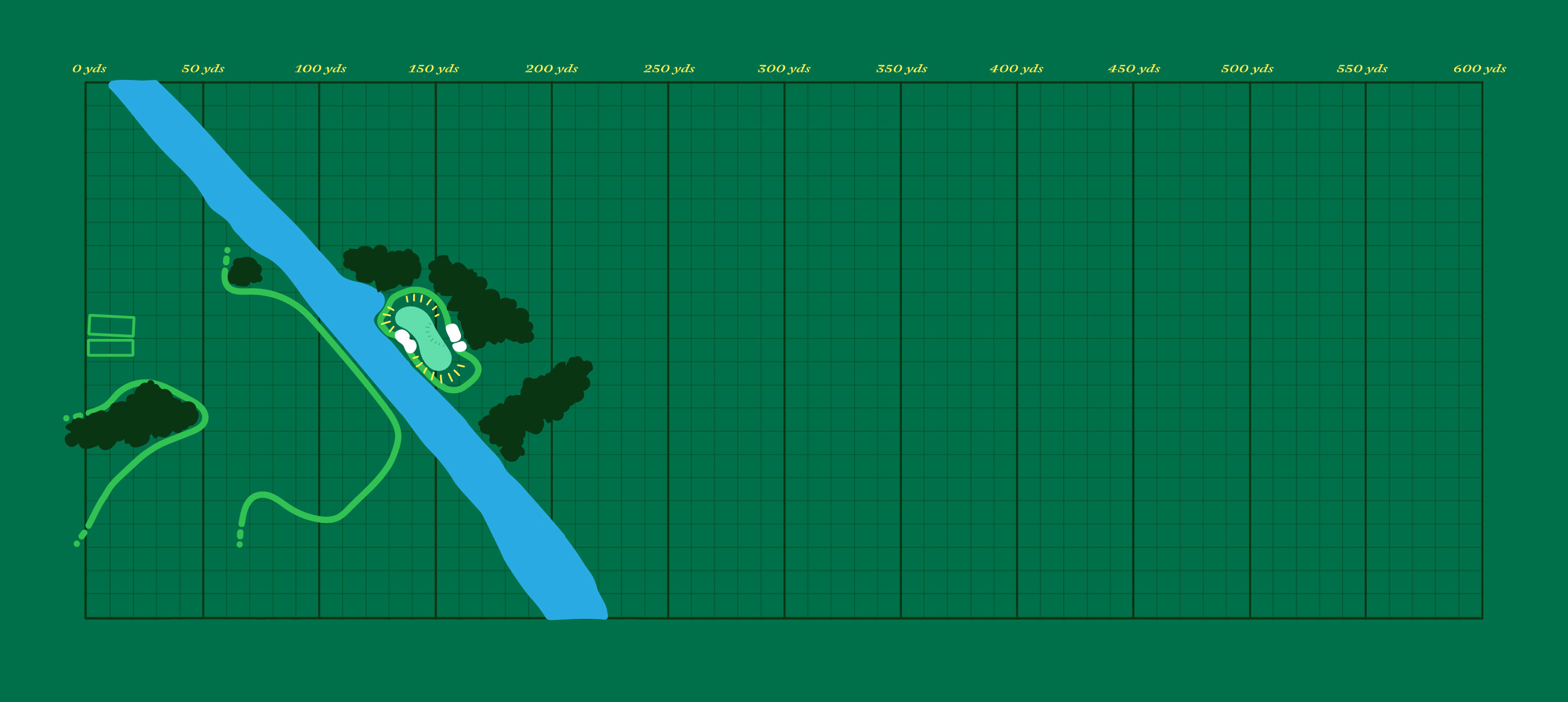
The focal point of Amen Corner and the center of gravity in any final round of the Masters, the 12th hole at Augusta National is as terrifying as it is beautiful. The difficulty of this little par 3 revolves around a high-stakes game of line and distance control. The green is shaped like the sole of a shoe, deeper on the left than on the right, and oriented on a short-right to long-left diagonal. In front, it is protected by a single bunker and a shaved bank feeding into Rae's Creek; in back, by a small runoff and a pair of bunkers cut into an azalea-decorated ledge. The farther the flag moves to the right, the more complex one’s calculations on the tee become. The far-right Sunday pin is about 15 yards deeper than a front-left location, but most players will aim for the middle of the green, over the bunker. This is a treacherous shot for right-handers, whose misses will typically be short right and long left. A push, therefore, is likely to end up in Rae's Creek, while a pull may bound into the foliage behind the green.
The hole's most famous and imposing defense, however, is the wind, which swirls chaotically through Amen Corner, deflecting off the tall stands of pines. This variable makes club selection on the 12th more art than science, testing a contender’s ability to commit to a number in the face of uncertainty.
{{every-hole-augusta-national-12-golden-bell}}
History
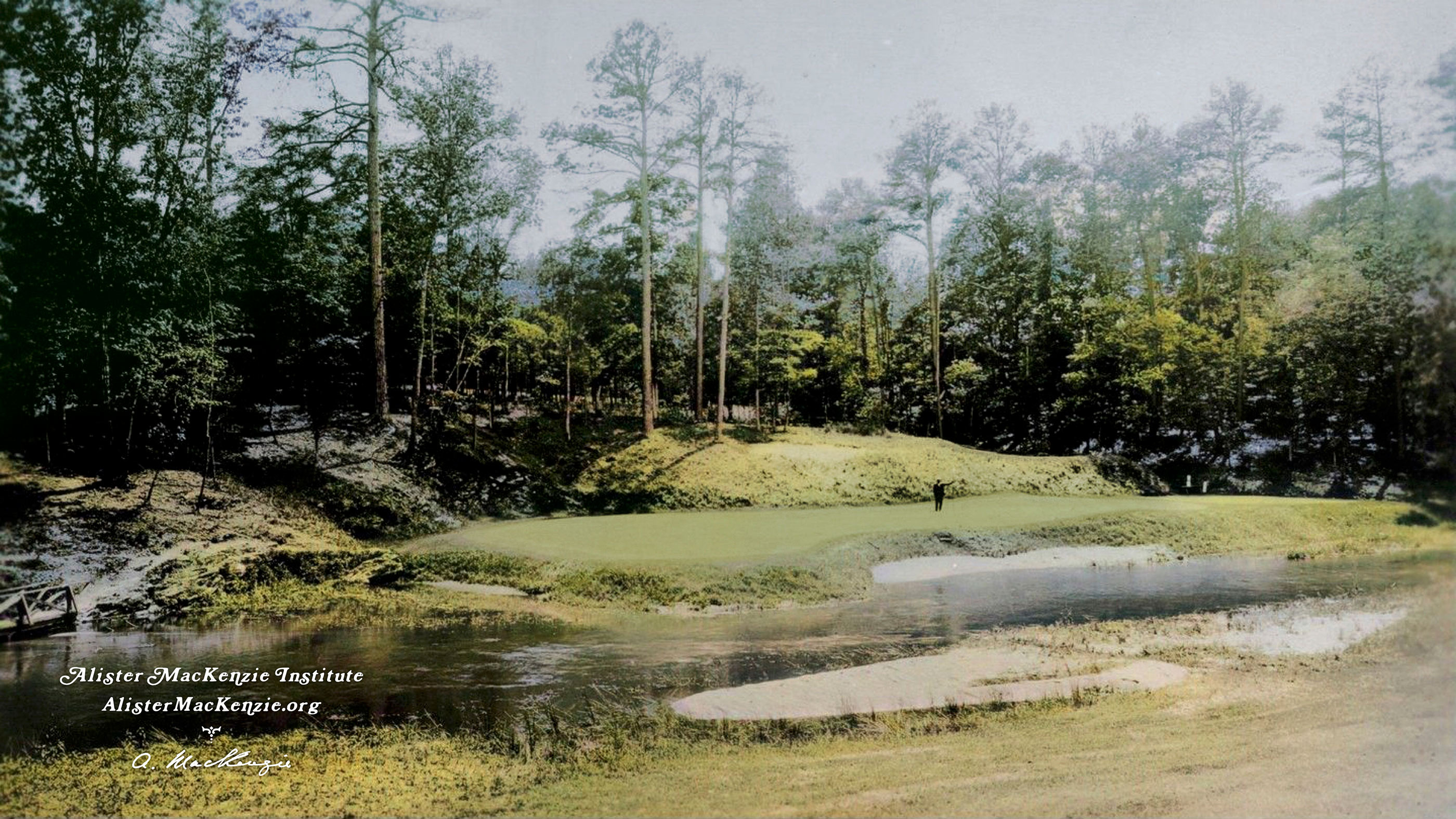
The 12th has changed relatively little over the years, retaining its unique capacity to petrify elite players. Initially, like the rest of the course, the hole had a more rustic aesthetic, with scraggly grass around the putting surface and primitive, ground-hugging bunkers. The green pad almost looked like it was part of Rae’s Creek — and unsurprisingly it was prone to flooding. In the decades after World War II, the club raised the green and worked to tame Rae's Creek through damming. The bunkers were also rebuilt in Augusta National’s now-familiar refined, flashed style.
Strategy Notes for the Masters
Center of the green — that’s the mantra on No. 12. The wind is notoriously difficult to judge, forcing players to choose a conservative target that provides some margin of error. A shot to 30 feet is fine all four days. The front-left hole location is the only one that allows for slightly more aggressive play. As long as the ball doesn’t come up short in the water or airmail into the bushes beyond the green, aggressive misses typically yield reasonable chances to save par. A long, on-target miss won’t kill you to this pin.
No. 12 is also one of the clearest examples of how left-handed hitters maintain an advantage at Augusta National. Lefties tend to miss short left or long right, aligning with the orientation of this green. Righties’ misses, on the other hand, overlay with trouble. –Joseph LaMagna
Our Take
Calling “Golden Bell” a great par 3 is a bit like saying The Beatles were a good band or The Godfather is a cool flick. No one will accuse you of courageous originality. But facts are facts: No. 12 is an extraordinary marriage of setting and design, peerless in its ability to define the narrative of each Masters Sunday.
Expert Commentary
Alister MacKenzie (1932): “This is an interesting pitch shot to a long narrow green immediately over a stream. The bold player will go for the pin on the right, while the less ambitious will steer for the larger landing space on the left side of the green. There is a steep sandy bank covered with beautiful trees beyond the green.”
Bobby Jones (1959): “The championship location for the pin here is in the shallow area of the green on the right. Here the distance must be gauged very accurately, and the wind sweeping down along Rae’s Creek is often deceptive to the player standing on the tee about to hit. The inclination here is to be well up, or at least to favor the left side where the green is somewhat wider. To play safely to the left is simple, but the putting problem which results is not an easy one. Pin locations on the left side of the green can be made testing only by pushing them far forward or far back. Once the tee shot has been played into the creek, the short pitch to the shallow green is terrifying indeed.”
Geoff Ogilvy (2019): “The wind is an element that has really made the hole famous, but without that, the genius of the hole, especially because most golfers are right-handed, is that short right is in the water and long left is over the green. And a right-hander, when they miss it left it goes long, and when they miss it right it goes short…. [The wind] seems to come down 13 fairway around the bend, hit the wall of trees [behind the 12th green], and bounce back towards the tee. You know [the wind] is supposed to be down off the right, but one minute out of every three, it can play into the wind because it bounces off that big wall of trees and it holds up the ball…. Nicklaus always said hit it over the bunker, go left of the [right pin] and go from there. That’s a great theory, but the middle of the green is short of where the [right] pin is. So if you pick that line and miss it right, you’re going to go in the water…. The most beautiful noise in golf is when you’ve made a putt on 12, and there is that speed-of-sound gap. You’ve got that three seconds until you hear the cheers. There is something about it that is really rare in golf.”
Memorable Shots
Jordan Spieth’s quadruple‑bogey 7 in 2016: When he turned to play the back nine, Spieth had a five-shot lead. But by the time he came to the 12th tee, that lead had shrunk to just one. He proceeded to put two balls in the water, a hole that will live in infamy for decades to come.
Fred Couples clings to the bank in 1992: It’s funny that one of the most famous shots ever hit into 12 was not a good shot, but it was the break of a lifetime. Couples was leading the Masters when he came up short, but inexplicably, his ball hung up on the bank a foot from the water. He saved par, and won the Masters by two strokes over Raymond Floyd.
Course Routing
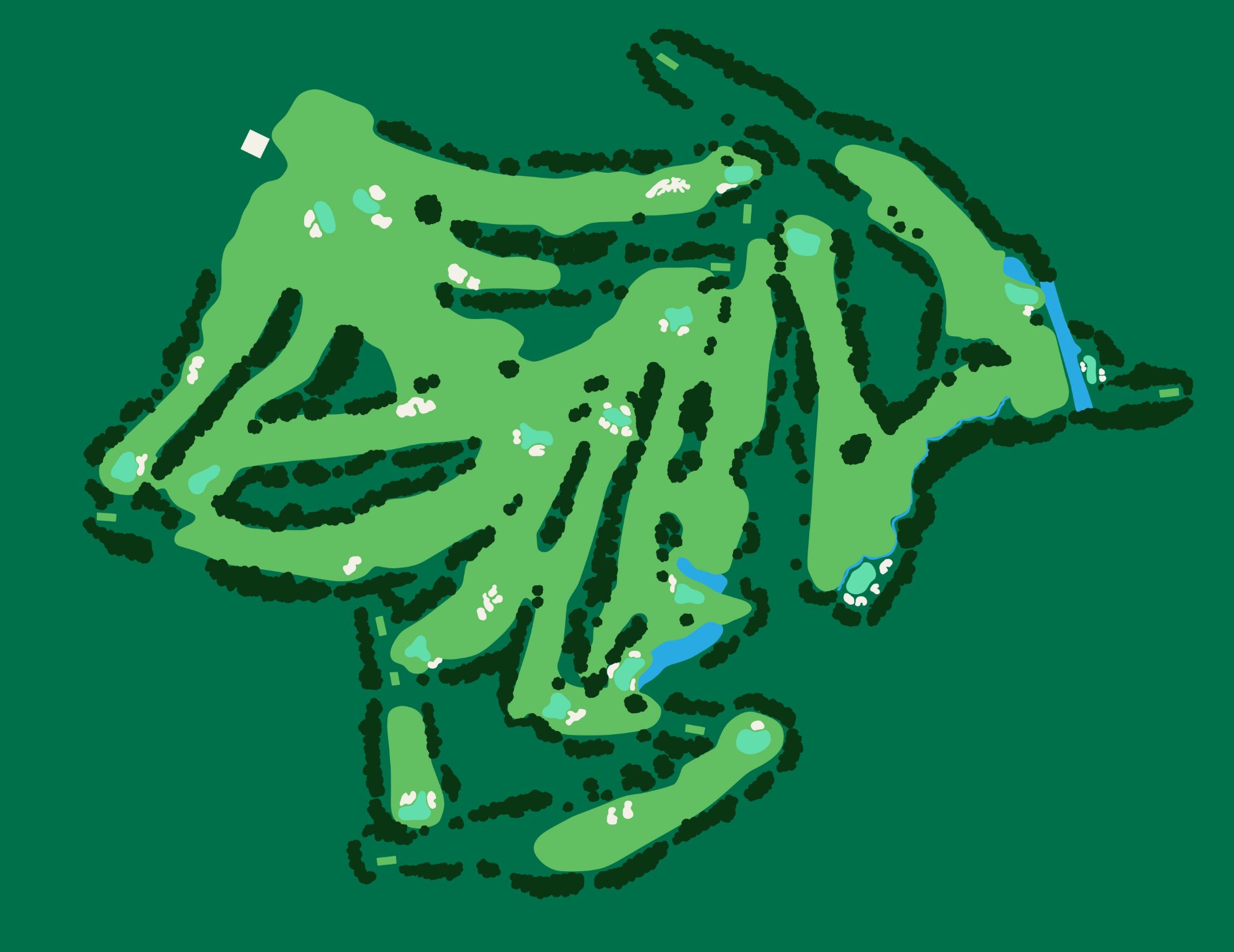
Click on a pin below to preview the hole or go to the full profile of the hole.
Augusta National
Ever since it opened, Augusta National has been in a constant state of evolution (for better or for worse), but it remains one of the greatest championship venues in the world
Hole 1 - Tea Olive
Augusta National's property is defined by a single broad downslope that ends at Rae’s Creek, and this par-4 opener is the only hole on the course that sits completely on top of it. Strategically, No. 1 at Augusta National is one of the most compelling opening holes in professional golf.
Hole 2 - Pink Dogwood
The second hole at Augusta National produces more off-the-tee variety than most par 5s in professional golf.
Hole 3 - Flowering Peach
Players face three basic options off the tee: hit a long iron or hybrid near the bunkers at the top of the first ridge, leaving a full wedge in; bash it left, past the bunkers and into the valley short left of the green; or go straight for the green in hopes of at least holding the narrow shelf short right. The most strategically complex hole on the golf course, “Flowering Peach” has stood the test of time, less affected by distance gains than most holes at Augusta National.
Hole 4 - Flowering Crab Apple
The first — and longest — par 3 at Augusta National has historically required a strong strike with at least a long iron, though club selections in the Masters have shifted as distance gains have spiraled out of control. Can you execute a towering shot with a long iron, hybrid, or fairway wood?
Hole 5 - Magnolia
“Magnolia” is like Paul Thomas Anderson’s film of the same name: brilliant, probably underrated, but a tad bloated. Nonetheless, the hole presents an honest challenge, and the green is one of the most artfully shaped at Augusta National (or anywhere else).
Hole 6 - Juniper
“Juniper” is, in our opinion, Augusta National’s second-best par 3. Each pin position presents a different range of challenges and exciting possible outcomes.
Hole 7 - Pampas
Yes, the green contours are fun, but “Pampas” has morphed into something that Alister MacKenzie likely would not endorse: a hole that merely defends itself through length and narrowness rather than asking complex strategic questions.
Hole 8 - Yellow Jasmine
This uphill three-shotter consistently produces the highest scoring average of Augusta National’s four par 5s, but it still presents a welcome birdie opportunity after the tough stretch of Nos. 4-7. “Yellow Jasmine” is the most underrated hole at Augusta National.
Hole 9 - Carolina Cherry
The ninth hole plays from a high point near the first and eighth greens, down through a valley frequently used by galleries, and up the hill where the clubhouse sits. From a risk-reward perspective, “Carolina Cherry” is a bit of a muddle.
Hole 10 - Camellia
The 10th hole kicks off the back half of the round in hair-raising fashion, plunging 100 feet into a valley shrouded by tall pines. Perry Maxwell’s 1938 transformation of “Camellia” is one of the rare cases in which a change to MacKenzie and Jones’s design represented a substantial improvement.
Hole 11 - White Dogwood
No. 11 is simply a brute, often playing as the most difficult hole to par at Augusta National. It’s also been one of the most frequently tinkered-with holes at Augusta National.
Hole 12 - Golden Bell
The focal point of Amen Corner and the center of gravity in any final round of the Masters, the 12th hole at Augusta National is as terrifying as it is beautiful.
Hole 13 - Azalea
This iconic risk-reward par 5 offers the first of a series of birdie opportunities on Augusta National’s home stretch.
Hole 14 - Chinese Fir
Although some nuances of MacKenzie and Jones’s original strategic concept for the hole have been lost, “Chinese Fir” is still a compelling par 4, rewarding precise and well-shaped shots both off the tee and into the green.
Hole 15 - Firethorn
No. 15 consistently presents one of the toughest decisions players have to make during their rounds: go for the green in two or lay up to one of the most demanding wedge shots in golf.
Hole 16 - Redbud
Set at the base of the ridge that the fifth green and sixth tee occupy, the par-3 16th hole provides a ready stage for championship-defining shots. Over the past several decades, the 16th has shown an undeniable knack for spectacle.
Hole 17 - Nandina
From tee to green, No. 17 is one of the simplest holes at Augusta National and is likely the least-loved hole on the second nine.
Hole 18 - Holly
“Holly” is a little funky, but its design is smart and elegant: bend it around the trees on the right and bypass some of the natural difficulty of the next shot.








New Cabot Wilds Resort Bolsters Canada's Destination Golf Reputation
A Special Round With an Old Friend

Q&A: Cory Griess, Superintendent at Prairie Dunes Country Club
Q&A with Golf Course Architect Sam Cooper
Merion East's Clever Inland Design on Display at 2026 U.S. Amateur
Is Royal Birkdale’s ‘Easiest’ Hole One of Its Best?
Get full access to exclusive benefits from Fried Egg Golf
- Member-only content
- Community discussions forums
- Member-only experiences and early access to events