
Every Hole at Augusta National - No. 14 Chinese Fir
History, Masters strategy, and expert commentary on the par-4 14th

The Basics
Par 4 | 440 yards
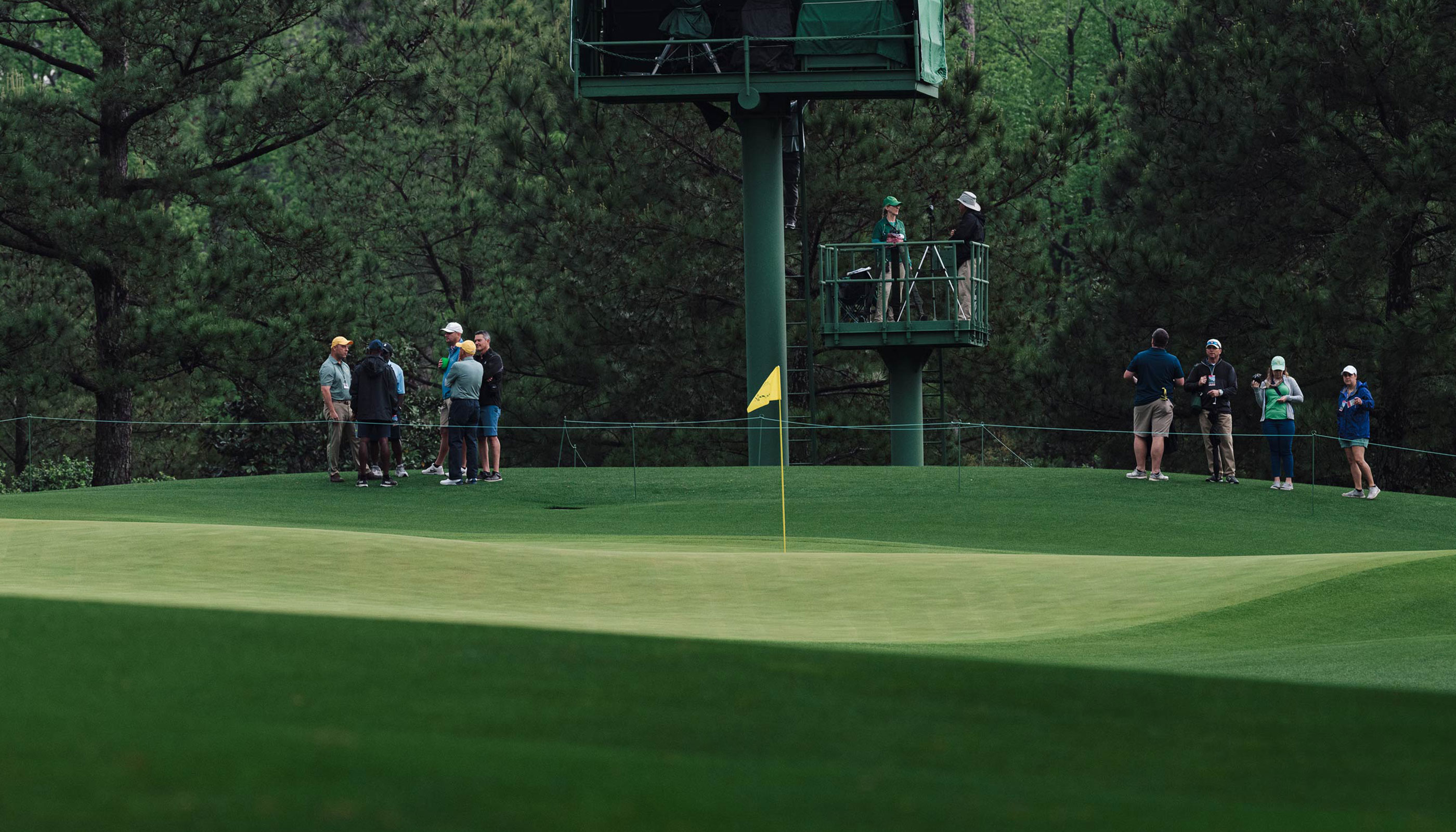
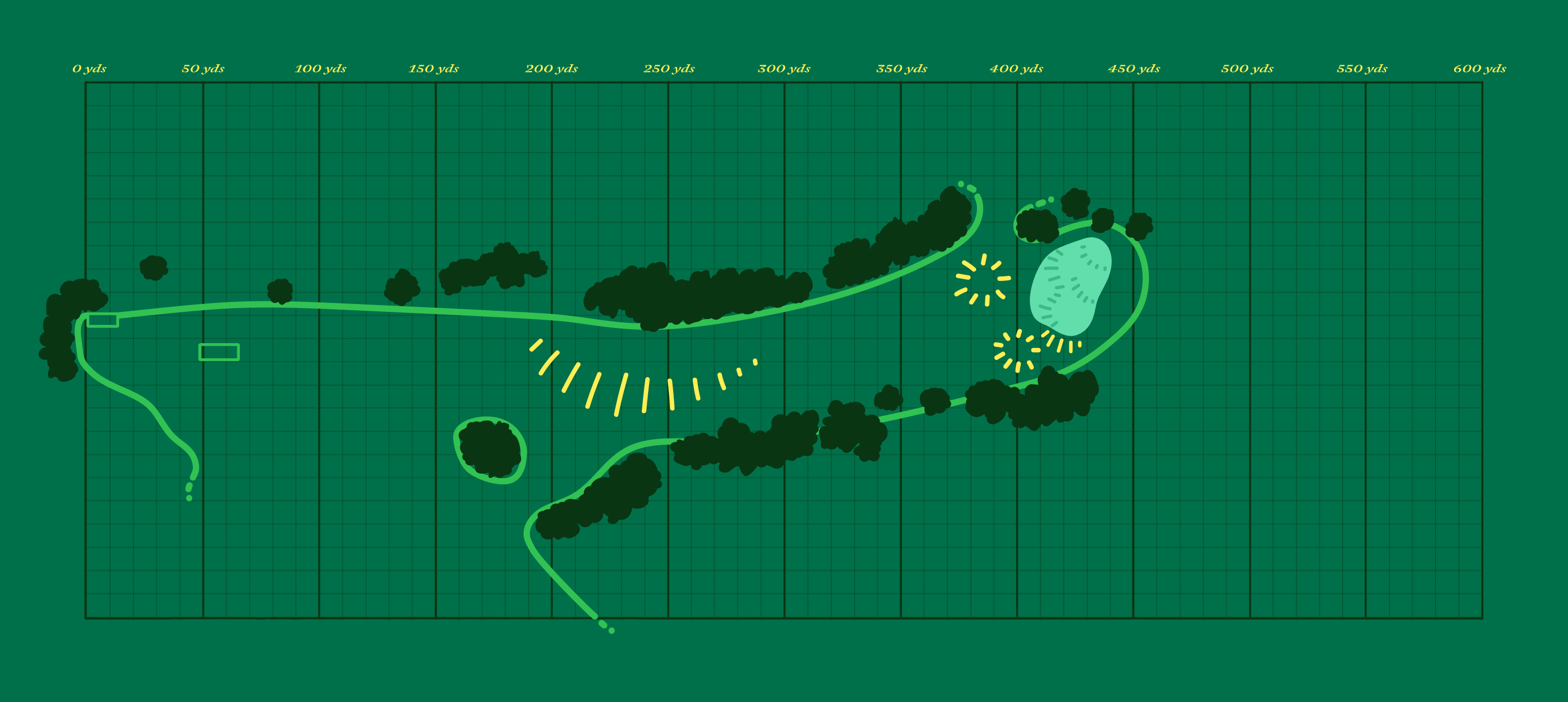
The only bunkerless hole at Augusta National, the 14th runs across a left-to-right slope and turns subtly to the left, in reverse camber. In order to prevent your tee shot from running down to the right and leaving a semi-blind approach, you must either challenge the tree line on the left or turn the ball from right to left. The green, also most receptive to a right-to-left shot, is one of Augusta National's most boldly shaped. A false front consumes half of the putting surface, but the flag is rarely seen on the small plateau below it. The typical pin positions are concentrated in a pair of pockets in the back. A sharp bank separates the two back shelves, allowing players to feed their approaches toward the traditional Sunday location on the right. This feature has generated many tap-in birdies and a few eagles in final rounds of the Masters over the years. Approaches that bounce over the bank, however, result in some of the hardest chips and lag putts to be found on the course.
{{every-hole-augusta-national-14-chinese-fir}}
History
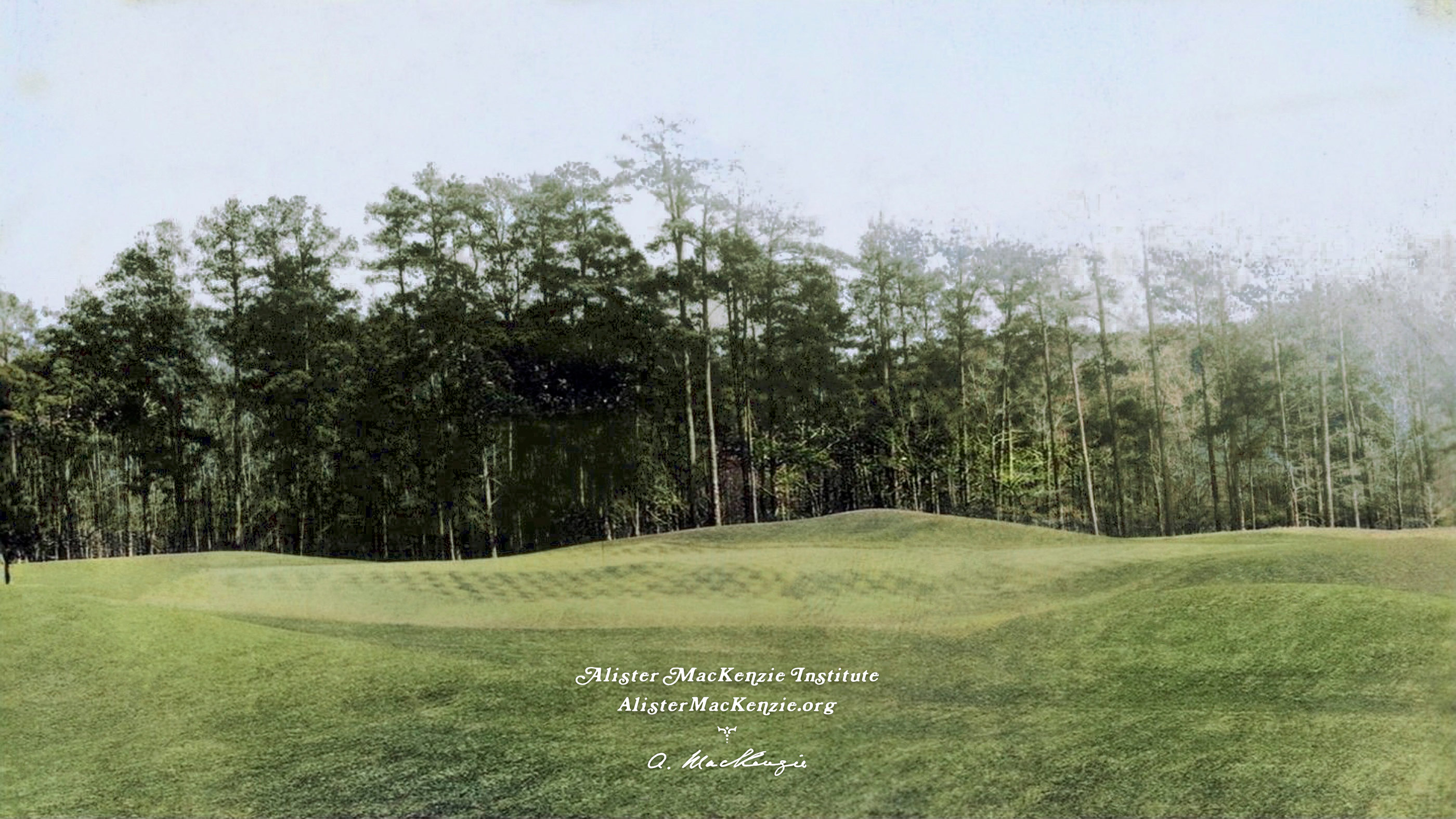
The 14th wasn't always bunkerless. Initially, it featured a single massive bunker stretching from about 100 to 175 yards off the tee, taking up the right half of the fairway. Carrying this hazard yielded an advantage: a large mound — another lost component of the hole — stood in front of the left portion of the green, obscuring the sightline from the left side of the fairway. Players who threaded the needle, taking on the bunker while avoiding the full run-out to the right, earned the cleanest view of and angle into the left-to-right-tilting green. Over the decades, the club gradually abandoned this original strategic vision. The stands of trees both right and left thickened and crept in, the bunker disappeared in 1952, and the mound came out in the late 90s. The once-abrupt mounding around the green has been smoothed out, too, but the internal complexities of the putting surface have largely survived.
Strategy Notes for the Masters
No. 14 is relatively straightforward from a strategic standpoint. A tee shot with driver or 3-wood down the center of the fairway sets up a short iron and a potential scoring opportunity. Players who find the left edge of the fairway — or miss the fairway left entirely — must contend with trees on the approach, while there is a little more room to navigate from the right side. As a result, players tend to favor the right side off the tee. Approach shots that come up short face difficult par saves up and over the sharp bank. Chip shots from over the back of the green aren’t exactly a picnic either. –Joseph LaMagna
Our Take
Although some nuances of MacKenzie and Jones’s original strategic concept for the hole have been lost, “Chinese Fir” is still a compelling par 4, rewarding precise and well-shaped shots both off the tee and into the green. Watching right-handed players hit controlled draws off of fade lies into the slope left of the Sunday pin is a reliable source of pleasure on Masters Sunday.
Expert Commentary
Alister MacKenzie (1932): “This hole embodies some of the features of the sixth hole at St. Andrews, Scotland. A long drive skirting or played over a bunker on the right will give a visible shot to the green. From the left the green is semi-blind and moreover a run up approach will be required over a succession of hillocks and hollows.”
Bobby Jones (1959): “The most popular line off the tee is slightly to left of center to gain the crest of the hill and not risk the runoff of the fairway to the right. A slight deviation to left of this line often encounters the upper branches of the group of pine trees on this side. A drive straying off to the right leaves the player on lower ground from which his ability to see the left side of the green is completely obstructed by a large mound in the middle of the fairway. The green is quite large and has many interesting and difficult contours. A mound in back protects against overrunning to the left side, but no such buffer exists on the right. The putting surface along the front spills over the contours into the fairway. A really good second shot leaving the ball close to the hole is most comforting here.”
Geoff Ogilvy (2019): “The fairway is quite high on the left and quite low on the right so anything that is straight or a fade is going to hit and run to the righ…. It’s probably the green that freaks people out the most…. That famous pin in the middle that they have on Sundays, where anything 20 or 30 feet left of it just rolls towards it, that’s a really fun pin to hit at. But you can get it wrong, because if you get it two feet right of the pin you’re going to have a 60-footer from the bottom right of the green. That might be the slowest putt at Augusta…. You can’t miss the green short. If you miss the green short, it might be a one-in-five up-and-down…. It’s a [green] you want to hit a draw into because you want the draw to hold the slope when it lands, but the ball is so far below your feet on the second shot that it’s really difficult to hit a draw.”
Memorable Shots
Jon Rahm’s flighted 8-iron in 2023: Rahm did have a three-shot lead when he came to the 14th hole, but he didn’t really have a signature moment yet. That changed when he pushed his drive to the right rough and had to flight an 8-iron under a branch toward the green. The ball took the slope on the left side of the green and cozied up to three feet. It was clear the Masters was his.
Greg Norman’s bad bogey in 1999: Norman had so many great chances to win the Masters, it’s easy to forget about his run in 1999 at age 43. In the final round, he eagled the 13th hole to pull into a tie for the lead with Jose Mariza Ozalabal. But a bad drive, a bad approach, and a poor effort with the putter from off the green led to a bogey, and he never recovered. Olazabal won his second green jacket, finishing two ahead of Davis Love III and three better than Norman.
Course Routing
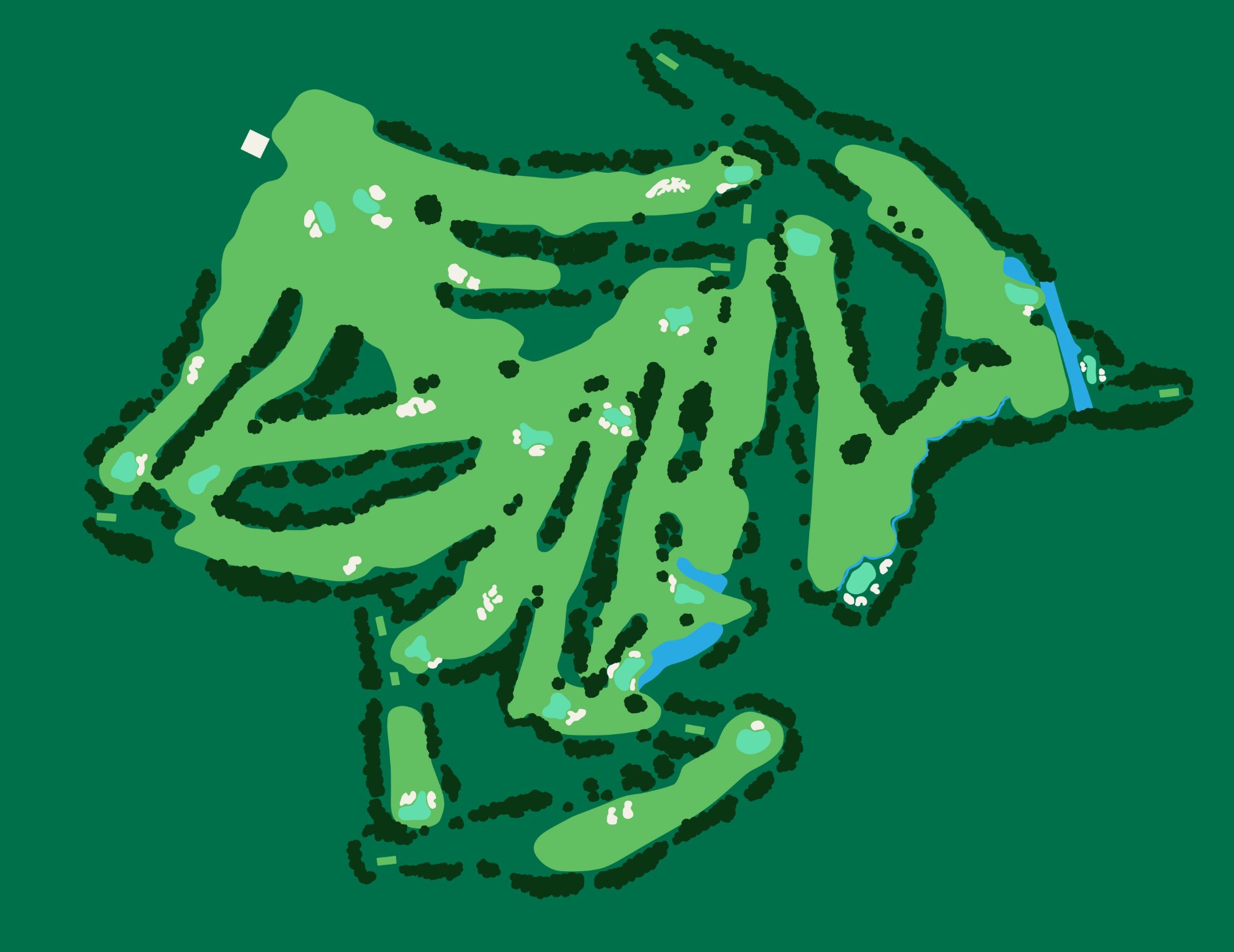
Click on a pin below to preview the hole or go to the full profile of the hole.
Augusta National
Ever since it opened, Augusta National has been in a constant state of evolution (for better or for worse), but it remains one of the greatest championship venues in the world
Hole 1 - Tea Olive
Augusta National's property is defined by a single broad downslope that ends at Rae’s Creek, and this par-4 opener is the only hole on the course that sits completely on top of it. Strategically, No. 1 at Augusta National is one of the most compelling opening holes in professional golf.
Hole 2 - Pink Dogwood
The second hole at Augusta National produces more off-the-tee variety than most par 5s in professional golf.
Hole 3 - Flowering Peach
Players face three basic options off the tee: hit a long iron or hybrid near the bunkers at the top of the first ridge, leaving a full wedge in; bash it left, past the bunkers and into the valley short left of the green; or go straight for the green in hopes of at least holding the narrow shelf short right. The most strategically complex hole on the golf course, “Flowering Peach” has stood the test of time, less affected by distance gains than most holes at Augusta National.
Hole 4 - Flowering Crab Apple
The first — and longest — par 3 at Augusta National has historically required a strong strike with at least a long iron, though club selections in the Masters have shifted as distance gains have spiraled out of control. Can you execute a towering shot with a long iron, hybrid, or fairway wood?
Hole 5 - Magnolia
“Magnolia” is like Paul Thomas Anderson’s film of the same name: brilliant, probably underrated, but a tad bloated. Nonetheless, the hole presents an honest challenge, and the green is one of the most artfully shaped at Augusta National (or anywhere else).
Hole 6 - Juniper
“Juniper” is, in our opinion, Augusta National’s second-best par 3. Each pin position presents a different range of challenges and exciting possible outcomes.
Hole 7 - Pampas
Yes, the green contours are fun, but “Pampas” has morphed into something that Alister MacKenzie likely would not endorse: a hole that merely defends itself through length and narrowness rather than asking complex strategic questions.
Hole 8 - Yellow Jasmine
This uphill three-shotter consistently produces the highest scoring average of Augusta National’s four par 5s, but it still presents a welcome birdie opportunity after the tough stretch of Nos. 4-7. “Yellow Jasmine” is the most underrated hole at Augusta National.
Hole 9 - Carolina Cherry
The ninth hole plays from a high point near the first and eighth greens, down through a valley frequently used by galleries, and up the hill where the clubhouse sits. From a risk-reward perspective, “Carolina Cherry” is a bit of a muddle.
Hole 10 - Camellia
The 10th hole kicks off the back half of the round in hair-raising fashion, plunging 100 feet into a valley shrouded by tall pines. Perry Maxwell’s 1938 transformation of “Camellia” is one of the rare cases in which a change to MacKenzie and Jones’s design represented a substantial improvement.
Hole 11 - White Dogwood
No. 11 is simply a brute, often playing as the most difficult hole to par at Augusta National. It’s also been one of the most frequently tinkered-with holes at Augusta National.
Hole 12 - Golden Bell
The focal point of Amen Corner and the center of gravity in any final round of the Masters, the 12th hole at Augusta National is as terrifying as it is beautiful.
Hole 13 - Azalea
This iconic risk-reward par 5 offers the first of a series of birdie opportunities on Augusta National’s home stretch.
Hole 14 - Chinese Fir
Although some nuances of MacKenzie and Jones’s original strategic concept for the hole have been lost, “Chinese Fir” is still a compelling par 4, rewarding precise and well-shaped shots both off the tee and into the green.
Hole 15 - Firethorn
No. 15 consistently presents one of the toughest decisions players have to make during their rounds: go for the green in two or lay up to one of the most demanding wedge shots in golf.
Hole 16 - Redbud
Set at the base of the ridge that the fifth green and sixth tee occupy, the par-3 16th hole provides a ready stage for championship-defining shots. Over the past several decades, the 16th has shown an undeniable knack for spectacle.
Hole 17 - Nandina
From tee to green, No. 17 is one of the simplest holes at Augusta National and is likely the least-loved hole on the second nine.
Hole 18 - Holly
“Holly” is a little funky, but its design is smart and elegant: bend it around the trees on the right and bypass some of the natural difficulty of the next shot.








New Cabot Wilds Resort Bolsters Canada's Destination Golf Reputation
A Special Round With an Old Friend

Q&A: Cory Griess, Superintendent at Prairie Dunes Country Club
Q&A with Golf Course Architect Sam Cooper

Merion East's Clever Inland Design on Display at 2026 U.S. Amateur
Is Royal Birkdale’s ‘Easiest’ Hole One of Its Best?
Get full access to exclusive benefits from Fried Egg Golf
- Member-only content
- Community discussions forums
- Member-only experiences and early access to events