
Every Hole at Augusta National - No. 18 Holly
History, Masters strategy, and expert commentary on the par-4 18th

The Basics
Par 4 | 465 yards
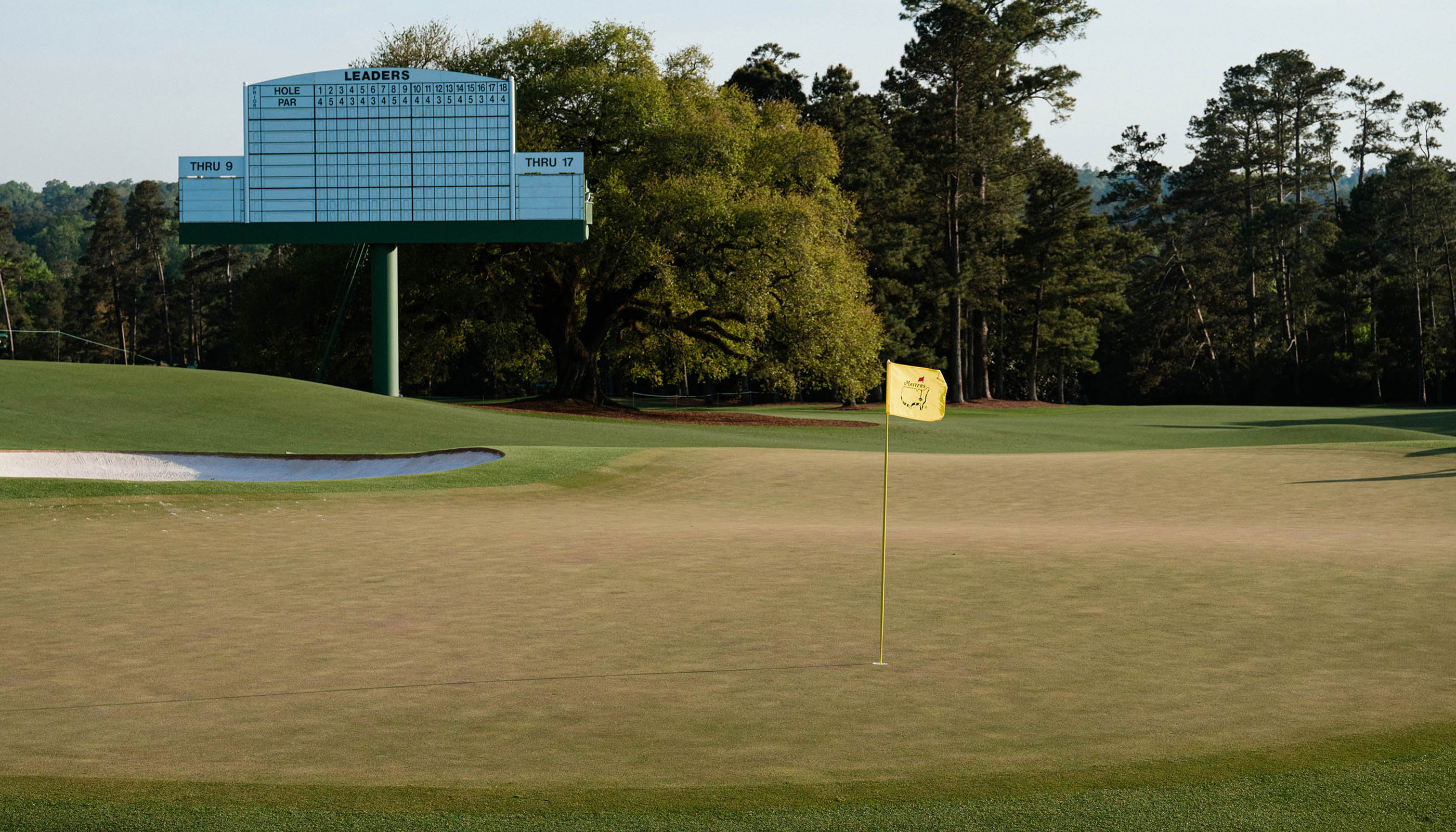
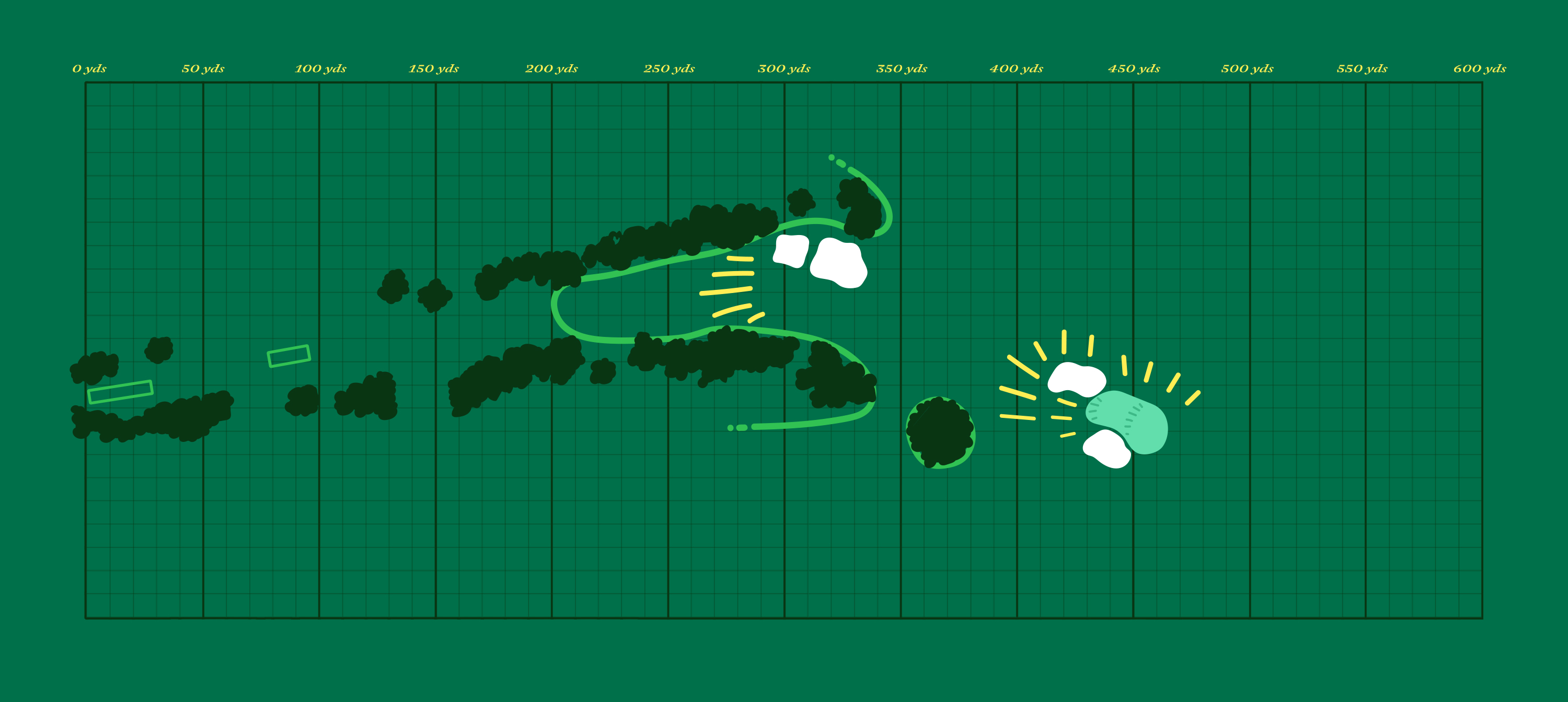
Augusta National's finisher slips through a chute of trees, turns right, and opens onto the hillside below the clubhouse. In order to avoid a painfully long approach (as well as the two bunkers on the left), players must hug the tree line on the right, preferably with a left-to-right shape. The right side of the fairway offers a friendly angle through the opening to the green. Even after a strong drive, however, the second shot is mostly blind and played from an awkward uphill lie. The long, comma-shaped green contains three main sections: a false front, a middle plateau, and a back tier. The typical Sunday pin is in the middle, allowing players to spin their approaches off the backstop and earn a makeable birdie putt. Miss a little long, though, and a championship-spoiling three-putt becomes a distinct possibility.
{{every-hole-augusta-national-18-holly}}
History
The 18th hole originally had no fairway bunkers, except for a decorative one about 100 yards short of the green. The club eliminated this bunker in 1956 and added the current pair on the left 11 years later. These bunkers are a symptom of distance gains in the professional game: they exist to prevent players from blasting the ball far enough up the left side that the poor angle on the approach doesn’t matter.
Unlike most of Augusta National’s tree-lined tee shots, the one on No. 18 has been there from the beginning. The trees have grown in and several have been added on the left, but the demand for a precise, left-to-right drive was part of MacKenzie and Jones’s initial vision.
{{historic-augusta-national-18-hole-gallery}}
Strategy Notes for the Masters
The finishing hole demands one of the straightest tee balls on the course. Trees pinching in on the left are visually intimidating and can interfere with tee shots that start slightly too far left. Just ask Jordan Spieth.
Approach difficulty varies drastically by hole location. Pins on the middle plateau offer strong birdie chances, while the back tier can play extremely tough. Getting up and down from the right greenside bunker isn’t too daunting a proposition, particularly to the traditional Sunday hole location, making it a popular miss for second shots. –Joseph LaMagna
Our Take
“Holly” is a little funky, but its design is smart and elegant: bend it around the trees on the right in order to bypass some of the natural difficulty of the next shot. The bunkers on the outside of the dogleg violate this simple strategic concept, but their purpose — to prevent big, dumb bombs down the left — is understandable.
Expert Commentary
Alister MacKenzie (1932): “The tee shot is played over a valley and bank running diagonally from left to right. The longer the drive to the right the easier the second shot. The approach to the green is bunkered heavily on the left.”
Bobby Jones (1959): “This hole is a slight dogleg to the right, the bend in the fairway coming at the top of a hill which can just about be carried by a fine tee shot. The bunker at the left front of the green makes it a matter of some importance to drive as close as possible to the trees lining the right side of the fairway or even, if possible, to bend the tee shot a bit around the corner. The front area of this green is nicely molded to receive a pitch and provide a good putt for a birdie when the hole is cut here. Yet a ball driven to the left side of the fairway safely away from the trees must be pitched quite closely over the guarding bunker. A second shot played up this slope even a dozen feet past the hole calls for a delicate approach putt and can very easily result in three putts. It was from just such a position that Ben Hogan three-putted to lose by one stroke to Herman Keiser in 1946. In 1958 both Doug Ford and Fred Hawkins tried and missed similar putts to tie Arnold Palmer. The 18th green is quite long. The rear one-quarter of the putting surface embraces a plateau area which is often used as a pin location. The great difficulty here is to be up without going over. A second shot played into the slope in the middle of the green either stops or rolls back, so that the ensuing putt is difficult indeed. In the 1957 tournament, Doug Ford avoided all these putting difficulties by holing a full blast from the bunker in front of the green to help give him his final winning margin of three strokes.
Geoff Ogilvy (2019): “It’s a tough tee shot, but for me, it was always one of the more comfortable tee shots on the course. My miss was always to the right if I didn’t smash it. After they made it longer, I struggled to get it to the bunkers. These big drawers, guys who struggle to move it left-to-right, it’s a tricky tee shot… The second shot I always found difficult because it’s a really extreme uphill that you’re hitting it off. There isn’t a good miss on 18 on the green. Maybe over the green to back pins…. That front pin, where a lot of people make birdie, you’ve got probably a 30-foot circle to hit it. If you miss that 30-foot circle, you’re going to have some problems.”
Memorable Shots
Mark O’Meara makes birdie to win in 1998: Know how many holes O’Meara held the lead for in the 1998 Masters? One, when he made the winning putt — a 20-footer — at the last. It was O’Meara’s third birdie in four holes to snatch the jacket from Fred Couples and David Duvall.
Phil Mickelson’s putt to win in 2004: Ernie Els was staying warm on the range, thinking he’d probably done enough to at least get into a playoff with a final round 67. But Mickelson's fifth birdie in the final seven holes gave him his first major victory and slammed the door on Els’ best Masters chance. The sequence is memorable not just for Jim Nantz’s famous call — ”Is it his time? Yes!” — but also for Mickelson’s microleap into the air, an image that would become his personal logo going forward.
Arnold Palmer celebrates too soon in 1961: Palmer was leading Gary Player by a stroke with one hole left to play, and when he hit his drive in the middle of the fairway, he assumed he’d wrapped up the tournament. As he walked toward his ball, he spotted one of his friends in the gallery, club manufacturer George Low, who congratulated him on his victory. Palmer accepted the congratulations, then proceeded to hit his approach into the front bunker. He hit his bunker shot over the green, made a double bogey, and handed Player the tournament. “That was the one time I did something I should have never done,” Palmer said. “I accepted victory without having victory. It taught me a lesson.”
Course Routing
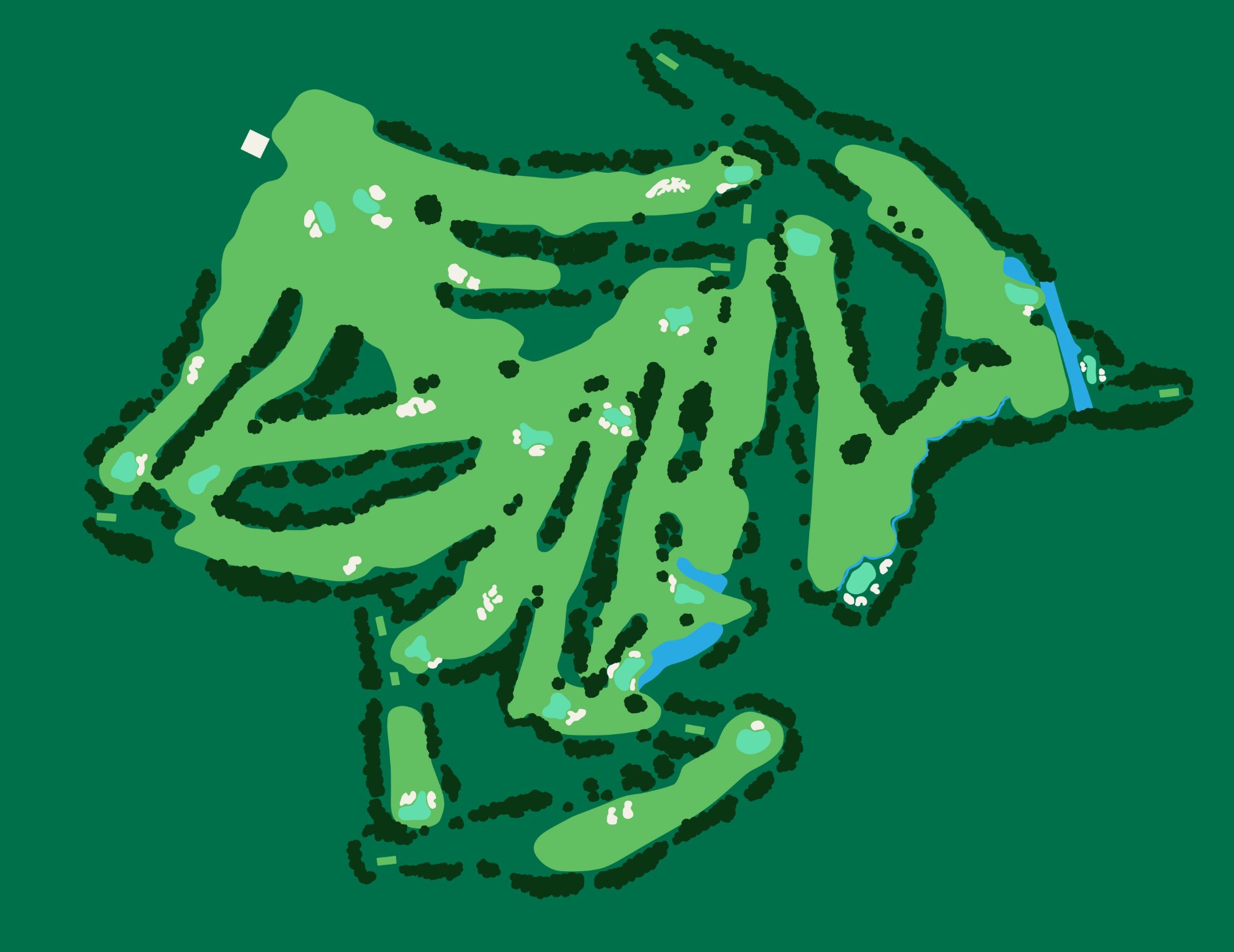
Click on a pin below to preview the hole or go to the full profile of the hole.
Augusta National
Ever since it opened, Augusta National has been in a constant state of evolution (for better or for worse), but it remains one of the greatest championship venues in the world
Hole 1 - Tea Olive
Augusta National's property is defined by a single broad downslope that ends at Rae’s Creek, and this par-4 opener is the only hole on the course that sits completely on top of it. Strategically, No. 1 at Augusta National is one of the most compelling opening holes in professional golf.
Hole 2 - Pink Dogwood
The second hole at Augusta National produces more off-the-tee variety than most par 5s in professional golf.
Hole 3 - Flowering Peach
Players face three basic options off the tee: hit a long iron or hybrid near the bunkers at the top of the first ridge, leaving a full wedge in; bash it left, past the bunkers and into the valley short left of the green; or go straight for the green in hopes of at least holding the narrow shelf short right. The most strategically complex hole on the golf course, “Flowering Peach” has stood the test of time, less affected by distance gains than most holes at Augusta National.
Hole 4 - Flowering Crab Apple
The first — and longest — par 3 at Augusta National has historically required a strong strike with at least a long iron, though club selections in the Masters have shifted as distance gains have spiraled out of control. Can you execute a towering shot with a long iron, hybrid, or fairway wood?
Hole 5 - Magnolia
“Magnolia” is like Paul Thomas Anderson’s film of the same name: brilliant, probably underrated, but a tad bloated. Nonetheless, the hole presents an honest challenge, and the green is one of the most artfully shaped at Augusta National (or anywhere else).
Hole 6 - Juniper
“Juniper” is, in our opinion, Augusta National’s second-best par 3. Each pin position presents a different range of challenges and exciting possible outcomes.
Hole 7 - Pampas
Yes, the green contours are fun, but “Pampas” has morphed into something that Alister MacKenzie likely would not endorse: a hole that merely defends itself through length and narrowness rather than asking complex strategic questions.
Hole 8 - Yellow Jasmine
This uphill three-shotter consistently produces the highest scoring average of Augusta National’s four par 5s, but it still presents a welcome birdie opportunity after the tough stretch of Nos. 4-7. “Yellow Jasmine” is the most underrated hole at Augusta National.
Hole 9 - Carolina Cherry
The ninth hole plays from a high point near the first and eighth greens, down through a valley frequently used by galleries, and up the hill where the clubhouse sits. From a risk-reward perspective, “Carolina Cherry” is a bit of a muddle.
Hole 10 - Camellia
The 10th hole kicks off the back half of the round in hair-raising fashion, plunging 100 feet into a valley shrouded by tall pines. Perry Maxwell’s 1938 transformation of “Camellia” is one of the rare cases in which a change to MacKenzie and Jones’s design represented a substantial improvement.
Hole 11 - White Dogwood
No. 11 is simply a brute, often playing as the most difficult hole to par at Augusta National. It’s also been one of the most frequently tinkered-with holes at Augusta National.
Hole 12 - Golden Bell
The focal point of Amen Corner and the center of gravity in any final round of the Masters, the 12th hole at Augusta National is as terrifying as it is beautiful.
Hole 13 - Azalea
This iconic risk-reward par 5 offers the first of a series of birdie opportunities on Augusta National’s home stretch.
Hole 14 - Chinese Fir
Although some nuances of MacKenzie and Jones’s original strategic concept for the hole have been lost, “Chinese Fir” is still a compelling par 4, rewarding precise and well-shaped shots both off the tee and into the green.
Hole 15 - Firethorn
No. 15 consistently presents one of the toughest decisions players have to make during their rounds: go for the green in two or lay up to one of the most demanding wedge shots in golf.
Hole 16 - Redbud
Set at the base of the ridge that the fifth green and sixth tee occupy, the par-3 16th hole provides a ready stage for championship-defining shots. Over the past several decades, the 16th has shown an undeniable knack for spectacle.
Hole 17 - Nandina
From tee to green, No. 17 is one of the simplest holes at Augusta National and is likely the least-loved hole on the second nine.
Hole 18 - Holly
“Holly” is a little funky, but its design is smart and elegant: bend it around the trees on the right and bypass some of the natural difficulty of the next shot.







New Cabot Wilds Resort Bolsters Canada's Destination Golf Reputation
A Special Round With an Old Friend

Q&A: Cory Griess, Superintendent at Prairie Dunes Country Club
Q&A with Golf Course Architect Sam Cooper
Merion East's Clever Inland Design on Display at 2026 U.S. Amateur
Is Royal Birkdale’s ‘Easiest’ Hole One of Its Best?
Get full access to exclusive benefits from Fried Egg Golf
- Member-only content
- Community discussions forums
- Member-only experiences and early access to events